Learn how to measure and track the concept of “brand” in a way that can help you tell a story about growth and opportunity.
AI Risks: Can Artificial Intelligence Affect Your Brand Equity?
Brand equity — that intangible asset that sets your brand apart and directly impacts its success, can either flourish or wither at the hands of artificial intelligence (AI).
Using artificial intelligence in your external communications can be a threat to any brand equity you’ve built up, but does this mean you shouldn’t use it at all?
In this article, we’ll explore the delicate dance between technology and human connection, exploring the AI risks when it comes to your brand equity.
What is brand equity?

Brand equity is the value gained from a consumer’s perception of a company, service, or product — beyond its functional attributes. It is the cumulative effect of various factors that contribute to how a brand is perceived, recognized, and differentiated from others within its industry.
There are four main elements of brand equity:
-
Brand awareness: The recognition and familiarity consumers have with a brand. If a customer has strong brand awareness, they are more likely to think of it when making purchase decisions — this is the first step to building brand equity.
-
Brand associations: The characteristics, qualities, and attributes that consumers associate with a brand. This can be through previous experiences, recommendations, or even online perceptions.
-
Perceived quality: The consumer’s perception of the overall quality of the brand. This will differ from person to person and does not always reflect the actual quality, instead being based on parameters that are important to the individual.
-
Brand loyalty: When a consumer chooses to buy from a particular brand over others. This could be related to repeat purchases or recommendations for higher ticket items, such as mortgages.
Brand equity will have a significant impact on the company’s success. Stronger brand equity often means brands can justify higher prices, enjoy customer loyalty, and be protected against competitors.
How does brand equity relate to AI usage?
Like everything else in marketing, AI can affect brand equity. With AI tools widely available, the two elements of brand equity that could be impacted are brand awareness and brand associations, i.e. what they see of your brand before having their own experiences.
When AI is harnessed effectively, it can either boost or erode brand equity depending on whether it enhances authentic customer interactions or turns them into robotic, disconnected experiences. In essence, the smart use of AI can either reinforce your brand’s value or, if mishandled, risk damaging the trust and emotional connections you’ve worked so hard to build.
How the overuse of AI can affect your brand equity
Brand equity is the culmination of years of trust-building, consistent messaging, and positive customer interactions. It’s the intangible asset that sets your brand apart in the hearts and minds of your audience.
The right AI-driven experiences can drive awareness and solidify positive brand associations in the minds of your customers. But while the temptation is there to utilize AI-generated content to speed up output, it’s important to know when to use it and when to stop.
Dangers of overusing AI for your customer communications
AI can be a valuable asset, but it can also be a potential liability in your marketing toolkit. It’s crucial to tread carefully and be mindful of the potential dangers lurking when AI-generated content is used within your communications.

Losing that personal touch
Your brand was made by humans, for humans. If your customers start to feel as if their interactions with your brand are too automated and lacking that vital human empathy, the emotional connection you’ve spent so much time building will begin to weaken. For example, you ask an AI tool to produce an article around a specific topic, and you upload that content straight to your site without fact-checking or personalizing it. That piece will stand out from the articles already on your website, either because of the change in tone of voice or mistakes and inaccuracies within it, leading the reader to question your branding, authority, and trustworthiness.
That loss of personal touch to content can not only affect what your customers feel about your brand but can also impact your site’s ability to rank. A recent AI vs. humans experiment carried out by Reboot found that pages created by copywriters outperformed AI-generated content in search engine result pages (SERPs).
Privacy concerns
Using AI tools to collect and analyze personal data can raise privacy concerns within your customer base. Because artificial intelligence is about always learning and improving, AI tools will store any information put into them, which includes any data. Allowing another party to store customer data opens up more opportunities for it to be viewed, copied, and even stolen by outside sources.
If your consumers believe their personal information is being misused by AI tools or their privacy is compromised, you can erode the trust in your brand and damage your overall brand equity.
To negate these privacy risks, some AI tools give you the option to opt out of this data storage. On ChatGPT, for example, there is a setting you can use to prevent it from saving your chat history.
Not understanding intent
Understanding and fulfilling intent is what helps your content to rank, and keeps your customers happy. AI content tools and recommendation systems might be unable to pinpoint customer intent or preferences. Continually missing the mark of what your customers want could negatively impact their perception of your brand’s competence.
If you’re looking to combat this pitfall, you can try asking the AI tool to create a piece of content with a particular search intent in mind. As with all content produced by artificial intelligence, though, this will need to be thoroughly fact-checked and edited by a skilled copywriter.
Loss of brand identity
Your communications could lack consistency with your brand’s image if they are solely produced by AI tools or even a mix of AI and human-generated content. Recognizable features of your brand are watered down, which could lead to confusion among your customers and a dilution of the all-important brand image.
Not only this but how can you be sure your tone of voice stands out when your competitors have access to the same AI tools? You know your brand best, and it is in your best interest to ensure any information you put out there is accurate, relevant, and on-brand.
Lack of human interaction
For complex or emotionally sensitive issues, customers might prefer human interaction rather than AI. If you don’t offer this option or rely too much on AI for customer service by only offering chatbots or email assistance run by artificial intelligence tools, you may start to notice increased dissatisfaction and reduced loyalty.
Can AI tools recreate recognizable brand communications?
As mentioned before, AI will affect your customers’ awareness and perception of your brand, primarily if you use it in your communications. Can you trust AI-generated content to adopt your tone of voice accurately?
Brand tone of voice is a direct manifestation of its personality and values. It’s what drives brand perception and feeds into equity if you take away all of the visuals, logos, and videos.
Let’s see how a popular AI tool, ChatGPT, deals with mimicking the tone of voice of a famous and instantly recognizable brand.
AI tackles Cards Against Humanity
Cards Against Humanity has one of the most identifiable brand voices out there, which feeds into customer perception. There are specific qualities and characteristics that those familiar with the brand would expect from its communications.
To test out the AI tool, we input the prompt:
Please write a 120-word ‘About Us’ section to be used on the Cards Against Humanity website. Make sure this copy is instantly recognizable to customers by matching the brand’s tone of voice and style of writing.
The word limit was to make sure the copy fits in line with the existing page the brand already has. For reference, this is the brand’s current About Us page on the site:

It’s short, to the point, and has brand-specific humor; it doesn’t take itself too seriously. It’s a tone that anyone familiar with the brand would associate with their messaging. But how will an artificial intelligence tool compare?
Going off the prompt, this is what ChatGPT produced:

While the finished products are dissimilar, you can pick out inspiration from the brand’s existing content. With phrases such as ‘renegades of irreverence’ and ‘inner misfit’, Cards Against Humanity’s somewhat overtly offensive branding comes through.
However, Cards Against Humanity thrives within the sarcasm, self-deprecating space, which is where the ChatGPT content misses out. It doesn’t quite have that tongue-in-cheek humor that is apparent from its existing About Us page.
How this could affect brand equity
Consistent branding is pivotal in constructing and upholding a positive brand perception. If you’ve built up a consumer base familiar with a particular tone of voice and personality but then start to move away from this, you’ll go against their perceptions and chip away at their brand awareness.
Even though Cards Against Humanity has already formed relatively strong brand equity through years of consistent messaging and good-quality products, that doesn’t mean it’s invincible. If the brand decides to go ahead with AI-generated content for its future communications, it risks going against its consumer perceptions and damaging its brand equity in the long run.
Striking the balance between automation and the human touch
AI isn’t the enemy of brand equity. But you do need to be careful when using it. Balancing creativity caution with AI is like finding the perfect blend in your morning coffee — too much AI can leave a bitter taste.
You should aim to avoid your AI-generated content coming across as robotic or inconsistent with your brand identity. By selecting the appropriate AI tool and always referring back to your brand’s unique voice, you still have the ability to craft captivating content that truly connects with your audience. Here’s how you do it:

1. Have a solid TOV guide
Why is having a tone of voice (TOV) guide a big deal?
It’s a roadmap for your messaging, ensuring your brand always sounds like, well, your brand!
This consistency is crucial for brand recognition and recall. When your audience can easily identify your style and personality across different channels, it’s like having a familiar face in a crowd — feeding into brand awareness and perception.
A well-crafted TOV guide can even set you apart from competitors in a sea of voices, helping you stand tall in your niche.
How to create a TOV guide:
-
Start by digging deep into your brand’s purpose. What’s your mission? Who’s your audience? What values drive your business?
-
Once you’ve got those nailed down, pinpoint your brand’s personality traits. Are you fun and casual, or all about professionalism?
-
Lay down some ground rules. Decide on vocabulary preferences, sentence structures, and even whether to use emojis (yes, they can be part of your TOV!).
But it doesn’t stop there. The key to a good TOV guide is keeping it fresh. Revisit and update it as your brand evolves. Get your team on board, train them up, and keep the dialogue open for feedback and tweaks.
2. Train AI tools to recognize and use your TOV
You can train many AI-content tools to use your brand’s TOV as you would with any new starter. Start by feeding it some of your brand’s past content so it begins to understand how you structure your sentences, how informal your messaging is, and how you talk to your audience.
Then, using Natural Language Processing (NLP) and machine learning, AI recognizes patterns in your communications and starts to produce similar content. With time and ongoing pointers, amendments, and tweaks, most tools can begin to recognize and use your TOV.
But remember, it’s an ongoing practice. You have to continuously fine-tune and review its outputs to keep it singing in perfect harmony with your brand’s voice.
3. Monitor AI content and edit
Even after you’ve trained your chosen AI tool to mimic your brand’s TOV, you still have to thoroughly check and edit the content it has created. Just as you would proofread and edit any work from a content writer.
Monitor the output and use your TOV guide to ensure it hits the brand’s values, tone, and messaging standards. AI tools occasionally throw out incorrect facts or statements without context. Publishing anything incorrect that can be disproven by your audience will alter brand associations and even perceived quality, so it’s important to have a rigorous fact-checking system in place.
4. Test and give feedback to the AI tool
Think of the AI tool as an eager employee. If you want it to improve, you need to provide thought-out feedback.
Start by conducting structured evaluations of its outputs against predefined criteria, measuring aspects like accuracy, relevance, and adherence to your brand’s tone of voice.
Then, maintain a clear and consistent feedback loop, offering specific and constructive comments to help the AI tool learn and improve over time, ultimately aligning it more closely with your brand’s unique requirements.
How to safely build brand equity with AI
The good news is that by adopting a thoughtful approach to AI and making some adjustments, you can generate content for your brand that is entirely distinctive and tailored to your identity.
There are some ways you can use AI tools that will work to spot patterns in your analytics to inform your ongoing strategies, as well as improve customer experiences.

Spotting data patterns and unearthing customer insights
Analyze customer data
Some AI tools can analyze large datasets, such as customer churn rates and sentiment analyses on social media, to identify patterns, trends, and correlations. This valuable insight into customer behavior can help to inform your brand to craft personalized marketing strategies and improved user experiences, ultimately leading to better decision-making and enhanced customer satisfaction.
It’s worth keeping in mind the privacy concerns point from above, though, making sure the AI tool you use has the option to not store chat history for this.
Stay in the loop with social media
There are AI tools that can track brand mentions, sentiment analysis, and emerging trends on social media. This will allow your social media marketing team to spend more time elsewhere, crafting perfect campaigns to work with the AI’s findings.
Do market research
Artificial intelligence has reshaped the field of market research, providing tools that can dissect data and generate invaluable insights. This is a great way to save your team time that would otherwise be used to analyze this data.
An example prompt to do so could be:
Generate a report summarizing the current market trends and customer preferences for [specific product, service, or industry]. Include information on key businesses and any notable shifts in consumer behavior. Please provide statistics and insights from the past year.
Improving customer experiences
Personalize content
After you’ve already used AI to sift through customer datasets, you can use the findings to produce personalized content tailored to their needs and preferences. This can span from customized product suggestions to tailor-made marketing messages.
24/7 chatbots
24/7 AI chatbots enhance the customer experience by delivering quick and reliable service around the clock — chatbot conversions are also pretty powerful for your bottom line. You can provide instant, consistent, and cost-effective customer support, handling routine queries efficiently and freeing human agents for more complex issues.
Automatic subtitles and image captions
With video becoming one of the preferred methods of consuming content, AI-powered subtitle generators such as Kapwing and VEED’s tools are getting increasingly popular. This helps with accessibility, which can improve user experience and save your team time.
How to avoid AI risks when it comes to your brand equity
Safely building brand equity with AI involves a strategic approach to harnessing the technology while mitigating potential risks. Here’s how to do it:
-
Define your brand’s AI strategy: Begin by setting clear objectives for AI integration in your branding efforts. How will you use it? Will you use the tools to generate content, automate processes, or gather insights? Ensure you have answers for these and the goals behind them. What are you hoping to achieve?
-
Apply strict quality control: Establishing a robust review and approval process for AI-generated content will help to protect your brand awareness, associations, and perceived quality. Human oversight will always be needed to catch errors and maintain consistency in messaging.
-
Remain transparent: Maintaining transparency with your audience about your AI use will help to build and keep their trust. If chatbots or automated systems are handling customer inquiries, make it clear that customers are interacting with AI. If a blog post has been produced using AI, add a disclaimer about it highlighting who the piece was checked by to make sure you’re still hitting ‘experience’ and ‘expertise’ in E-E-A-T.
-
Focus on data privacy and security: Safeguard customer data rigorously. Comply with data protection regulations like GDPR or CCPA, and communicate your commitment to data privacy to enhance brand trust. Similar to the above, share any instances where personal data is handled by AI systems and the steps taken to make sure it remains confidential.
-
Be prepared for a crisis: Even with the most watertight approval processes, some mistakes still slip through the net. This is no different when using AI. To safeguard the audience trust you’ve built, ensure you implement a plan to address potential AI-related crises, such as misinterpretations or mishandling of sensitive issues.
Key takeaways
There will always be AI risks if using it in customer-facing content, but this doesn’t mean your brand shouldn’t use it.
To successfully integrate AI into your brand’s strategies while building brand equity, you should ensure all uses align with the brand’s values, messaging, and customer expectations.
Have solid processes in place for everything from proofreading and fact-checking to keeping all customer data confidential. This way, you’ll be able to protect your brand awareness, associations, perceived quality, and, ultimately, your brand equity.
Celebrating Canada’s Small Business Month With Sustainable Local Biz Tips

Happy Small Business Month to the 1.19 million small-to-medium enterprises (SMEs) in Canada! You employ 10.7 million Canadians (88.1% of the private labor force) and contribute to 50.4% of the gross domestic product (GDP). Your numbers, percentages, and contributions outweigh those of large businesses in many ways, meaning that Canadian SMEs have awesome collective power to be part of the transition to sustainability which we all know we need in order to protect the beautiful earth on which we depend for life.
Localized green production is considered one of the top methods of healing the climate, but in order for customers to discover and choose your sustainable business, you’ve got to have a strong presence in Google’s local results. Today, let’s talk to 3 of my favorite Canadian local SEOs — Darren Shaw, Colan Nielsen, and John Vuong — for expert tips on becoming highly visible in Google’s local pack rankings.
And, if you’re working to green your business or planning to start a new one, we’ll highlight a few sustainable models for your inspiration. The transition off fossil fuels is a narrative of gains, not losses, and as a local business owner, you have the opportunity to play a starring role in this dramatic evolution towards a better future for all of us.
3 expert Canadian local pack ranking tips

I asked my honored colleagues to the north what the top factor they see currently impacting Google’s local pack rankings (shown above) in Canada. You’ll find a diversity of answers, because all local SEOs notice different things as they work with different industries and geographies, making all advice worth listening to. Here are their tips for you:
-
Keywords in Google Business title

Darren Shaw, the CEO of Whitespark, says:
“The top factor I’m seeing driving local rankings in Canada is the same as the top factor I see in any country. Unfortunately, it’s keywords in the Google Business Profile business name. Google gives too much ranking weight to this factor, and it’s helping businesses spam their way to the top of the search results. It’s technically against Google’s guidelines to use a business name that is not your business’ actual real-world name, but the sad reality is that Google does not police or penalize this, so spamming the business name with additional keywords has become a common practice.”
When Darren refers to spamming Google Business Profile names with keywords, he’s talking about this practice:

Google’s guidelines make it clear that the only thing that belongs in this field is your real-world business name. No one in Canada knows local rankings better than Darren, who is the annual publisher of the Local Search Ranking Factors Survey and Report, and he and I both expressed our disbelief that Google is still allowing keyword-stuffed business names to have such influence on visibility.
What is an honest local business owner to do in this scenario? Join in the spam? Report it? I’ve created this graphic to explain the several paths open to you:

This graphic doesn’t represent every possible bend in the road, but it covers the big ones. In sum, if you’re being outranked by a spamming competitor, you could decide to join in the spam. But that could make you lose potential customers who think your name looks untrustworthy, and Google might eventually edit your business name, which could lead to a loss of rankings once your extraneous keywords are removed. If you’re investing in spam instead of other more solid marketing tactics, you’re always on the verge of losing out.
Meanwhile, you do have the option to report spammy competitors to Google by flagging the name right on the listing or via the Business Redressal Complaint form, but even if Google acts on this and edits the keyword-stuffed name, the spammer is all too likely to come back. Spam fighting is a good competitive tactic, but can’t form the whole of your marketing strategy.
If you choose not to spam, you will look authentic to the customers who do see your listing, and you just have to be philosophical about the fact that spammers may outrank you in Google’s system. If your competitors’ business practices are as iffy as their names, you know their disgruntled customers will likely end up coming to you one day, anyway, for better service, and we can all hope that Google may one day utterly downgrade this ranking signal.
Finally, if you’re preparing to launch a brand new business, you could choose to brand it with one or two top keywords in mind, knowing that this could give you a boost in Google’s local packs. However, there are two big conditions to this route. Firstly, don’t go overboard. Don’t name your business Best Organic Farm-to-Table Restaurant With Sustainable Practices And Righteous Poutine in Toronto. This is just going to look silly to anyone who is evaluating whether to become your customer. Stick to just one or two keywords at most, and remember that your business name must be consistent on your real-world signage, website, and how you answer the phone.
The second condition is that brand names that are too specific can sometimes require later rebranding if the business expands. For example, if you name your first restaurant location Toronto Farm to Table and you become successful enough to open a second location in Mississauga, your original branding is going to become a problem in your new setting. If you plan to grow, be wary of city names or other geo-modifiers in your branding that could hold you back in the future.
2. Primary category selection

VP of Sterling Sky, Colan Nielsen, agrees with Darren about keywords in the business name, but don’t miss his second tip because it’s a major one:
“The local algorithms in Canada tend to be driven by most, if not all, the same factors that drive rankings in the USA. Here are a few things that we have seen have a significant impact on rankings recently:
Keywords in the business name. Yes, yes, I know… everyone is tired of hearing about keywords in the name. But even here in the great white north, it has a significant impact.
Getting the primary GBP category right. We recently advised a Family Law practice to change the primary GBP category from “Law Firm” to “Family law attorney,” and it improved their rankings significantly.”
If you download the free Chrome extension, GMB Everywhere, you’ll be able to make the most of Colan’s tip about getting your primary category right by looking at it in comparison to your competitors’ Google Business Profile listings. The primary category (in this case, garden center) is marked with a star in this useful interface:

It’s almost impossible to rank for your most important local search phrases without selecting the right primary category, so a shop like this garden center in Edmonton has to be sure that the first category they choose when creating their Google Business Profile is of prime importance to the business. They can then add up to 9 additional categories for aspects of secondary importance, and one key way of determining what your primary category should be is by seeing what your top-ranked competitors have chosen. In this example, the top result for this search has, indeed, chosen “garden center” as their primary category:

For more tips on this key area of local listing optimization, read: How to Choose Google My Business Categories with Cool Tools
3. Searcher-to-business proximity

CEO John Vuong of Local SEO Search Inc. says,
“Physical proximity is the top ranking factor for the local pack right now. Google wants to provide users with the most relevant search results possible, and this includes showing them businesses that are closest to them. Make sure that you are optimizing your site for local search to rank best in your local area and try to get solid reviews with local justification trigger terms in them on Google (e.g. close by, near me, neighborhood/city, highly rated, etc.).”
John is referring to two things. The first is the phenomenon of knowing you are likely to rank best in the local packs for searchers nearest you, like this:

This can not only help you determine the ideal spot for your company to be physically located so that it’s closest to your intended audience, but this nearby geography should also feature highly in how you optimize your local business website. City names and neighborhood names matter.
Secondly, John is describing the eye-catching local pack elements known as local justifications, which look like this:

Read: Local Justifications are a Big Deal and You Can Influence Them to get a speedy education on this neat feature that can influence clicks on your listings, and don’t miss this quiet but fascinating recent tip from Colan on how to get Google to show the “provides” justification on your listing.
3 Deeply sustainable Canadian small business models
Are you an entrepreneur who wants to be part of the sustainable transition by founding a Canadian SME? Consider these models:
-
Feeding local people local food

“Farming. It had everything we were looking for; it was a real and concrete way to work at creating change.” — Liz Beasley and Matt Rock
Small organic growers like Joyfully Organic Farm in Markham, Ontario, aren’t merely producing vegetables without synthetic chemicals; they are focusing on regenerative agriculture, which improves land over time while also greatly reducing the fossil fuels required to put meals on neighbors’ plates. When managed organically, farm stands, farm shares, CSAs, farmers’ markets, and community gardens can abundantly feed us with the fresh, nearby, unprocessed foods medical experts say are best for us. Farmers say you can even keep eating locally in winter in most of Canada with a combination of cold-weather crops and ancient practices like preserving.
-
Launch a local ReStore for local people

“Thrift stores are idealized as the perfect place to find unique and affordable items, with proceeds benefiting local charities. In reality, 75 percent of your donations are being shipped overseas. Conversely, Habitat’s ReStore operates in a highly transparent way to assure you that. your purchase from our ReStore really does have an impact on local families.” — Habitat ReStore, Ontario
Overconsumption, fast fashion, long-distance shipping, and planned obsolescence are the opposites of sustainability. A really good solution to keeping your neighbors clothed and stocked with basic household necessities could be launching a community ReStore. If you are good at mending and repairing a variety of merchandise, your re-store could significantly reduce the number of times people nearest you have to buy new. This phenomenon has become so popular in Europe that Sweden opened the world’s first recycled mall and it’s about to celebrate its tenth anniversary.
-
Offer green, local production of basic goods

One green trend I’m keeping a close eye on is helping people transition from seeking happiness in owning lots of stuff to pursuing joy through intangible experiences like staycations and community projects. These increase satisfaction in being where you are, the truth is that we all need some basic belongings like clean water, food, clothing, shelter, warmth, and a few simple household goods.
If you’re launching a new venture or looking to transition an existing one, consider how you can emphasize local production of necessities. Squamish Nation-owned Raven and Hummingbird Tea Co. reduce the need for imported drinks by locally growing traditional herbs in their community garden. Customers looking for nearby drinking vessels could go to TAV Ceramics of Vancouver which sources their clay locally and uses lead-free glazes. Another nearby outfit, Just Potters, highlights how diversity, equity, and inclusion are meant to be part of the energy transition; they’re embracing their community by employing neighbors with both physical and mental health challenges.
Look around your home, office, and town and see if you can identify daily-use items that are currently being imported and shipped long distance to your neighbors. Could you produce these items locally? Are there parts of your existing supply chain that you could switch to more local sources? Business ideas, persuasive USPs, meaningful content marketing, and a better future could exist if you have the right vision.
Why I secretly want Canada to lead in healing Climate Change

Canada is so beautiful! Some powers-that-be may see you as the world’s oil can, but Canada is so much more worthy, inspiring, and awe-inspiring than that.
I was personally thrilled when Moz evolved beyond Seattle to include a branch in Vancouver and expanded our Moz Local offering to help Canadian businesses get listed on the major local business directories and platforms. As a California girl, I’ve always been a secret Canada fan. I grew up with a really special feeling for Canadian children’s television like Degrassi Junior High, and wanted to live on PEI with Anne of Green Gables. Your country gave us Rush, one of the greatest rock bands of all time. Your figure skaters and hockey players are global legends, your gardens are gorgeous, and your natural spaces are beyond monumental. You understand my fierce love of both maple syrup and beavers. You spell better. And you might just have the prettiest flag in the world.
Yes, I’ve always felt close to Canada, and in recent years, that kinship has been more deeply forged by the losses we are both suffering in California and Canada due to the wildfires of Climate Change. We know first-hand now what it means to see loved spaces turned to ash, making the transition off fossil fuels immediate and urgent to us both. While penning this column, I haven’t been able to go outside for five days due to air quality alerts from heavy wildfire smoke. Climate Change is, indeed, impacting every aspect of business and life throughout North America.
But, together, by making sustainable local goods and services easier for everyone to find and choose online, we can reduce fuel consumption and, perhaps, bring new meaning to the symbology of both our homelands’ flags. You have a maple leaf, and I have a bear. Let’s do business like people who know we not only depend on nature but are part of it. Wishing you a strong and sustainable Small Business Month in 2023!
Making Industry Landing Pages Engaging for B2B Companies – Whiteboard Friday
Learn how to transform your industry landing pages into powerful sales enablement tools for B2B success. Discover the key strategies to bridge the gap between search relevance and customer expectations in this Whiteboard Friday.
12 Local Search Developments You Need to Know About from Q3 2023

The previous quarter in local search has felt slightly more mellow than the first two of this year, but industry experts have definitely made some noteworthy discoveries, and Google has made one major move.
With the holiday shopping season up next, now is the time to examine any emerging opportunities or learn about new rules, before things get too busy for the local businesses you market. Let’s hop right in!
1. No second reinstatement chances from Google

Ben Fisher wins the quarter with his detailed breakdown of the biggest Google local news. Already launched in the EU and coming to us all globally at an unspecified date is a set of changes to the Google Business Profile reinstatement process.
The main improvement Ben highlights is somewhat more transparency in the process, offering some clues as to why your listing was suspended. The biggest fly in the ointment is that you have just one chance to make this application for reinstatement. Ben shares these two useful links:
Google may continue to tweak this process in the coming months. In the meantime, if a listing you’re managing gets suspended, you’ll be better equipped to handle reinstatement if you’ve bookmarked Ben’s article.
2. Try out “&near=[ZIP]” remote location emulation

Take 60 seconds to watch Chris Long’s useful video on emulating zip code location by editing the URL of your query. Chris offers this process:
1. Copy the ZIP code of the geography you want to emulate
2. Search for your target query (e.g.. “fence repair near me”)
3. At the end of the URL, append “&near=[ZIP]”
4. Click enter and analyze the local search results
While it’s important to remember that Google’s results can be hyperlocal to the searcher, meaning that any emulation tool or tactic may not exactly represent what a unique searcher sees as they move about town, try Chris’ tip next time you want a general idea of what rankings look like in a remote location. Fast and quite fun!
3. Review tests, spam, and warnings
We’ve got three different items of note in this category this quarter.
1. Inline reviews test

Mike Blumenthal has captured this interesting test in which reviews do not stem from individual reviewers but from third parties like Best Company and Home Advisor. Historically, Google has sometimes showcased third-party reviews in sections labeled “Reviews from the web” or similar lingo. But, this test mixes platform reviews right in with customer’s direct reviews. Keep your eye out for this test in your area.
2. No lasting consequences for Google review spam

To understand why Joy Hawkins calls reporting review spam to Google “as about as effective as trying to teach a goldfish to play piano,” watch her video on the frustration she experienced in repeatedly reporting purchased reviews. Joy documents how each report resulted in some reviews being removed from the errant company’s listings, but then they simply bought more, creating an endless cycle of tomfoolery. If Google doesn’t ban brands that violate guidelines by buying reviews, consumers will continue to be taken in by unearned high-star ratings, and the local search results will remain untrustworthy. On that note…
3. Spammers, en garde in France!

We take our hats off again to Mike Blumenthal for sharing this screenshot of a French reviewer being warned that their review isn’t being posted because it may violate Google’s policies. It remains to be seen whether this is EU-wide (if you know, please @ me), but it certainly doesn’t seem to be the case yet in the US, where we’ve gotten into a sad pattern of lagging behind Europe in anything regulatory-related. Wouldn’t it be fantastique if Google would roll this out globally, and publish such warnings not just to the reviewer, but on the profiles of brands that have been repeatedly caught violating review guidelines?
4. Interesting GBP Developments
We’ve got several wondrous things to ponder in the world of Google listings this past quarter, including:
1. Footnotes in overviews?

I don’t often feature myself in these quarterly roundups, but look at this weird thing I came across in the local packs! My Twitter (ugh, ‘X’) thread compiles a bunch of instances I saw of what appear to be numbered footnotes within overview descriptions within the local pack. Look at this example, where the numbers go as high as 9:

And here’s another curious one on GBP that claims to be linking to a menu:

The trouble is, none of these footnotes are actionable. They don’t link to anything, and they aren’t explained. There appears to be no point to them, so they almost feel like a bug. But… they do have a familiar tone. Don’t these sound rather like AI of the kind we’ve been previewing in experiments like SGE? I’m wondering now if what I spotted presages an AI/local mashup ahead. Keep watching!
2. You can’t list services as GBP products anymore

I think we all share Claire Carlile’s disappointment that you can apparently no longer add services as GBP products. Until recently, it appeared fine to do so, but that’s Google local search for you: a dynamic environment in which today’s best practice is tomorrow’s bad hair day (which is why reading columns like this one becomes necessary just to keep up with the changes). I wish Google would reverse course on this. For SABs, their services are what they sell; they are their products.
3. Getting the “Provides” local justification to show on your listing

Speaking of SABs, who wouldn’t want this awesome Provides local justification to appear on their local pack listings, catching the eyes of potential customers? I don’t know what wizardly work my friend Colan Nielsen has been up to lately in the deep recesses of GBP, but when a Local Search Forum member asked why she couldn’t get this justification to show up on her listing, his reply got my attention. Colan indicated that if you want that justification to appear, you need to contact Google support to ask them to completely remove the “on-site services” attribute from your profile and that this can help you get the Provides option, instead. That was news to me, and I’d love to hear more stories like this.
4. New Google policies bring some transparency to formerly-secret processes

This document makes public Google’s formerly secret policies on why and when they might suspend an account, and I highly recommend watching Near Media’s full commentary on what we’ve learned from this disclosure. I quote:
“Google rolled out a number of new policy statements regarding the rules guiding suspensions and content takedowns affecting Google Business Profiles (GBP). These guidelines, long the working rules that affected listings and listing content, now make explicit how user accounts, and abuses affect whether a business continues to have access to any given listing or whether that listing will be removed from Google. While this increased clarity is welcome, the devil is in the details.”
Local search depends on authenticity, and I warmly welcome any public declarations of this kind by Google.
4. Grab bag ‘o other local finds
1. What’s your blue zone?

Check out what Andy Simpson noticed when looking at the map for “nearby searches”: an unusual blue zone none of us seem to have seen before. It indicates both a walking and driving distance, and as Andy said, could be useful in helping you choose a new location for a business, given Google’s penchant for user-to-business proximity. How great to be running a business that customers can walk to.
2. What are you mentioned in?

While not specifically local, getting this “Mentioned in” treatment captured by Brodie Clark could be good for any local business, especially if the recent loss of FAQ-rich results impacted you. Google appears to be testing different versions of this result, and it strikes me as a reminder of how the Authoritativeness signal of E-E-A-T works in action. Who is mentioning your brand, and how can you get more mentions from top sources?
3. Is your Performance data spooky enough for Hallowe’en?

We’re finishing up with a notable case study from Joy Hawkins that was kicked off when an attendee of a LocalU event asked why his storage client’s GBP Performance section was showing him ranking for restaurant queries. Dismissing the notion that people safeguard leftover meatloaf in storage units, and getting no insight directly from Google on the mystery, Joy posited and confirmed a theory: the client was participating in the paid Performance Max Google Ads program, which gives you a little branded pin on Google Maps… often for queries that are totally unrelated to your business.
As Joy explains, this Performance Max data then transfers over to your GBP Performance stats, convoluting paid with organic info. Joy was able to confirm that a branch of this business not participating in the Performance Max program was not getting this weird data, giving good credence to her theory. She also offers a warning that you shouldn’t immediately blame SEO if you see performance drops being reported to you by Google – it could be coming from your paid ads.
And that’s it for Q3 in local search marketing. Now we’re headed for the wild and wonderful holiday shopping season, my friends. Please, come back in January to see how it all played out!
How to Collect & Use Your GA4 Data to Transform Your Content Strategy
Content without data is like a property without a foundation — it lacks stability. Without data, you can’t truly understand the impact of your content and what to do next.
Victor Ijidola put it best in his recent article on informational content, “You want your content to persuade your readers to do something,” but if traffic is low or sales are slow, chances are your content isn’t working hard enough at generating interest.
In the last few years, content marketing has become more data-driven than ever before. Content marketers and SEOs have tools like Moz Pro and Google Analytics to thank for that. These tools can help you identify which articles are working, how many conversions your content is generating, where your content gaps are, and much more.
Google Analytics 4 (GA4) replaced Universal Analytics, Google’s long-standing analytics reporting tool, in July 2023. Hopefully, you’ve already migrated to GA4 and taken ownership of your GA4 property, had a good look around, begun unpacking all of your data, and made yourself familiar with the reporting platform’s layout. As you settle in, you can begin to learn just how much GA4 can help you renovate your content marketing strategy.
Whether you’re creating content for a SaaS knowledge hub, planning articles for a service-based company’s blog, or publishing product guides for an e-commerce platform, the tactics I am about to share will help you evaluate your content marketing efforts so far (or within the last two months or 14 months, depending on your data retention period), figure out which pieces of existing content to improve, and identify gaps and opportunities in your content.
This article presumes that:
-
You have admin access to your website’s GA4 property.
-
You have admin access to your website’s Google Tag Manager (GTM) container or have a developer who can help you with tags.
If you don’t have admin access to your GA4 property, get this set up first! If you’re unable to gain access, you can send some of these recommendations to those who do, so they can share the reports we create with you.
Let’s begin!
How to evaluate your content performance using GA4
As a content marketer, there’s always a desire to create new content. After all, we’re often told that Google favors “fresh” content — wisdom that is widely debated. That’s why I recommend working on your content strategy by improving existing content first.
This doesn’t just draw new attention to older articles. Beginning by improving your existing content also makes it much easier to develop new content ideas.
The first step in improving your existing content is to figure out which articles you should work on and prioritize. Enter GA4.
I’ll explore each of the following metrics in more detail, including where to find them in GA4. But first, here’s a quick rundown of the most helpful metrics when it comes to understanding how well your content is performing and choosing which pages to focus on for optimization:
-
Page/screen views
-
Engagement rate
-
Average engagement time
-
Exits
-
Bounce rate
-
Scroll
Page/screen views
Let’s start with one of the most important and easy-to-find metrics — page/screen views. Views will provide a helpful indication of your content’s performance, i.e., how many times your article has been viewed in a specific period of time.
In GA4, you can find this by going to Reports > Engagements > Pages and screens. Once there, you’ll see a list of pages and the number of views they had during your selected time period. By default, this is set to the last 28 days, but you can update this to a duration that suits you.
Filter this data so you can concentrate on your blog or content hub only. In most cases, you can do this by:
-
Clicking “Add filter” at the top of the page
-
Choosing to filter by the “Page path and screen class” dimension
-
Selecting “contains” as your Match Type, then enter the subfolder that contains your relevant content — usually “/blog/” or “/news/”

Order the results by views, and you’ll see which articles have had the most — and the least — views during your selected time period. You might want to focus on a selection of the least visited articles first as these could have the biggest potential, so add those pages to your list.
Simple enough — but things can get complicated when choosing which period of time you want to evaluate. Older pieces of content will typically benefit from having a higher number of views just because they’ve existed longer. That is why other metrics can be more helpful in understanding what’s working well and what isn’t.
However, if posts about similar topics feature prominently in your least viewed articles, you may want to remove this type of content from your blog or hub altogether. It’s OK to delete content that attracts little attention or combine some of these pieces into a longer guide that provides more value for your readers. Just remember to implement redirects from your old URLs to the new ones for your guide.
Engagement rate and average engagement time
Google defines engagement rate as “the percentage of engaged sessions on your website or mobile app,” where an “engaged session” is a “session that lasts longer than 10 seconds, has a conversion event, or has at least 2 pageviews or screenviews.”
Put simply, engagement rate measures the percentage of visits that involve a significant interaction with your website.
The engagement rate isn’t included by default in GA4, so you’ll need to add this to your report. The pages and screens report we just used to see views is a good place to add this metric.
Here’s how:
-
At the top right, just below the date range, click the pencil icon to customize your report view
-
In the “Report Data” section, click “Add Metric”
-
Type “Engagement rate” then “Save”


Average engagement time should be added by default. This metric provides the average “amount of time someone spends with your webpage in focus or app screen in the foreground.”
Analyze engagement rate and average engagement time against your pages to identify those with lower-than-average results. In the Base Creative blog, our average engagement rate is 51%, so I’d pay close attention to articles that are much lower than that and those that have a short average engagement time (which should already be in your report).
The aim is to use this data to improve engagement. Some quick wins based on engagement metrics could include:
-
Increasing font size so it’s easier to consume content (particularly on smaller devices)
-
Breaking up longer paragraphs into smaller chunks to improve readability
-
Adding links to related content and/or downloads or (more) links to your calls to action
-
Incorporating a range of media formats, such as audio, video, images, or interactive assets like quizzes or infographics
Interactions across different devices
You can go one step further and compare how your content performs against these metrics across different devices. Compare desktop and mobile performance against each other in GA4 by using the “Add comparison” feature on any report screen you’re looking at:
-
Click “Add comparison” just above the graphs
-
In Dimension, choose “Device category”
-
Choose “exactly matches” in the Match Type
-
In Values, choose either Mobile or Desktop and click “Apply”
-
Click “Add comparison” again and add the other device, e.g. “Desktop” in Values

In Base Creative’s case, there isn’t a large difference between engagement rates across devices. Around 90% of visits to our blog take place on desktop, so I’d pay closer attention to these statistics when reviewing performance, but you might find some interesting results that could make you rethink the design and layout of your blogs if there are some drastic differences between devices.

Exits and bounce rate
An exit counts as a session that ends on a particular page or screen. It’s similar, but not the same as a bounce, which is a single-page session where no engagement occurred.
Both are useful metrics for identifying weaker pieces of content, but I find the exit rate more helpful when it comes to articles. A high number of exits suggests that your content isn’t encouraging any further action on your site. Ideally, we want our articles to lead our readers to visit another article or — even better — your money pages (usually a service, product, or contact page).
Currently, Google doesn’t offer an exit metric in the Reports section of GA4, so you’ll need to create an exploration in the Explore section. You can add the bounce rate here, too, to see how it compares. Here’s how:
-
Go to Explore and click on “Blank exploration” to create a new exploration
-
Click the “+” icon next to DIMENSION, choose “Page path and screen class” under “Page/screen”, click “Import,” then drag to ROWS
-
Click the “+” icon next to METRICS, choose “Exits” and “Views” under “Page/screen,” then “Bounce rate” under “Sessions”, click “Import,” then drag to VALUES
-
Filter to just show your articles by dragging “Page path and screen class” to FILTERS. Update Match Type to “contains,” then enter your blog’s subfolder (e.g.,/blog/) below and click “Apply”


Don’t forget to change your date range on the left to a helpful time period and reorder by the number of exits, which you can do by clicking on the “Exits” column.
What can you do with this information?
If you see high exit pages here, for example, if your number of exits on an article equals at least 50% of its views — then these are your priority to review. The aim here is to keep visitors on your site for longer (by visiting another page) or to encourage them to take action, so take this opportunity to add helpful, relevant links to related content or other appropriate pages.
This is also a good place to add links to your least viewed articles (that we identified previously) if you believe they still provide valuable information for your visitors, as they may be difficult to find on their own.
Site scroll
If you’ve enabled enhanced measurement in your GA4 property (which you can do by going to Admin > Data Streams > Web stream details, then clicking the toggle on Enhanced Measurement), then you’ll begin recording a “scroll” event. This will count every time a visitor has scrolled through 90% of your page.
 Data Streams > Web stream details in GA4, where you can toggle Enhanced measurement” height=”1600″ width=”666″>
To see scrolls, go to Reports > Engagements > Pages and screens, then under “Event count,” you can choose to just see “scroll.” Compare this number against the number of views to get a sense of how many users are making it to the end of your article without any additional setup.
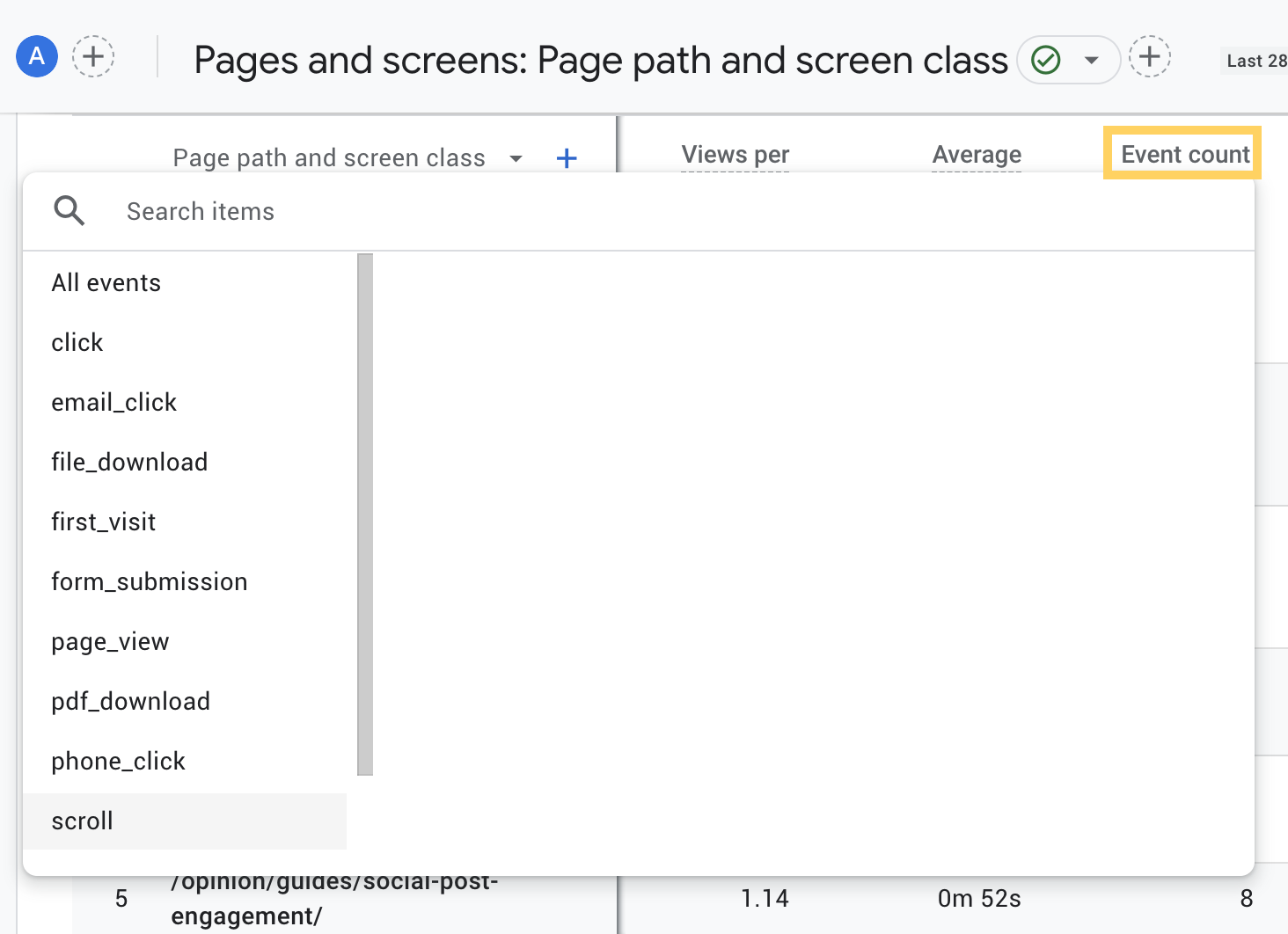
GA4’s offering provides a limited interpretation of scroll depth but combined with Google Tag Manager, you can learn more about your visitors’ scrolling behavior.
Using Google Tag Manager to enhance your data
Remember how I mentioned that content and data work so well together? Well, the same applies to GA4 and Google Tag Manager (GTM) when it comes to reporting on the impact of that content.
There are plenty of insights you can glean from GA4 alone, but you can take it further with GTM.
Chances are, you’ll already be using GTM to track meaningful engagements with your website and conversion events like form submissions, purchases, and video views. However, you can also use GTM to send some helpful data for analyzing content performance directly into your GA4 property.
Here are some tags I recommend setting up specifically for content analysis:
Improved site scroll
We’ve seen that GA4 can give us a basic indication of scroll depth. Angela Petteys’ Introduction to Google Tag Manager shares some helpful tips on how to set up scroll depth so you can create an event that triggers every time a visitor scrolls 25%, 50%, 75%, and 100% down the page, to give you more detailed scroll data in GA4.
Depending on your GTM setup, there will be various ways to see this data in GA4. You could create a scroll depth exploration like this:
-
Go to Explore and click on “Blank exploration” to create a new exploration
-
Click the “+” icon next to DIMENSION, choose “Page path and screen class” under “Page/screen”, “Event name” under “Event” and “Percent scrolled” under “General”, then click “Import”
-
Drag “Page path and screen class” to ROWS
-
Drag “Percent scrolled” to COLUMNS
-
Click the “+” icon next to METRICS, choose “Event count” under “Events”, click “Import,” then drag to VALUES
-
Filter to just show your accordion clicks by dragging “Event name” to FILTERS. Update Match Type to “exactly matches,” then enter “scroll”
-
Additionally, you can filter by page by dragging “Page path and screen class” into the FILTERS section
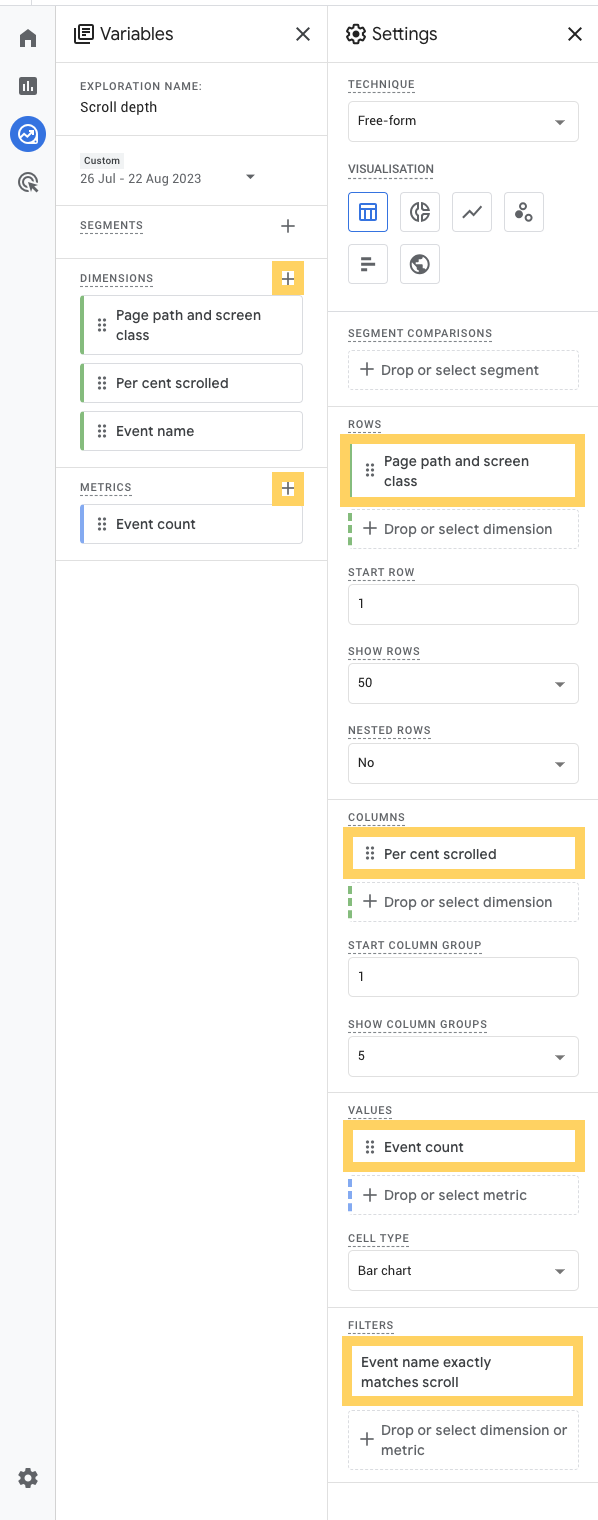
Use the data you see here to help optimize your content. At which point on the page do visitors tend to drop off? Are they seeing your calls to action?
If all your CTAs are at the end of each page and most visitors are dropping off around the 60% mark, then you might want to test moving these up to a more prominent position towards the top of the page.
Click events on FAQs
With informational websites, I’ve found it useful to track what visitors click on, particularly for areas like FAQs that typically use accordions.
Depending on their implementation, there are lots of ways to set up accordion tracking in Google Tag Manager. Often, this will be setup in the form of a GA4 event tag and a “Click – All Elements” trigger. These will look out for clicks on your accordion based on a specific set of rules, like when a “Click class” contains “Accordion_title”.
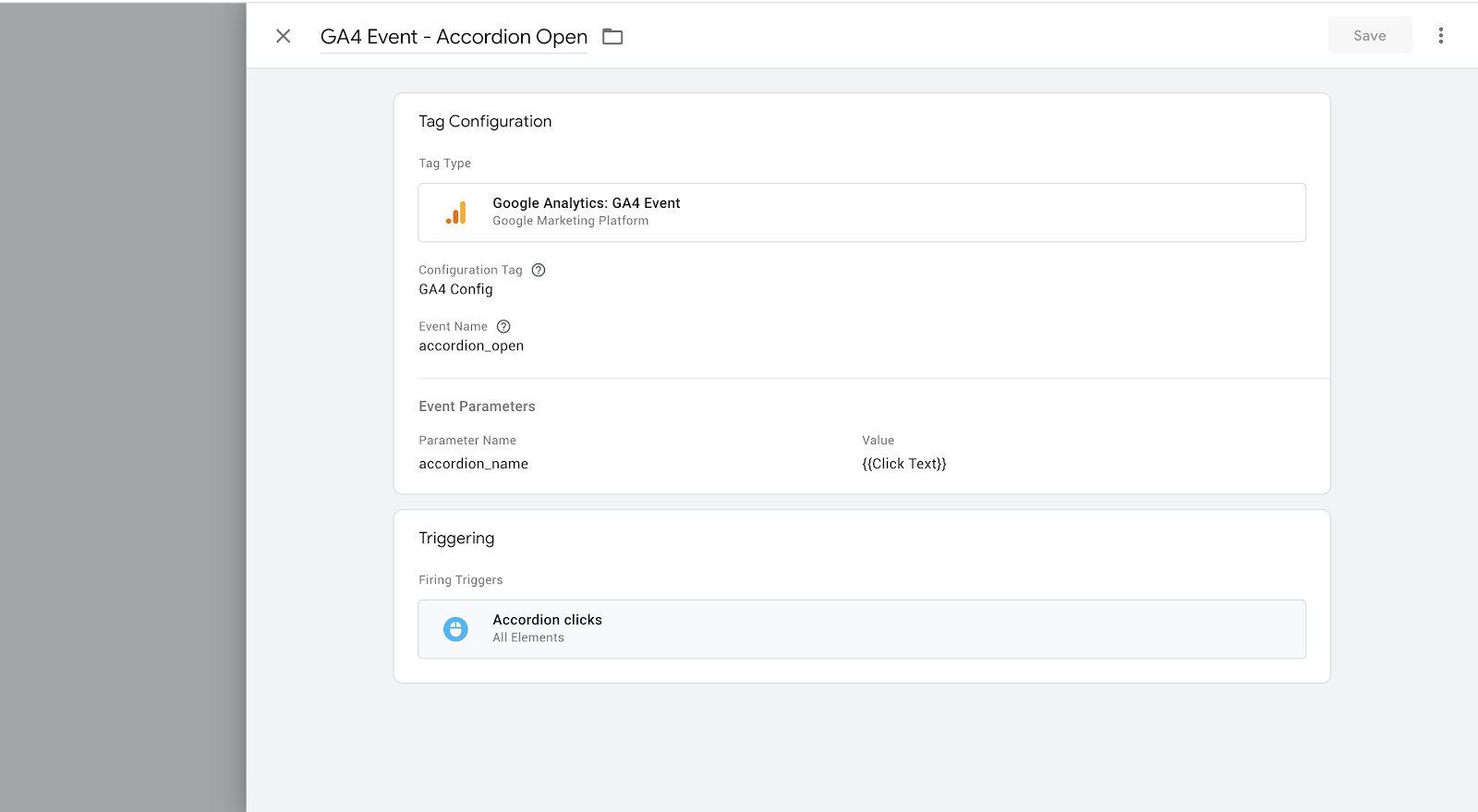
You’ll then want to scrape the text on your accordion, so you can see what visitors are clicking on in GA4. In your Google Tag Manager tag, create an Event Parameter with a helpful name (something like “accordion_name” or “faq_name”), then set the Value to “” to grab the accordion’s title.
You may need to do some testing to find out what you should use here or check with your web developer.
Once you’ve got this set up, you should start seeing this event — let’s call it “accordion_open” — being recorded in your GA4 property within a few days. But there are some extra steps to take to specifically review the FAQ titles in your GA4 property.
You need to create a custom definition. To do this:
-
Go to Admin > Property > Custom definitions
-
Click “Create custom definition”
-
In the Event parameter box, you should hopefully see the Event Parameter you set up in Google Tag Manager (e.g. “accordion_open” or “faq_click”)
-
Choose this, and name your dimension the same thing.

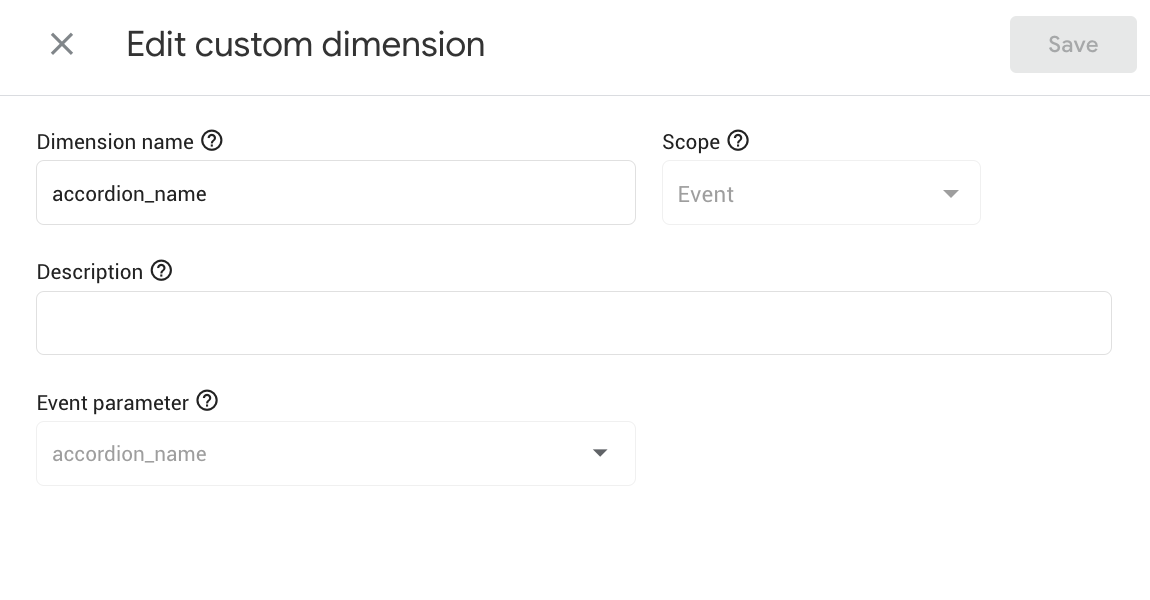
That’s the setup. Now to review the activity! This calls for another exploration, which you set up as follows:
-
Go to Explore and click on “Blank exploration” to create a new exploration
-
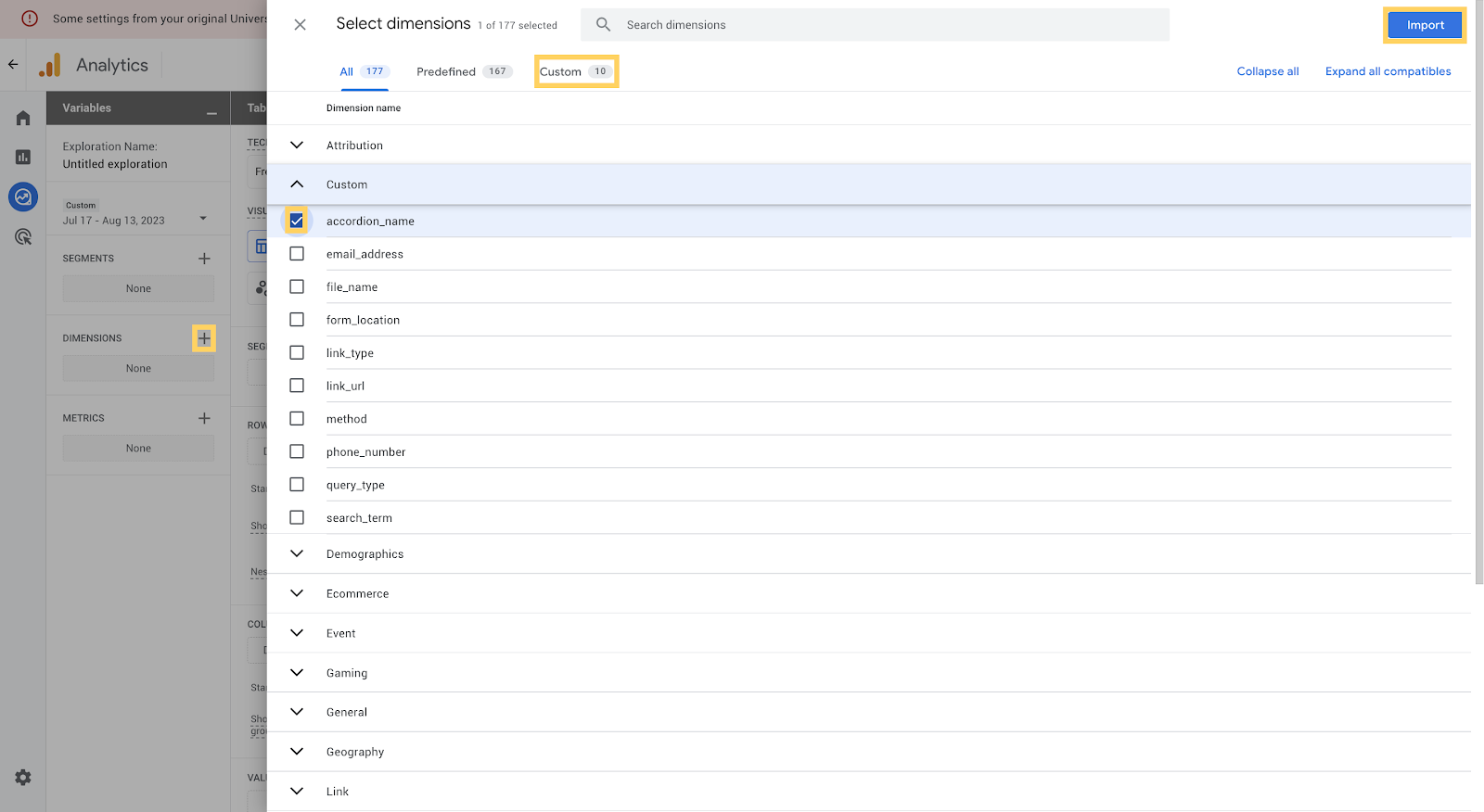
Click the “+” icon next to DIMENSION, choose your custom definition e.g. “accordion_name” under “Custom”, click “Import,” then drag to ROWS
-
Click the “+” icon next to METRICS, choose “Event count” under “Events”, click “Import,” then drag to VALUES
-
Filter to just show your accordion clicks by dragging “accordion_name” to FILTERS. Update Match Type to “does not exactly match,” then enter “(not set)”
-
Additionally, you can filter by page or section by also importing “Page path and screen class” as we did in the previous example and using this in the FILTERS section
With this information, you can see which queries are being clicked on more than others.
Are there any themes in which types of questions are engaged with more? If so, these could provide the basis for more in-depth content.
Are there questions that aren’t clicked on often, but you think they should be? Consider moving them to pages with higher traffic for more exposure.
Using site search to identify content gaps
We’ve explored ways to identify and improve, move, combine, or delete existing articles based on GA4 insights. But what about new content ideas?
Hopefully, you’ll already be using tools like Moz Pro and insights from your sales teams to find content opportunities, but your GA4 data can also provide great content ideas. Specifically, GA4 can help you identify content ideas that address your customers’ pain points.
Your site’s search bar is a goldmine of content ideas based on what some of your most engaged site visitors are looking for. In GA4, there are a few ways of finding site search data.
But first, you’ll need to make sure you’re set up to track site searches. In most cases, you’ll need to enable enhanced measurement in GA4, which you can do by going to Admin > Data Streams > Web stream details and then clicking the Enhanced Measurement toggle.
You’ll then need to set up a “search_term” custom definition (which you can do via Configure > Custom definitions like we did with “accordion_name”). This reports on the actual search terms from the “view_search_results” event.
Then I recommend you create an exploration. Here’s how to set this up for site search:
-
Go to Explore and click on “Blank exploration” to create a new exploration
-
Click the “+” icon next to DIMENSION, choose “search_term” under “Custom”, click “Import,” then drag to ROWS
-
Click the “+” icon next to METRICS, choose “Event count” under “Events,” then click “Import,” then drag to VALUES
-
Filter to just show your search terms by dragging “search_term” to FILTERS. Update Match Type to “does not exactly match,” then enter “(not set)”
Now you’ll see a table with all your site search queries ordered by the number of times they were searched for. This information is valuable for many reasons, and you can analyze and review these results to inform your content strategy.
The next step doesn’t involve any GA4 tactics. It involves you, a list of popular search terms, and your web browser of choice. Visit your website and try out these search terms yourself. What content crops up in your results? Is it helpful?
You can use your site search analysis to:
-
Compile a list of topics for articles or thought leadership pieces on your site, especially for terms that have a high number of searches but there isn’t currently an article or page that covers it well
-
Create FAQs that answer the most popular searches, especially for terms that are formatted as questions
-
Update or move content around so it’s easier to find or make better use of customer terminology if a term is being searched a lot and there is content on your site that covers it
Prioritize your pages: combining site search with exits
Want to learn even more about your site searches? Let’s combine site searches with exits.
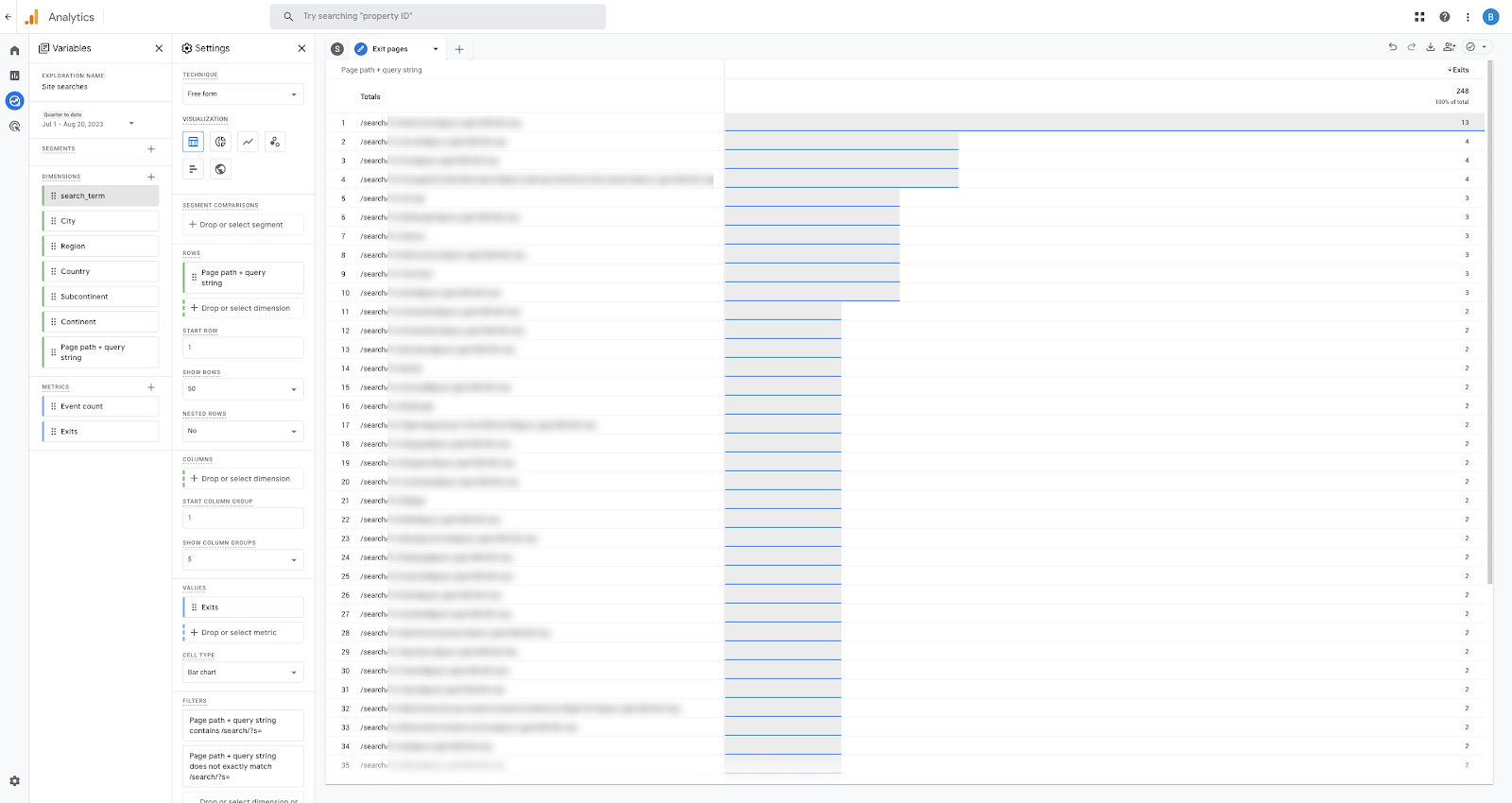
Either create a new exploration or create a new tab in your “Site search” exploration, where you’ll then do the following:
-
Click the “+” icon next to DIMENSION, choose “Page path + query string” under “Page/screen”, click “Import,” then drag to ROWS
-
Click the “+” icon next to METRICS, choose “Exits” and “Views” under “Page/screen”, click “Import,” then drag to VALUES
-
Filter to just show your search terms by dragging “Page path + query string” to FILTERS. Update Match Type to “contains,” then enter the relevant information here, which means you’ll just see your search results pages. In most cases, this will be something like “/search/” or “/?s=”
Once you order by exits, you’ll see which searches most often end in someone leaving your website, suggesting these are your highest priority content gaps. Add these to the top of your content to-do list.
Final tips
There are countless ways that GA4 can help you analyze, plan, and optimize your content strategy. The more you get to grips with your GA4 property, the more you’ll develop your own measurement criteria for evaluating your content’s performance, but these metrics will provide you with a great starting point.
Use your GA4 insights to create content experiments backed by data. If your data tells you that your CTAs are too far down the page, then move them and review them. If your data tells you that visitors keep searching for a particular topic, then make sure it’s prominent across your website.
Setting up new events and dimensions can take time. When testing your new events or custom dimensions, expect to wait at least 24 hours before seeing data in your GA4 property.
My final tip — be patient when collecting data and keep testing. By following the data and fine-tuning your strategy, you’ll see your content pay off in the long term.
How to Create a Brand SEO Strategy — Whiteboard Friday
Miracle shares valuable insights on establishing your brand’s online identity and dominating the SERPs in this informative Whiteboard Friday.

Click on the whiteboard image above to open a high resolution version in a new tab!
Video Transcription
Hi, everyone, my name is Miracle Inameti-Archibong. I’m the head of SEO at John Lewis Finance. Welcome to “Whiteboard Friday.” Today I am going to be speaking to you about how to create your brand SEO strategy.
Why do you need a brand SEO strategy?

Now, why are we talking about brand SEO strategy? I mean, it’s 2023. Traditionally, SEOs have always been after generic keywords, and that’s not a bad strategy. I mean, that’s where the search volume is, isn’t it? However, if we’re all competing in the same crowded space, then it gets really tricky to gain visibility. We’ve all seen the SERP evolutions. I mean, since 2000, there’s been 233 major algorithm updates and it feels like Google and all search engines are constantly chasing the goalpost. And rather than running after them, why not get your customers to come directly to you? Now, I’m not saying don’t go after the generic space. Please do, but we need to diversify our audience. In case there’s an algorithm update, in case something changes, we have something to fall back on. Now, except you’ve been living under a rock, you’ve heard of AI. And we’ve all seen how search engines are integrating AI into the SERPs.
And that means that visibility is going to get harder and harder, because with personalization, the data’s gonna get brought back, and it’s only the top brands that will most likely be included in that SERP. So we want to make sure that people are searching for us and they’re coming directly to our content. Another thing is the increase in competition. Have you ever done a search? I mean, I did a search for hope, like a poem about hope, and I got over four million results. And all of the page titles look very, very similar. And it became really, really difficult for me to distinguish between which one I wanted. And so at the end of the day, I just went for a brand, a newspaper brand that I knew. And that brand identification helped me to identify what I wanted to see. And that’s why we’re talking about brand SEO because we want to make sure that your brand stands out in the SERP and people can come to you.
How to start creating a brand SEO strategy
Now, how do we start with this strategy?

Become an entity
The first thing is to make sure that your brand is a recognized entity. Google your brand. Does it trigger a knowledge panel? How do you get your brand to trigger a knowledge panel? How do you get Google to understand that that name is a brand, this is the product we sell, and this is who we target? First things first is to make sure that you are using a consistent naming convention. Across all your brand assets, your social medias, your platforms, make sure. The amount of times I’ve seen websites migrate or change their name, and although instead of like changing the name of their social media platform, they just abandon that one or close it down and create a new platform or a new entity. What you need to do is to make sure that you’re being consistent across, you’re taking ownership of any old assets you want, and you’re pointing it in the right direction. Do you have a Wikipedia page?
I know they’re notoriously hard to get, but Google takes at least 70% of its content for the knowledge panel from there, so you want to make sure that you have one.
Establish relationships between entities
The next thing to do is to establish relationships between all of these identities. Now, when you search for, say, dresses, ‘cause I’ve got a lovely dress on, when you search for dresses, what makes Google recommend, and maybe I search for Zara dresses, what makes Google recommend Forever 21 or H&M? What makes Google understand that all of these brands have a similar profile? So what you want to do is establish those links. There is a tool called TextRazor where you can take some of your content, put it in, and Google shows you some of the links and the associations that it’s making with that content.
So what you need to do is think about where you’re building links, where you’re getting citations, and make sure that you are targeting similar brands with competition that you want.
Utilize schema markup
Another thing to do is give a markup. Now, Google can crawl the web, they can understand content, but what you want to make sure you’re making your content super clear. You want to make sure you’re tagging up your organization schemas, your product, whatever you’re doing that just makes it easier for search engines to understand what your content is about.
Engage with your local audience

Again, if your content is local, make sure that you’re engaging with your local audience. Now, this is not just about starting off your GMB profile and feeling like, “No, I’m done.” This is about creating an engagement strategy.
So responding to reviews, creating a review collection strategy, making sure that you’re engaging with your audience so much that they want to like post about you, they want to take pictures and share with search engines. Because at this point, search engines value more what your consumers are saying about you than what you’re saying about yourself. So you want to make sure that you’re using all of the features, the post features, the promotion features, you’re keeping everything up-to-date, you’re answering questions, and you’re really engaging with that audience.
Dominate your brand’s SERP

Again, are you dominating your brand’s SERP?
Now, I did a search. Traditionally, everyone just thinks that if your brand name is in that search, in the keyword when someone searches, you will rank position one. But that’s wrong, as more brands are ignoring their brands and chasing after generic keywords. So I did a search for how to book a flight on Expedia. And surprise, surprise, Expedia, even though it’s a big brand, was not in position one.
Now, the site that was in position one is called Techboomer. They had a full article step-by-step guide, screenshots from Expedia’s website on how to book a flight. They also had a video as well to accompany that, and that was what was in position one and two. Now, I went to Expedia’s website and I tried to look for this content. I couldn’t find it. And to make matters worse, Expedia is bidding on that keyword. So they are paying for their own brand traffic when they could have just been targeting it right by content, using content.
Create a plan to maintain a positive brand reputation

Again, we talked about reviews when you’re part of local search. You want to make sure that you’re doing the same, even though you’re not in the local space. Where are people engaging with your content? What forms are people having chats about your brand, your products, whether you’re doing well? You want to make sure that you’re on there, you’re getting all of that feedback, and you’re targeting them with content that makes it easier for them to understand your product.
You want to make sure that if you’re on Trustpilot or whatever review tool you’re using, that you’re actively seeking to collect reviews and you’re responding as quickly as possible.
Build a top-of-funnel content strategy

Again, you want to build a top-of-the-funnel content strategy. Now, a lot of SEOs shy away from this because it’s really hard to measure, but if you’re really intentional on the purpose of this and you work with the right channel, so this is not just an SEO strategy. You have to work with brand, social media, the product team to bring this into life. And the key to this is establishing your brand’s online identity.
Now, you want to give your brand, you want to position your brand so that it has a distinctive, unique identity. For instance, what makes someone an Apple? What makes someone an Android? And those two users, “Well, I can never use the other product.” And that’s what you’re trying to do. Establish who your brand is for and who you’re targeting with your top-of-the-funnel content strategy. There’s something called social identity theory, which states that if you can do this for your brand, people get like a boost of self-confidence when they associate with a brand because they feel like that brand understands them. And they became your marketers. They recommend your brand to other people. They advocate for your brand in the world. And that’s what you want to do with your brand SEO strategy.
Now, I’ll finish on this note. If we are all targeting the same keywords, we are competing in a very, very crowded space. Your brand’s online identity is your beacon. So make them come to you.

Thank you.
How To Get Buy-In by Setting Strategic Content Marketing Goals
Marketing teams are under more pressure than ever. 50% of small and mid-size businesses have in-house content marketing teams that are struggling to overcome challenges, according to UpCity’s Content Marketing Survey.
Some find it difficult to measure ROI, while others struggle to identify strategic collaborations. Even among those that are effectively measuring content marketing KPIs related to their goals, there is always room for improvement — especially when management wants to know how you will attain that next best result.
To secure budgeting, resources, and cooperation from internal partners, you need to get those stakeholders to ‘buy in’ to your content marketing strategy. You can do that by setting clear content marketing goals that guide you toward more optimal performance. According to Marketing Week, nearly 39% of SMB (Small and Midsize Business) marketers now focus more on performance because of pressure from senior leadership to achieve specific targets.
Whether you seek buy-in from the C-suite or are interested in presenting data to your stakeholders, here’s how to bridge the gap between your team and those with decision-making power.
What are content marketing goals?
Content marketing goals are strategic initiatives that marketing teams set and track in pursuit of their overarching content marketing objectives.
It’s no longer enough to produce quality content, click the publish button, and hope for the best. Content marketing is a strategic approach for creating and distributing content to achieve business goals. These goals look different for varying businesses. For some, the core objective may be to attract new customers and boost brand awareness, whereas another company may focus solely on lead nurturing and conversion. These goals will change over time and in response to varying target audiences.
Regardless of the primary objective, content marketing goals allow teams to gauge progress and communicate to those most interested in that progress. SMART goals provide direction, allowing you to prioritize content creation to allocate your budget effectively.
Think of content marketing goals as a roadmap to achieve success. For example, you may want to increase conversion rates by X% in six months. This clear goal helps you track KPIs to adapt accordingly.
But you shouldn’t run before you can walk. Instead of collecting as much data as possible, set a clear goal and start small. Measure the elements that will provide actionable insights so you can pivot quickly.
For example, if your primary goal is to increase brand awareness and rank higher in the SERPs, you may focus specifically on new website visitors or inbound links, and alter your strategy and approach as further information becomes available.
Top 3 content marketing goals
Content marketing goals can help you grow, engage, and retain your audience. However, you must determine your primary goal to optimize your next campaign and choose the most relevant KPIs. The following three content marketing goals can help you take your strategy to the next level and achieve real, measurable results.
Create content to fill a content gap
After conducting a content audit, you may notice that the performance of your content doesn’t align with your current goals. This audit will be highly specific for some, such as uncovering a keyword gap with competitors.
When you’re ready to review the data, leverage an analytics tool like Google Analytics to look at engagement, traffic, conversions, or other indicators. Based on that data, identify gaps where your content misses the mark concerning your goals, your audience’s needs, or your competition’s standards.
You may discover you lack content for a particular stage in the buyer journey, or you may not have enough content for a specific persona. From insufficient keyword-driven content to the absence of content for an industry trend, there are many reasons why a gap exists. Identify it and act fast to ensure the most significant impact.
Moz’s Keyword Gap tool is particularly useful for identifying content gaps relative to a website’s competitors. Simply plug in your site’s URL (either domain or subfolder) and those of your competitors, then voila! You will see which keywords your competitors are ranking for in comparison to your own rankings. Narrow down your results by using the “Your Rank” filter and inputting your desired rank minimum or maximum to only show keywords that are most attainable for you to go after.
To hone in on the most viable opportunities, you can use Volume and/or Difficulty Score metrics. By setting a Difficulty Score <20, for example, you’ll find keywords that any well-established website should be able to target and ultimately rank for, versus aiming to create content and rank for keywords with higher difficulty.

In the above example, I compared UpCity’s B2B marketing blog against two industry-leading marketing blogs, HubSpot and Digital Marketing Institute. The Keyword Gap tool reveals that UpCity has content ranking in position #8 for the keyword “ppc on google,” while the other blogs are ranking in position #3 and #5 for that keyword, respectively.
With this data, UpCity can optimize its existing content to rank higher for these competitive keywords, and see new content opportunities by looking at phrases for which they are ranking in the 51st position or higher (which, in terms of SERP placement, “higher” is not always a good thing.)
Create content for link-building initiatives
If you have not prioritized link-building strategies, you’re leaving significant growth opportunities on the table. While link building was all about quantity in the past, quality has the upper edge in 2023 and beyond. The quality and authority of the pages where you build links play a major role in ranking.
This goal is of the utmost importance if you are in a competitive industry and want to improve your SEO strategies. To ensure success, you must begin with helpful, quality content that people want to share. Part of this approach will be knowing where to find prospects, or websites, that might be interested in linking to your content.
Create content to rank in the SERPs
The forever-changing SERPs can make it tough to maximize the value of your keyword data. However, there are some fundamental considerations when the goal is to rank.
As you adjust your strategy to rank higher on Google, you’ll get more traffic and drive conversions. But to achieve that, you need to offer quality content. Google continues focusing more on user experience, accounting for bounce and click-through rates, and rewarding sites that publish comprehensive content with search intent, scannability, and speed to value in mind.
Content marketing KPIs
To help drive the above goals, you need insight into what’s working and what isn’t. One way to do so is by paying attention to key performance indicators (KPIs) that align with those goals. While the metrics depend on your objectives and audience, these four are critical for any team to optimize resources:
-
Sessions: If you want to know whether users are landing on specific pages and staying long enough to engage with the content, dive deeper into average pages per session. When using Google Analytics (GA4), you can track Events per Session or Engaged Sessions per User, which Google defines as a session lasting longer than 10 seconds, a session with a conversion event, or two or more screen or page views.
-
Keywords: When building a campaign based on target keywords, you must track the keywords’ ranking positions. Focus specifically on rank checking and visibility.
-
Revenue: You can discover how much revenue is generated directly from your content marketing efforts by determining which conversions come from content and which conversions come from ads. This data can help you compare your strategy to other marketing and sales tactics, and it’s vital for gaining buy-in from other teams.
-
Backlinks: For content, few KPIs are as crucial as backlinks. Think of every link as a vote. Once you start growing backlinks from authoritative sites, you’ll know your audience is engaged, and your reputation is strengthening, both in the eyes of your readers and search engines.

Mix and match your KPIs to content types
Not all content marketing KPIs make sense for every content type or situation, so knowing when and how to match them will provide more value. For example, the following content types often come with unique goals, which can help you determine the most appropriate KPIs to measure.
Educational resources
Commonly referred to as hub-and-spoke content, educational resources serve as a foundation of information on the given topics on which your site focuses. Having informational content around the products and services you offer plays an integral part in establishing authority and trust.
Educational resources may be centered around “What is?” and “How to” queries, and should heavily focus on targeted keywords for that topic. Not only does this help prove your knowledge and expertise to users, but it also significantly helps with your site’s SEO and ranking potential.

Tools like AlsoAsked and AnswerthePublic do a great job of visually displaying hub-and-spoke queries related to the topic or keyword you input. These tools work by scraping search engine results’ “People Also Ask” boxes to quickly show what questions users are asking, helping you to produce content that people are interested in learning about.
Keywords and backlinks will help you grow your audience and boost your ranking, whereas session data will help determine how your potential clients or customers interact with your educational content. Is one resource page attracting users for an average of five minutes compared to another resource that holds interest for 30 seconds? Determining why this happens can ensure you create more helpful, meaningful content that supports a healthier ROI.
Most vital KPIs:
-
Sessions
-
Keywords
-
Backlinks
Tools
Whether it’s a mortgage calculator or data scraper, a company name generator or a three-question quiz, users love finding helpful and engaging tools and sharing them with others. That’s why online tools are arguably the most linkable assets for content marketers.
If, for example, you are a professional video marketing service provider, you might create an interactive tool that allows users to estimate the cost of making a professional video. Enabling users to add and remove options for their desired video like “music,” “live action,” or “animated” would adjust the price accordingly. This tool would prove helpful for anyone exploring professional video services, making it a great link target for link building outreach, as well as sharing on social media platforms and online threads.
Most vital KPIs:
-
Sessions
-
Keywords
-
Revenue
-
Backlinks
Surveys/Data reports
Collecting proprietary data through surveys, carefully analyzing the results, and publishing a high-quality report is a proven content marketing strategy that works time and time again, like this survey on ‘What Diners Write About Most’. Producing survey reports and sharing results with top-tier journalists can help land your brand highly coveted media placements on strong domains.
Similarly, surveys are one of the best content types for link building outreach, as your data can often fit seamlessly into existing content on other sites that have written about the topic of your report. Website owners are typically much more willing to reference your data and link back to your content as opposed to other content types, which are more difficult to earn placements for.
Further, data reports can rank more easily in the SERPs compared to other content types. There is no shortage of users searching for “[topic] statistics” on a daily basis, so it’s wise to do keyword research to hone in on the specific keywords that are being searched for your targeted topic. By incorporating these keywords in your report, you’ll significantly increase your chances of ranking in the SERP.
Most vital KPIs:
-
Keywords
-
Backlinks
Quote roundups
Publishing quotes — especially unique, thought-leadership quotes — can help you gain backlinks. You can create an “expert roundup” content piece quoting leaders or influential parties in your industry, also using this opportunity to build collaborative relationships.
You can also combine quote roundups with other content types, like data reports or educational pieces, by adding expert quotes to support the information in those pieces. Adding expert quotes to an article can improve its authoritativeness (an integral part of E-E-A-T) and increase backlink opportunities.
Leveraging reporter-supported platforms like HARO and Qwoted can make putting together quote roundups a breeze. It is more common than not for expert contributors to expect a backlink in return for sharing their insights, and the site publishing the piece shouldn’t stray from asking the featured individuals to return the favor. Expert roundups can truly be a win-win.
Most vital KPI:
-
Backlinks
Measuring up: How to report against your content marketing goals
Once a piece of content is published, you need to track its performance to have actionable data to report. Without that information, your team will be left in the dark.
Results should align with ongoing content marketing goals to ensure progress and growth. Based on the common goals and content marketing KPIs discussed above, here is how you should approach each scenario.

Content gaps
When the goal is to fill content gaps, the optimal result is relatively black and white — you filled the gap, or you didn’t.
There are several ways of looking at content gaps, ranging from outdated information to fluctuating keywords and shifting customer interests. So, when gaps appear, it doesn’t mean you’ve done something wrong in the past. However, if you want to stay ahead of the game and remain competitive, you must identify and address any new gaps, as they will quickly become missed opportunities.
Keyword research will be imperative here to ensure your content ranks high. To get started, focus on a competitor keyword analysis or leverage a tool like Moz Pro, which includes the Keyword Gap tool described above.
Quick Tip: If you are experiencing a lull with your target keywords, it’s time to incorporate more long-tail keywords. These keywords, which are keyword phrases of three words or more, are less competitive and are often highly effective because they represent customers further along in the buying process.
Link-building results
While link quality is of the utmost importance, quantity still matters too. To put it simply: the more quality backlinks you get, the better.
To measure the success of any link-building campaign, you must consider the number of backlinks your site has and the quality of those links, or the number of referring domains acquired within a set period (often month over month).
However, patience is vital before you make significant shifts to your strategy. On average, it takes anywhere from three to 12 months from when you build links to when you see major changes in SERPs. You can also dive deeper into the organic growth of traffic.
Lean on the tools available, like Link Explorer, to make this process as accurate and efficient as possible.
Quick Tip: When the goal is to collect data from your campaigns to measure your link-building success more efficiently, set a benchmark. This benchmark will act as a reference point so that you can pivot and better contextualize your results.
Content that ranks
SEO campaigns are crucial for businesses across varying industries and niches, ranging from retail to technology. While organic search and visibility go hand in hand, ranking is one of the most significant advantages of investing in SEO. Showing up on the first page of Google has massive implications. According to First Page Sage, the average click-through rate for Google’s first three organic results is 68%. By the tenth position, that number falls to 2%.
The first step is determining if your content already appears in the SERPs. The SERP Analysis tool in Keyword Explorer can help you with this process as you tweak SERP features. Pay attention to whether your content is optimized after determining whether it is ranking. Again, this is when you start associating the connection between content marketing and SEO. Focus on keywords and user intent, but don’t overdo it.
From a content marketing perspective, remember that content should serve the user first and the search engine second. The best approach here is to create research-driven content that is high quality and reliable. That way, you’ll cover both bases.
Some of the most valuable metrics to consider include:
-
Organic traffic, which you can access in Google Analytics or Moz Pro
-
Keyword rankings, which will help you determine which keywords drive traffic to your website. Moz’s Rank Checker is ideal for this process.
Quick Tip: Always implement best practices to optimize for technical, off-page, and on-page SEO. Know what to prioritize and when based on your initial goal and ongoing KPIs.
Adjust content marketing KPIs to your business goals
Whether you want to sit down with your management team or present figures to stakeholders, you must know how to translate your content marketing goals into actionable KPIs.
As you select clearly defined metrics to track, you will better understand if your marketing spend is producing an attractive ROI. If not, you’ll now have enough information to make more informed decisions. Well-presented data will make decision-makers “buy in” to your initiatives, especially if you have already adjusted and refined your strategy to show improvements.
Whether you have an in-house or outsourced content marketing team, be sure to align and establish KPIs based on your unique objectives. Learning how to measure and report against your chosen KPIs effectively could make or break your next campaign.
Takeaways from an Irish Locksmith: Listing Spam Scandal
“I did what people normally would do — Googled ‘locksmiths near me.’”
These telltale words preface a scandalous account of listing spam I recently ran into on an Irish call-in radio show on RTÉ. I’m going to share a summary of it in today’s column, offer my best understanding of the root of the problem, and close with takeaways both for consumers and for local business owners who operate in Your-Money-Or-Your-Life (YMYL) industries, like security.
When local search reads like a mystery novel

Host, Katie Hannon, and her team did a good job of structuring this unfolding mystery on the Liveline with Joe Duffy show. Sir Arthur Conan Doyle would definitely have gotten hooked into this plot.
Caller #1
On a bank holiday, a woman came home to find herself locked out of her house. She called the first locksmith she found on the web. The locksmith told her the lock cylinder needed to be replaced, did the work, and 5-6 minutes later, presented her with a bill for €391 ($419.35 USD). She had been so frazzled by the ordeal, that it wasn’t until the next day that she began to wonder why the charge was so high, but when she re-contacted the company to ask for a breakdown of the cost, she was informed that while the fee might appear large, it reflected the expertise of their staff.
Later, a licensed locksmith would confirm for the customer that, on a bank holiday, the charge should have been about €200.
Caller #2
“I did what people normally would do – Googled ‘locksmiths near me.’ I needed it done as quickly as I could. I took the first one that popped up. I spoke with a young lady, and she said she’d have someone get in touch with me,” said the next caller of his experience of hiring a locksmith when his door handle stopped working, when questioned about the locksmith’s online presence, he answered, “It looks very professional with very good reviews. There was certainly nothing to warn you.”
After a series of non-fixes, the locksmith got the caller’s door open but said he’d leave it without any lock unless the customer was willing to pay for replacement of the mechanism. Not wanting to risk having a door that couldn’t be made secure, the customer found himself with a bill for €1,143 ($1,225.87 USD) and began to worry he’d been overcharged when friends remarked that he could have gotten a whole new door for that amount.
Later, a licensed locksmith would confirm that the charge for the work should have totaled less than €500.
Caller #3
When one woman needed a rusty door lock replaced, she did what most of us would do,
“I just Googled ‘Dublin locksmith.’ It had reviews and everything.”
The locksmith who arrived charged her €60 for the service call but told her he’d need to order a €400 ($429 USD) replacement lock. When some days had gone by with no follow-up, she re-located the Google Business Profile she’d clicked on and again spoke to a receptionist. The receptionist told her she’d need to email the man on the invoice she’d received, but when her email went unanswered, the customer set out to find the elusive locksmith.
Via the Internet, she located a street address, and that took her to the house of a completely different person…
The Case of the Retired Locksmith

Caller #4 was the gentleman whom the woman with the rusty door lock found at the Dublin residence, and he is a retired licensed locksmith who served the industry for 45 years. I won’t do screenshots in this piece, but my own research confirmed that he appears to be the victim of impersonation via a Google Business Profile, and other local business listings. The top-ranked listing I found for the search in question featured the retired locksmith’s name and a 4-star rating on the basis of some questionable reviews + a few complaints.
It turns out that not only does the retired licensed locksmith know about this scandal, but he has felt so upset by customers being overcharged by the alleged impersonator, that he has been going to their homes to explain that he is not the service person they contacted and to offer them advice on what steps they might take. He is proud of the reputation he worked hard to build over more than four decades and is understandably unhappy to find his good name being tarnished, saying,
“I wouldn’t have survived this long in business if I had given a bad service to people.”
He has reported the issue to the authorities but has yet to receive a response, and unfortunately, there isn’t much he can tell these homeowners to do. In most cases, they did receive the work they paid for, but the charges simply were not commensurate with industry standards.
Google… I don’t know how they operate their business
During the radio program, Caller #5 phoned in to say that she, too, is a licensed locksmith, and has had four local people reach out to her lately after apparently receiving outrageous charges for basic services from this same entity. She stated:
“Google, I feel, is partly responsible for providing disinformation, but I don’t know how they operate their business. I would really like to know what is going on beneath all this because I do feel that there is an establishment that may be running companies like this. They’ve seen a niche in the market, and they’ve grabbed onto it, and they are making an absolute fortune. They’re unlicensed, and they are ripping people off.”
And therein lies a very large key to this common problem. Neither consumers nor legitimate business owners in this case (and in many) have a clear idea of what Google’s omnipresent local search results consist of, how they are ranked, or how often they contain spam.
Vulnerabilities in Google’s local search platform make it quite possible for a scenario like this one to take place, of an individual apparently spoofing the identity of another company and creating a listing around it. It’s also possible to hijack the listing of another business and insert your own phone number so that you receive the calls that should be going to your competitor. It’s possible to pay for fake reviews that make a dubious business look trustworthy, and as my honored colleague Joy Hawkins recently reported, you can repeatedly spam Google’s review component without any lasting consequences.
Lack of meaningful competition in the local search space has not motivated Google to fix this problem of listing spam over the past several decades, despite volumes of reporting both by major media outlets and industry journalists. At the same time, Google has never succeeded at widely engaging with or offering adequate support to the millions of local business owners whose data they use to populate their local search results. No matter how many times they rebrand and reshape local search, Google just isn’t getting the basics right to create a trustworthy, manageable platform or consumer experience.
So, where does that leave local business owners and Google users?
The cause and effect of local online scams

“You have to be so careful about who you have come to your home to fix a lock or deal with your security.” — Katie Hannon, RTÉ host
Misinformation, disinformation, and web spam are a threat to public safety in YMYL scenarios. I remember writing an article nearly twenty years ago about having a medical emergency and realizing that Google’s local pack results were full of inaccurate listings for ERs and hospitals. And clearly, when it comes to home security, no one would want someone untrustworthy working on their locks.
Meanwhile, I was listening to another Irish call-in show recently in which guests had lost tens of thousands of euros to scammers allegedly claiming to be from the online finance app Revolut, and the subsequent nightmare they’ve gone through in realizing that even the real Revolut isn’t like a real-world local back with an office and phone number you can contact for emergency help if you’re robbed.
Imagine spending 12 hours with a chatbot because it’s the only source of customer service available to you after having $10,000 dollars taken from your account! One of these callers even wondered afterward if the person she was speaking to at the scam company was a real human being or AI with a Dublin accent. Scenarios like these seem to me to stem from and create the following cascade:
-
Civil societies function on members having a certain degree of respect for authority, whether the authorities are teachers, medical experts, licensed professionals, or government leaders.
-
Many members of society have mistaken tech companies and their products for authorities, implicitly trusting that if something is as big and powerful as Google, it must be vetted, regulated, accurate, and authoritative.
-
In non-daily circumstances like suddenly needing a lock changed, having a medical emergency, or thinking your finances might have been compromised, people are flustered. They reach out for the quickest possible help to get themselves out of trouble and are not in any state to use their best critical thinking. Very intelligent people who say they would normally know not to give out sensitive information to strangers find themselves doing so in emergencies.
-
Because scammers know people are vulnerable during a time of stress, they build business models around exploiting others during these episodes.
-
This is a global problem that no government, regulatory body, or tech company has effectively solved. It has been nearly 20 years since Google Maps first appeared, and in the US, there are still no meaningful consequences for a search engine that profits from publishing spam that fools, misleads, misdirects, and even harms people. Regulation does not keep pace with rapid technological development.
-
Invested tech companies are now actively worsening this problem by presenting AI as an authoritative source of information rather than as an amalgamation of whatever data it has been fed, good or bad, real or not real. If countless people have already been scammed by others who use platforms like Google Business Profile to misrepresent themselves via spam listings and reviews, there’s pretty much no end to what bad actors could do with the opportunities AI will offer to spoof legitimate entities to disastrous consequence.
The effects of scams on communities are deeply serious. Scams undermine how humans feel about the societies they live in. Living in a setting in which people have to be constantly suspicious of their neighbors is stressful, and long-term stress undermines physical health. Some callers I listened to expressed shame at having been fooled, and others were reticent about admitting to anyone that they were swindled for fear of looking out-of-step with the times and the tech. All of them suffered financially, which is especially difficult in Ireland right now given that its people are experiencing what they call a “cost of living crisis,” which appears to have its same root as the 40-year transfer-of-wealth scam American economists cite as the cause of our present state of poverty in the US.
Thieves have always existed. The internet has simply allowed them to scale up and cause harm to vast numbers of people. When societies are unprepared and unprotected from swindles, an unfortunate outcome is that people have to look out for themselves (a very anti-social state of affairs that improves life for no one), but this is where I believe we’re at in the absence of better regulation, and I’ve got a few tips to share.
Tips for increased safety amid Google Business Profile spam

Let’s start with tips for customers — folks like you and me who are using the internet to navigate our local landscape:
1. Understand that spam is widespread on Google
Know that it is very easy to create illegitimate Google Business Profile listings and that a recent large-scale study by Uberall found that Google is the platform with the highest percentage of suspicious local business reviews. Know that Google does not have adequate safeguards in place to identify and remove fraudulent information from their product. The local results you see when you search for nearby businesses may well contain both fake listings and fake reviews and do not deserve your unqualified trust.
2. In a quiet moment, create a list
To protect yourself from being manipulated in a time of stress, consider the types of sudden incidents that take people unawares at some point or another in many of our lives. These might include:
-
Medical incidents requiring emergency assistance
-
Auto accidents and malfunctions requiring roadside assistance, auto repairs, and sometimes legal assistance
-
Security needs, like locksmith assistance or home security malfunctions
-
Damages from weather events like storms or fires, requiring rescue or urgent remediation services
-
Household malfunctions like septic overflows or plumbing problems, garage door failures, major appliance repairs or replacements, and other needs that require urgent assistance
-
Financial emergencies, such as fearing your banking card has been lost or stolen
It may sound like I’m trying to turn back the hands of the clock to pre-internet times, but at this point, you will be better off writing a list of the names, phone numbers, and addresses of reputable resources and keeping a copy of it in your wallet, purse, vehicle, and home rather than trusting random local business listings for YMYL scenarios. You could definitely put the list on your mobile phone, but you might want a paper copy as well in case your phone gets hacked, lost, or runs out of juice.
When you are not in the middle of an emergency, you can thoroughly research and contact your options to vet them. You can ask your friends and family for recommendations. And if you are traveling even a little distance from home, you can make such a list to protect yourself from being scammed in an unfamiliar setting.
In short, Google may be fine for helping find a quick cup of coffee or a slice of pizza, but don’t trust the local packs or Google Maps if your money, health, bank account, or life is at stake. Don’t invest Google’s results with an authority or accuracy they don’t possess. As a seasoned local SEO, I don’t like having to say this, but it’s my honest take on the state of affairs.
3. Start relying more on people in your life and less on the internet for YMYL decisions
Speaking of ethical scandals, we all need to be bracing ourselves right now. Large publishers you once trusted for vetted, fact-checked information that is hand-researched and hand-written by experts and authorities, may be making decisions right now to replace some of their staff with AI. We are already seeing results in the form of shocking pieces being published like this one (now removed) from Microsoft, which advised tourists to Ottawa to enjoy visiting a local food bank on an empty stomach.
The combination of spam local business listings and reviews + the increase of what could be a real mess of AI-generated nonsense in both chat-based and organic results could mean you should be very careful of letting the internet be your guide when making decisions that involve your life, health, money, security, or major purchases. Publishers have profit goals in view in replacing human authors with AI-generated information, but you need recommendations from people who have your best interests in mind. And that, of course, lands you back in the circle of your friends and family.
You are likely better off asking your mother, your neighbor, or your friend from work where to find a trustworthy outfit to replace your broken windshield than you are asking ChatGPT, Bard, New Bing, local listings, or organic results. You are likely better off steering clear of the web and asking your existing doctor where to find a specialist, if the need arises. Word-of-mouth recommendations are a tried-and-true method that long pre-dates the internet of finding reliable help, and it works on the basis of trusting that real people in your life want the best for you. They may not always get it right, but lived experiences are a rich source of useful information we all can share.
4. Know that asking to see credentials is not bad manners
Know the licensing laws of your country and/or state and request that any service provider show you proof of their credentials before you contract with them. I’ve heard kind people say they worry it sounds rude to ask for this documentation, but remember that legitimate service providers have to go through all kinds of steps to earn their credentials, and they will not be in any way annoyed by sharing the results of their efforts to be compliant with regulations. These credentials set them apart from scammers they already know exist in their geographic markets. If a potential contractor makes a fuss about proving they are licensed, it’s a red flag to you that they don’t have the necessary proof.
In sum, the internet can be a great place for local consumers to browse their communities and connect with local businesses, but when it comes to specific high-risk categories and transactions, you will be safer if you do your research ahead of sudden events and make sure you are working with licensed professionals with legitimate business credentials and contact information.

Now let’s turn to the local business side of this story. What can you do if you know your Google Business Profile categories are polluted with spammers, putting your neighbors and potential customers at risk of being scammed?
1. Report what you can
This shouldn’t be part of your job description; it should be Google’s responsibility to keep their index as free as possible from spam listings and reviews that violate their own guidelines. Nevertheless, you can report spammers to Google, and sometimes they will act on those reports, and that may help you move up in the local rankings. However, do go into this knowing Google often won’t act and that spammers will often simply come back. It’s not ideal, but you do have the following options for reporting:
-
Use the Business Redressal Complaint Form to report Google listings you are convinced are spam and in violation of the guidelines, or review profiles you believe are the result of forbidden activities.
-
If three weeks pass and you have seen no movement on what you’ve reported, you also have the option to post your redressal case ID in the Google Business Profile Community help forum to ask a product expert to consider escalating your case.
2. Treat credential content as central rather than as an afterthought
On your website, social profiles, and in areas of your listings like Google Updates (formerly known as Google Posts), create content that explains what your credentials are, and why you have them. Too often, service providers’ sites simply have a license number in the header or footer, with no explanation of why it matters. Build core content that educates potential customers as to what legal requirements there are in your field for licensed or credentialed providers, and take the opportunity to warn your community against spammers and scammers by teaching people to ask to see credentials before they hire anyone.
3. Don’t abandon business cards and fridge magnets
Tech news might make you think that everything has to happen online these days, but the truth is, being generous with handing out business cards, magnets, car stickers, and other tangible marketing assets with your contact and credential information on them is a great way to ensure customers come back to you in a moment of stress, instead of going with another random provider they find online. The oil change business I go to always places a little transparent window cling on my car that is branded with their name, contact info, and the date I should come in for my next service. Any service provider can offer a physical reminder to the customer of whom they should trust when the time comes.
4. Build a simple referral program
This is very easy to do when your business is a cafe or grocery store that locals visit on a regular basis. Offering a free cup of coffee after a customer’s fifth visit or a coupon for ½ off dinner with a friend is simple. But when you are in a YMYL category, chances are good that the same customer isn’t going to need you on a regular basis. What you want is for them to share your good name with their friends and family in advance of the need arising, and a branded merchandise campaign could be one good option for accomplishing this.
For example, imagine you own an auto glass repair company. You might invest in branded stainless steel water bottles that people can take in their cars instead of plastic. Your branding can include your name, phone number, address, and credentials, as well as your logo. When completing a job for a customer, you could let them know you have a special offer of one of these bottles if they agree to give a second one to a local friend or family member. You’ll not only be reducing plastic consumption in your community, but you’ll also be getting your brand name into people’s cars so that they remember it right away if their car window gets damaged. A plumber might offer a toilet brush set. A locksmith might offer a cool keychain charm. The point is to get your trusted name into the hands of your neighbors when they need you, making them safer from scammers and earning you new business.
In sum, you have some options for reporting online spam to Google, but your strongest bet will be to build real-world relationships with the people in your community so that they learn to trust you and recommend you to their circle.
Local listing and review spam harms communities, and AI is likely to take scams to as-yet-undreamt-of levels. While the internet is an amazing tool for finding things, it cannot replace the offline social contract of trust that surrounds time-honored word-of-mouth recommendations amongst family and friends. When your money or life is on the line, or if your business provides services for people with urgent, unexpected needs, trust is a must.
The MozCon 2023 Video Bundle Is Here (Plus, Our 2022 Videos are FREE!)
This year’s MozCon was a journey into the future of our industry, set against the stunning backdrop of our brand new venue, Seattle Convention Center’s Summit building. Whether in-person or via livestream, more than 1,000 people gathered for two days of insights and tactical presentations from industry leaders and to connect with fellow attendees. Just a few of the practical lessons we learned include:
-
How to explore Seattle like a local and make the most of your time in the Emerald City
-
How to prepare for an SEO conference, and why conferences are more important than ever
-
How to convince your boss that sending you to an SEO conference is good for your business
And while the industry continues to evolve at a lightning-fast pace, our 22 speakers offered up next-level advice for leveraging emerging technologies and staying ahead of the competition. If you missed the conference live, we’re happy to share that the MozCon 2023 video bundle is now available for your viewing pleasure!
For $299, you’ll gain access to every presentation and speaker deck to watch as many times as you’d like. That’s 22 talks and over 11 hours of content! Schedule a viewing party with your team and get everyone on board with the best digital marketing advice, data, tools, and resources for the coming year.
If you’d like a taste of what this year’s video bundle’s got cooking, check out one of our top-rated talks from Ross Simmonds:
The Evolution of Content & the Future of Our Industry
Is it all over? Is the world as we knew it a wrap? With the rise of AI — is it realistic to assume that the world of SEO and content will stay the same? Or should we all start dusting off our resumes to try something new? In this presentation, Ross shares a blend of both the realities of how AI can be incorporated into our work (maybe to give us additional runway) and answers the question as to whether or not AI is actually coming for our jobs. Ross shares what we can do to ensure that we’re ahead of the curve when it comes to using these tools, embracing the technology, and finding edges amidst rapid change.
Watch the MozCon 2022 videos for free in our SEO Learning Center!
SERP Strategies
Andy Crestodina
Every key phrase is a competition. But the best competitor for that competition depends on what you see in the SERP. Getting your page to rank organically is only one of the many possible strategies. In this talk, Andy Crestodina explains big-picture strategies in the context of ever-more crowded search results pages.
Search What You See: Visual Search Tactics, Tools, and Optimizations
Crystal Carter
Visual search has been at the forefront of Google’s search and product innovations in the last year. Watch this talk for “search what you see” optimizations via Google Lens and more with Crystal Carter.
Unlocking the Hidden Potential of Product Listing Pages
Areej AbuAli
E-commerce website product listing pages contain hidden potential. This talk is all about unlocking the magic of your listing pages by making the most out of filters and internal linking. Instead of being fixated on those landing page head terms, turn your attention to the indexability of long-tail pages with high conversion. Whether you work in e-commerce or not, we’ll also cover how to embed yourself within tech teams and analyze impactful changes.
Get Your Local SEO Recipe Right with Content & Schema
Emily Brady
Local SEO can be so much more than off-site listings, so let’s talk about it! By using content and schema on local landing pages, businesses can create unique value that satisfies customers and search engines with Emily Brady.
SEO Gap Analysis: Leverage Your Competitor’s Performance
Lidia Infante
Ranking is as easy or as hard as doing better than your competitors. For that, you have to benchmark the sites on your search landscape, meet them where they are, and gain an edge. In this talk, Lidia Infante shares how she built SEO strategies off the back of a gap analysis, along with her templates and success stories.
The Future of Link Building: What Got Us Here, Won’t Get Us There
Paddy Moogan
11 years ago, Paddy Moogan stood on stage at MozCon and shared 35 ways to build links in 35 minutes. In 2022, he spoke about lessons he has learned during the last 10 years, some reflections on what he got right and wrong, along with what the future holds for link building.
Moving Targets: Keywords in Crisis
Debbie Chew
There are many types of link magnets, but there’s one that’ll never go out of style: data-backed research reports. When done well, you’re creating a piece of content that helps your E-E-A-T, drives backlinks, and is genuinely interesting content for your target audience. Debbie Chew covers the different steps needed not just to create a research report but to create one that can get links.
Breaking into New Areas with Topic Maps
Noah Learner
In this talk, Noah Learner goes beyond keyword research to explore how to build topic maps and internal linking maps (that align with Google’s understanding) to help you conquer new SERPS and win more budget from stakeholders along the way.
Building Remote Culture That Feels Like a Culture
Ruth Burr Reedy
Remote work is the new normal for many marketers — but leading a successful distributed team is about more than just making sure everyone’s got their home office set up. Ruth Burr Reedy talks about how to build a vibrant, cohesive, and productive company culture when your team isn’t all in the same place and how to give remote employees what they need to set them up for success.
Moneyball Is the Future of SEO
Will Critchlow
Advanced statistical analysis has changed the face of professional sports, and similar insights are changing how we do SEO. In this talk, Will Critchlow shares the approaches he’s seeing from the most forward-looking SEO teams, as well as the lessons learned from their analysis of what’s working and what’s not.
More Than Pageviews: Evaluating Content Success & Correcting Content Failure
Dana DiTomaso
Throw that tired pageview-and-bounce-rate-heavy report right out the (virtual) window — we can do better than that! Dana DiTomaso peels back the layers of measuring content success. You’ll learn which metrics will actually tell you if your content is doing what it’s supposed to be doing and how to link these metrics to your SEO strategies and tactics.
Trash In, Garbage Out: A Guide to Non-catastrophic Keyword Research
Tom Capper
Keyword research is one of the first and most basic tasks that SEOs learn. And yet, it’s strewn with pitfalls and errors, even for experienced practitioners. In this talk, Tom Capper talks you through the various ways the wrong data can lead you astray and how to leverage the right techniques for the right tasks.
SEO In the Enterprise: Tips and Tricks for Growing Organic Traffic at Scale
Jackie Chu
In this talk, Jackie Chu shows us how to identify, prioritize, and get buy-in on large-scale SEO campaigns to drive traffic and revenue.
The Future of Local Landing Pages
Amanda Jordan
Location landing pages are extremely important for local businesses but are often repetitive and uninteresting. This presentation focuses on strategies to make your location landing pages valuable and interesting to search engines and site visitors. Amanda Jordan discusses ways to incorporate first-party data, third-party data, and user-generated content to create local landing pages that don’t fall short.
How Marketing Data Intelligence Skyrocketed Our B2B Conversions
Tina Fleming
If you want to geek out on data, this will be the right session to check out. We’re not talking about Google Analytics or your plain old CRM data. We’re talking about de-anonymizing your website traffic, providing one-on-one personalized user experiences, shortening your lead forms without missing out on valuable information, and doing everything possible to get to that SQL. In this presentation, Tina Fleming demystifies the basics of marketing data intelligence, revealing actionable strategies for your day-to-day conversion marketing, and sharing real examples of how her agency has skyrocketed B2B conversions with the addition of marketing intelligence.
Achieve Accessibility Goals with Machine Learning
Miracle Inameti-Archibong
3.8 million US adults aged 21-64 have a visual impairment, but 98% of the world’s top 1 million websites don’t offer full accessibility (despite legislation to encourage this). This leads to 1 in 3 baskets being abandoned, leaving an estimated 13 trillion up for grabs. One of the top issues is image alt text. This text is essential for making images accessible — however, it isn’t always a priority when it comes to SEO strategy due to the challenges of implementing it on a wider scale. Miracle Inameti-Archibong walks you through easy, scalable alt text generation — an intuitive and easy-to-understand tutorial, with most of the heavy lifting already done for you.
How True Leaders Transform a Marketing Department into a Dream Team
Paxton Gray
There are hidden, structural factors holding stellar marketers (and their teams) back‚ and it’s not their fault. Discover what these factors are, how to root them out, and how to help your existing team members reach their potential in Paxton Gray’s MozCon presentation.
Myths, Misconceptions, & Mistakes (Lessons Learned from a Decade in Digital PR)
Hannah Smith
For more than 11 years, Hannah Smith has been tasked with coming up with content ideas that people will share, and journalists will write about. In this session, she shares some of the most important lessons she’s learned along the way.
E-Commerce SEO Horror Stories: How To Tackle the Most Common Issues At Scale and Avoid An SEO Nightmare
Aleyda Solis
A dynamic inventory, complex categorization and filtering options, lack of unique product descriptions, well-established global and local competitors… E-commerce sites are known to be amongst the most challenging types of sites when it comes to doing SEO and often result in some pretty frightening horror story scenarios. But it doesn’t have to be that terrifying. In this session, Aleyda Solis takes us through the most common issues and shows how to effectively address them at scale before they become real nightmares.
Why Real Expertise Is the Most Important Ranking Factor of Them All
Lily Ray
In this presentation, Lily uses real data to demonstrate how the rise of E-E-A-T has led to Google prioritizing expertise and authority above all else.
You Need Audience Personas — Not Buyer Personas
Amanda Natividad
Traditional buyer personas help your marketing team make decisions and run campaigns for your ideal customers. But even when done right, buyer personas don’t benefit half your marketing — the half that’s not customer-facing. Instead, consider a suite of audience personas that support a holistic business and marketing strategy. Your audience personas go beyond helping your performance marketing team — they’ll help your content marketing, PR, brand, and events teams drive better business results. Learn more in this session with Amanda Natividad.
Rabbit Holes: How Google Pushes Us Down The Funnel
Dr. Pete Meyers
As an SEO, you’ve probably fallen down the rabbit hole of “organic” results that lead to more Google SERPs. If you map that rabbit hole, you’ll see a systematic effort to push searchers down the funnel to commercial results. Why is Google doing this, what does it mean for SEO, and what can we learn about our own customers’ journeys? Dr. Pete Meyers talks through how Google pushes us down the funnel.
Beyond the Button: Tests That Actually Move the Needle
Karen Hopper
In a world that has a million different options for every creative element… where do you start? How do you know a particular element is where you’ll see an impact big enough to make a difference for your bottom line? This is the number one question CRO strategists get asked, and the answer every time is: it depends! Karen Hopper walks you through understanding your testing opportunities, generating test ideas, and measuring your results with scientific accuracy.
Understanding Key Performance Factors: Using Data to Make Smart Decisions for Organic Search
Joe Hall
What KPIs are actually key? In this talk, Joe shows how organizations can use their own data to ascertain what’s relevant for actionable insights in the hopes of helping you to develop smart SEO strategies.
Finding Your Way To SEO & Content Success: A Framework
Ross Simmonds
Let’s cut to the chase: there are a million ways to win online today. You can create amazing scalable landing pages. You can build a backlink empire. You can create a bunch of pillar assets and clusters. The options are endless. But how do you determine what’s the best investment for your brand to generate organic traffic? Ross Simmonds shares a framework that will help guide your thinking, along with some tactical techniques and case studies you can steal.
Things I Learned from Sales Teams that Every SEO Should Know
Petra Kis-Herczegh
Whether you’re trying to build a business case or get buy-in for your SEO project, some of the core challenges will come down to the same thing: How well can you sell it? As SEOs, we often forget that, even though we spend our day-to-day analyzing data and optimizing content and websites for bots, at the end of the day, we are working with human beings — and some of those people have decision-making power over what we can and can’t achieve in our roles. This is where learning a good set of sales skills becomes crucial. In this talk, Petra Kis-Heczegh explores some critical skills and methods sales teams use and how you can apply these to your SEO work.
How Localized Content Can Double Your Link Earning Potential
Amanda Milligan
When we talk about digital PR and link earning, we often focus on national coverage, which is fantastic. But local coverage (and the content that leads to it) is often neglected. In this presentation, Amanda Milligan explains how brands can add localized content to their strategies to earn more media pickups and high-quality links.
Advanced On-Page Optimization
Chris Long
Take your on-page optimizations to the next level using advanced tactics for one of the most common SEO tasks. This presentation goes beyond simply adding keywords. Chris shows you how to utilize tools such as IBM’s Natural Language Understanding to find semantic entities of competitor pages, how Google’s EAT guidelines apply to content, and what actionable steps you can take to improve content, perform on-page content experiments, and measure the impact of those tests.
Keyword Research for Thanks Instead of Ranks
Wil Reynolds
Seer Interactive has used keyword research methods to uncover ways to help clients understand their customers better. From diversity and inclusion to hopes and fears, customers are leaving clues in their long-tail searches. Wil Reynolds demonstrates why you should spend the time to find them.
Ready for more?
You’ll uncover even more SEO goodness in the MozCon 2023 video bundle. At the low price of $299, this is invaluable content you can access again and again throughout the year to inspire and ignite your SEO strategy:
-
22 full-length videos from some of the brightest minds in digital marketing
-
Instant downloads and streaming to your computer, tablet, or mobile device
-
Downloadable slide decks for each presentation
 Exemplo de Mulher Cursos