How SEOs and Developers Can Work Better Together

This is part one of a three-part series with Helen Pollitt on how to work better with folks within your company.

SEOs and developers need to work better together. Understand how to communicate with each other in a way that fits into each other’s processes. By doing so, you can safeguard your organic traffic while also safeguarding your entire website.

Digital whiteboard of how SEOs and developers can work better together

Click on the whiteboard image above to open a high resolution version in a new tab!

Video Transcription

Hi, I’m Helen, head of SEO at Car & Classic, and today we’re going to look at how SEOs and developers can work better together. Now, I’d spend some time explaining to you why developers and SEOs need to work better together, but it’s kind of obvious really. Developers have the opportunity to make our lives so much better by quickly implementing that fix to load speed or making our lives so much worse by accidentally rolling out some code that completely de-indexes the website.

But actually, we can really help developers as well because we have the opportunity to give them data into usability and accessibility. It’s actually quite important that we work well together. Now, you often hear people say that if you want to get on well with your developers, you need to bribe them with doughnuts, which is a little bit insulting and a lot expensive because who has that kind of doughnut money just hanging around?

But actually, we need to work out how we can form a really good working relationship with developers that doesn’t rely solely on baked goods. How do we do that?

Understand processes

Understand processes

Well, first off, we need to start by understanding their processes, because essentially if we’re asking them to do things for us, we need to make sure that we are communicating in a way that fits into their processes.

So learn how to brief in your requirements in a way that helps them to prioritize and plan your work. So what is it that they do at the moment? Do they have a ticketing system that they use that they put all of their requirements in, and it allows it to be monitored as it moves through the process? Or do they have some other way that they track the work that they’re doing? But make sure that you are putting in your requirements and your requests in the format that works for them.

There’s no point just shooting over an email to them, asking them to fix something if it doesn’t actually make it into their work. So what else do you need to do? You need to look at where you have briefed things in the past and it’s not really worked out well. So perhaps mistakes were made, there was a misunderstanding, a problem with communication. Have a look through some of the tickets that you’ve submitted in the past and look to see whether there are reasons why they got rejected or misunderstood.

What do you need to do to clarify things when you’re briefing in work for your developers? Perhaps you can look at other teams and what they do when they are briefing in work for the developers. Maybe you can understand how they are structuring their tickets or whether there’s a particular terminology they use to help communicate things to the devs better. But learn from where other people are doing it better as well as where you’ve not done it so well in the past, and hopefully you’ll come up with a really good way of helping your developers understand what work you want them to do.

Look at things like their work cadence. So do they commit to doing work two weeks in advance? Do they commit to a whole month worth of work before they get going? Or do they have some slightly confusing mix of agile and waterfall that essentially means no one knows what work they’re doing, but it has to be done right now? Whatever way your developers have their work planned in for them, make sure that you are aware of it because that cadence is going to be really important.

If you want something done and you need it done soon, then you’re probably going to have to see if you can get it prioritized in order for it to be in this sprint or the next sprint, for example. You want to know what kind of time frames that they’re working to. How much time is your ticket going to take? So if you’ve asked them to do something really complicated on the website, it’s going to take a lot more time, testing, and resources for that to actually be rolled out.

So make sure that you’ve got that planned in for your own schedule of work. Finally, what you do if everything explodes on the website and you need to get it fixed right now? So say the entire website has been de-indexed somehow. Are you supposed to just put a ticket in and wait for two weeks for the next sprint for it to get fixed? That doesn’t sound like a good idea. So how do you escalate when there are some real serious, critical issues that you’ve identified?

Do you have to put a ticket into a different work stream? Do you have to talk to someone in particular about it? Do you just have to run around the office screaming a little bit until someone pays attention to you? What is the way that you get your tickets escalated at your company or at your client’s company?

Train colleagues in SEO

SEO training

Next, look at some training. What are the common things that your developers run into when they are being asked by the SEOs to implement work?

So are there problems with pagination often that you’re asking them to fix, or they’re implementing links in a way that isn’t particularly SEO friendly? Can you just train them in this kind of stuff in advance so that they are already equipped to know how to do things from an SEO perspective, rather than waiting for you to say, “You did that wrong”? Maybe you can put together a repository of these documents. So actually, why don’t you write this kind of stuff down?

So whenever you tell someone how to implement pagination in an SEO-friendly way, write it down, give the context of what it is that you asked them to do and how that was fixed, so that they can refer back to it, other members of the team can refer back to it, and actually all the SEOs are on board and making sure that they are recommending the same ways of working in the future. If you want to train your developers, they’re busy.

They’re busy people. They might not have an hour or two hours for you to go through the intricacies of how websites are crawled by search engines. Is there an alternative way that you can train them? Look at things like, how do they train each other actually? Do they send over videos? Do they write it all down? Do they have a real quick 15 minutes distilling of information?

How do they train each other? How do they upskill themselves? See if you can conduct your training in a similar way.

Get an SEO Q&A process in place

SEO QA process

Really important to making sure that you’re working well with your developers is getting some kind of SEO QA process in place. So this means things like being tagged in the tickets that are being taken through the development process. So it might be that developers aren’t aware of things that could be affecting SEO, and therefore if they can just tag you on the tickets, you can go in and check to see whether there’s any SEO impact or any input that you need to have.

You can also assign a point person. So perhaps there’s a project manager or there’s an engineering lead within the development team that you can always go to and make sure that you have an SEO that they can always come to. That way, you’ve got a point person, a point of contact between both teams, so whenever there is any kind of confusion or discussion around tickets or priorities, they’re getting one message from one person and you’re not confusing the situation with lots of voices all chipping in.

Make sure whatever happens, you have the authority to stop something being rolled out. Make sure that you’ve spoken to the right stakeholders so that you have that authority to say no to something being implemented, because it’s all very well being tagged in a ticket or being told of future developments, but actually, if you’re not allowed to say, “Hold on, we need to change how we’re implementing this,” then it’s kind of useless and a waste of your time.

Ultimately, you don’t want something to get rolled out that is going to have a really negative impact on your organic visibility just for it to have to get fixed or rolled back at a later date. You want to be able to say no before it’s rolled out in the first place.

Get buy-in from your developer team

Getting buy-in

Last up, how do you get buy-in from your development team? Well, I once gave a survey to a whole bunch of developers asking them what they needed from the SEO team to work better with them, and of the two developers that actually responded to my survey, they both said they wanted more context around the tickets that we were putting in.

They want to know why we’re asking for stuff, not just what it is we’re asking for. So if you’re asking for your developers to implement hreflang tags on a website, make sure that you are telling them why. What is it that you are trying to end up with? What do you want from the hreflang tags? So that they understand the context and they can perhaps suggest better ways of doing things, or they can make sure that wherever they are implementing SEO changes is not negatively affecting the website in other ways.

Our job as SEOs is to safeguard organic traffic, and their job as website developers is to safeguard the entire website. So they probably want to know why we’re making changes so that they can check it’s not going to have any adverse effects. Make sure you understand their ways of working. So if they like to communicate through emails or instant messaging services, or perhaps they like to only communicate about tickets within the ticketing system itself, so they’ve got a nice audit trail that anyone can refer back to, try and make sure that you’re working in a similar way so that your recommendations and your advice and your questions don’t get missed.

If they’re only checking the tickets to see what people are commenting on or asking and you’re sending the emails through, then chances are that the right people aren’t going to see the things that you’re commenting on. Try and get yourself an SEO champion, and this is kind of good advice for any of the teams that you’re working with, but make sure that you have a person within the development team or your client’s agency that really wants to know more about SEO, that really gets SEO and wants to improve their understanding of it, because if you have someone who’s really keen to learn more, perhaps they did SEO a bit in a previous job or they just have an interest in it, then you’ve got a person who’s probably going to be on your side when you are asking for things like changes in ways of working or for a whole new process to be implemented.

If you have a champion, someone in the development team that wants to learn more from you, that you can perhaps mentor a bit in SEO, then you’re going to have someone who’s really keen to help you. Look at the tools and data that you have access to as SEOs that your development team doesn’t, and see whether there’s data they’d actually find quite valuable. Yes, they can interrogate a database, but they don’t necessarily have the tools to crawl a website in the same way that we do, for example, and it might be that they want to find information and understand how a search engine is perceiving something.

So you can either train them in using things like Google Search Console, or you can give them access to the data instead. But make sure that you are communicating with them the data that they will find useful because it’s a great way of getting buy-in. Show them the results of their work. So if they have done something that’s greatly improved Core Web Vitals, show them. They’re going to want to see all the green ticks just like we do.

So maybe you can communicate and give updates regularly to the development team after they’ve completed a ticket of what impact it had. Maybe it improved rankings. Maybe it helped with usability. What is it that their work did that had a very positive effect on SEO? You can even go as far as giving them scores and feedback on it because they want to learn, they want to get better at their jobs, and if SEO is a part of that, then you kind of need to give them feedback so they know where to improve.

So thank you so much for listening. I’m going to go and find myself a doughnut. Is there a doughnut shop? Have you got a doughnut shop around here?

Video transcription by Speechpad.com

How to Combat SERP Volatility

Have you ever lost keyword rankings and felt a sudden wave of panic?

If so, you’ve likely been on the wrong end of SERP volatility, meaning periods of extreme fluctuation in keyword rankings.

But before you go into optimization overdrive without any concrete strategy, the most important thing to remember is to take a deep breath and not panic.

In fact, SERP volatility is a normal part of today’s highly competitive world of SEO.

So once you’ve collected yourself, take time to analyze your data, pinpoint the cause, and make changes to content (or sometimes not), with full confidence.

To help you understand how to do such an analysis and optimize content with the best possible chance of stabilizing keyword rankings, let’s now take a deep dive into SERP volatility.

What is SERP volatility in SEO?

SERP volatility occurs when SERPs change based on various contexts. Occasionally, extreme fluctuations in both the positive (a higher ranking) and the negative (a lower ranking) direction can occur. It’s extremely normal nowadays, because there are millions of websites competing for top ranking positions.

To make things simple, think of SERP volatility similar to stock market volatility. It can all change even within a single day and that’s not necessarily something to automatically fret about.

Why SERP volatility impacts SEO performance

While one small loss in keyword rankings might not have a major impact on SEO KPIs and performance, if things start to add up and many keyword rankings are lost – especially if they’re revenue-driving keywords – that’s when you’ll want to take a deeper look at the data.

When this happens, your entire business objective to generate traffic and increase revenue from SEO grinds to a halt. If pages don’t rank, you don’t get the clicks or the conversions, leading to losses in new leads and sales.

Here’s a visual summary to give you a better understanding:

Infographic summary of SERP volatility

So as you can see, keeping an eye on changes that are needed is crucial, which is why content optimization is so important for long-term SEO success.

8 Reasons for SERP volatility and how to combat it to maintain keyword rankings

The best possible way to combat SERP volatility is to review data to determine the root cause.

When reviewing data, ask yourself:

  • What keywords are experiencing the most volatility?

  • What content is ranking, and then not ranking for those specific terms?

  • Are there any underlying technical errors that are impacting SERP results?

Try to drill down and pinpoint what is causing all the instability in your rankings. Then, you can implement the appropriate changes and monitor how those changes affect performance.

Now, let’s break down some of the most common issues that trigger SERP volatility and ranking fluctuations, as well as proposed solutions for how to fix them.

Reason 1: Mixed search intent, SERP variety

Mixed or vague search intent means that the search engine is unclear how your content addresses the query in the search bar.

Let’s use the example of a B2B tech firm called Healthcare IT.

When entering the query “healthcare IT” into search engines, here’s the top result that appears on the page:

News search intent:

Screenshot showing news search intent for the keyword 'healthcare IT'

Consulting search intent:

Screenshot showing consulting search intent for the keyword 'healthcare IT'

Government database search intent:

Screenshot showing government database search intent for the keyword 'healthcare IT'

So you can see from these examples that many types of content appear (SERP variety) because Google isn’t precisely sure what the user is searching for (mixed search intent).

How to combat SERP volatility for mixed or vague search intent

Mixed search intent is one of the most common reasons for SERP volatility. The good news is that it can be resolved entirely, so unstable keyword rankings don’t become a recurring issue. The solution involves specifying intent through your own keywords within the content. For example, if your page is all about “healthcare IT news,” specify that on-page by using keywords that include ‘news’ rather than just having ‘healthcare IT’. This way, it’s easier for Google to determine the type of intent you’re targeting so that it can show the correct content to the user.

In order to identify and monitor whether you’re impacted by this issue, consider if the keyword and the intent behind that keyword has changed. Keep track of keyword ranking averages across 3 – 6 months to monitor how people search for and engage with queries in SERP results. Remember that daily fluctuations in results are inevitable, so a better strategy is to monitor monthly fluctuations to identify trends.

Additionally, always keep an eye on new SERP competitors. Are there new players in the market with compelling reasons to rank for those same terms? If so, you may need to implement a content refresh as explained above to get your rankings back on track.

Reason 2: High keyword difficulty

This is another common reason for SERP volatility. There are billions of web pages competing for top SERP positions and the organic traffic they deliver. This high level of competition creates “keyword difficulty.” If you’re targeting keywords with high difficulty, it can be relatively easy for competitors to bump you down from high-value positions without warning.

Have a look at this example of a search for this high difficulty keyword: “SEO beginner guide.” The data is pulled from Moz.

Screenshot of Moz Pro's Keyword Explorer results for the keyword 'seo beginner guide'

Now, here’s a list of some of the sites that appear in the results. They’re constantly changing positions from week to week, largely due to content refreshes.

Screenshot showing websites that rank for the keyword 'seo beginner guide'

How to combat SERP volatility for high difficulty keywords

Similar to this example, check to see if your competitors have recently optimized or refreshed their content.

Furthermore, you also need to consider the authority of your own website. If your keyword rankings were high, but have stayed at a constant low later on, consider if your domain has the authority to own the search term as competition has grown.

A great way to check this is with Moz’s Keyword Explorer tool, which allows you to compile lists of keywords where you can compare keywords against each other by search volume and difficulty. So if you see that a keyword has become too difficult due to high competition, you may consider using a lower difficulty keyword that’s easier to rank for.

Ultimately you’ll also need to decide how much of a priority ranking for that term is important for your business. If it’s of high value, try optimizing your own content to gain greater visibility. If it’s not of high value, it’s probably worth letting that one go.

Reason 3: High market competition

This is a similar challenge to the previous one. Your competitors, with directly or indirectly competitive products, may be investing a lot into new content creation. As they produce new fresh content, signals are sent to search engines that their sites have something of value to provide to audiences.

Due to the frequency and quality of their publishing strategy, they’re constantly gaining topical authority around the subject matter. Over time, the cumulative effects of their content strategy translate into higher topical authority that helps to elevate their site rankings.

How to combat SERP volatility for high market competition

The solution here is a simple matter of monitoring your competitors and what they’re doing. Identify what content they’ve recently published that seems to be gaining the most traction.

Then, determine how you can create something of a similar nature but with a unique spin that provides even greater value to your competing audience. In the example above, this came in the form of regular content refreshes related to industry trends and algorithm updates.

You’ll also want to ensure that your entire content architecture works together to build topical authority over time, which will help you stably rank for high difficulty keywords.

Reason 4: Trending topic

Let’s use a very topical example to explain this one. Recently, the search term King Charles gained a lot more search volume, which is understandable in light of the recent coronation.

However, prior to his ascension to the throne, the term King Charles had more to do with dogs rather than the newly crowned king. Notice the change in intent?

Screenshot showing the search results for the keyword 'king charles'

Sometimes, a trending topic can cannibalize the focus of a particular keyword. You either need to come up with a whole new SEO strategy to shift the focus and recapture the intent of that term, or you need to decide if it’s still worth the effort.

How to combat SERP volatility for trending topics

Work around the hijacking of that specific term by instead investing in long-tail keywords. While long-tail keywords do have less search volume than broader generic terms, the intent behind long-tail queries is much more specific on the part of the audience.

Someone who searches for a phrase like “how do I use technology to manage healthcare” is looking for a more specific answer than someone who simply searches for “healthcare IT.” Decide if playing the long-tail game is worth shifting focus away from shorter head keywords.

Keep in mind that this approach could drop your organic traffic volume. On the other hand, it should drive up CTRs and conversion rates because those who do find you want what you can offer. So in the end, focusing on long-tail will result in stronger revenue results from SEO.

Reason 5: Indexing issues

Here’s where we get into more technical SEO challenges. Sometimes, your on-page SEO could be top-notch, and the content you’re creating is fully optimized for the appropriate keywords. Yet, despite your best efforts, the results aren’t coming through.

If this is the case, you likely have some technical problems with your site, and your indexing issues could be where the trigger for SERP volatility lies.

How to combat SERP volatility for indexing issues

The first step to solving this challenge is to run an audit using GSC or another SEO tool, such as Moz Pro’s Site Crawl. Identify the pages that are being improperly indexed so that you can isolate them from the search engines.

Screenshot of the tool Google Search Console, showing pages that are not being indexed

These technical glitches typically occur during a site migration, page optimization, or site structure changes. If you’ve recently undergone one of these technical updates, speak with your developers to figure out how best to fix the problems.

Reason 6: Google A/B testing SERPs

Sometimes, the direct cause of SERP volatility has little to do with your SEO or your business model. In certain periods of time, Google is simply reevaluating what appears in specific SERP results.

This is particularly common when trending topics emerge for certain search terms. A perfect example is the term “ChatGPT.” Since its launch in 2022, there have been thousands of news articles written about the impact the AI algorithm will have on content creation.

Each one of those news updates receives higher ranking authority because it’s discussing the latest trend about a new market offering. Google will run A/B tests on its own SERP parameters to ensure audiences receive the most relevant information as new updates are announced.

How to combat SERP volatility for Google’s A/B SERP testing

The best approach is to monitor rankings using your site analytics. Keep track of keyword ranking averages over a span of three to six months and evaluate the impact of the fluctuations on performance.

If you notice a big change, that’s a signal that your site content needs to be optimized to regain authority for the appropriate terms.

If the impact is minor, you may just need to take a wait-and-see approach. Watch the changes carefully and see if Google pushes you back up to the top of the rankings. Also, remember to check your analytics data to determine if the UX could be a cause for reduction (for example, look at bounce and exit rates to see if people are abandoning your site as soon as they arrive).

Reason 7: Algorithm changes or penalties

Periodically, Google and other search engines will announce sweeping changes to their search engine ranking algorithms. Some of these updates, like Google Panda, can change the entire nature of how search engines index and rank specific websites. Others are minor tweaks to the algorithm with less permanent SERP volatility.

If you’ve noticed trending topics on social media about search engine algorithm updates, look for discussion threads about the recent changes. Another nifty way to monitor algorithm updates is by keeping an eye on the Moz Google Algorithm Update page. You’ll be able to determine if the problem lies with your site or if this is an algorithmic update that’s affecting everyone.

Here’s an example of a site that was negatively impacted by the overuse of AI generated content.

Example of a website negatively impacted by the overuse of AI generated content

Important note for this example: Using AI to write content doesn’t automatically mean you’ll get a penalty – but spamming does.

How to combat SERP volatility for algorithm updates or penalties

Do a little research into the algorithmic update itself. Try to ascertain what specific feature the new algorithm is impacting to get a better sense of how your site will fare.

You may find technical problems with your site that impact performance, such as:

  • Site speed

  • Topical authority

  • Domain authority

  • Quality of inbound links

  • Etc.

Also, remember to go back into GSC and run your own site audit to see if there’s anything specific that may be weighing you down. Find the culprit and erase it, so you can get yourself out of “Google Jail.”

Reason 8: Cannibalization

If you’ve created content with headings that are similar to each other and have focused on the same intended search terms, you may be sending confusing signals to search engines about what content to feature for the appropriate keywords. This is when the concept of “content cannibalization” comes into play, meaning where multiple pages could rank for the same keyword, and Google is unsure about which one to show.

A perfect example is if a CMS brand tries to rank for “headless CMS.” They used the phrase “headless CMS” on:

  • The homepage (to describe their product)

  • A blog with the URL blog/what-is-headless-cms (a more insightful piece on the topic)

  • A blog with the URL blog/headless-cms-advantages (a second thought leadership piece about the same theme)

Where the issue lies is the fact that they have used multiple pages to cover similar topics, so the keyword rankings for these pages were constantly changing.

How to combat SERP volatility for cannibalization

Make sure you always refer to your keyword map when building out new pages. Your keyword map should be your singular source of truth to help you build out and connect different web pages around an umbrella topic.

Ensure that you’re not creating duplicate content or targeting similar search terms with multiple variations of content. Keep things structured and organized so that you avoid ending up on the wrong side of Google’s algorithm updates.

If you do find content that’s live and is cannibalizing, like the avoid example, consider condensing the pages into one or doing a redirect to the primary page to rank.

To combat SERP volatility: don’t panic, review the data, and optimize with confidence

Remember that the best thing you can do when you notice keyword rankings suddenly drop is not to panic. Take the time to analyze the situation and drill down to the root cause.

Panic optimizations help no one and can even cause more harm than good. Once you dive into the data, you’ll know what changes are appropriate (if any). Map out the best course of action and plow full steam ahead to get the ship back on course.

When you keep important keyword rankings, your SEO performance stays strong, and so too are the conversions generated from it!

Why SEOs Need to Embrace AI

It’s no question that the AI conversation has dominated the SEO community during the last year. The implications of this new technology are both extremely exciting and a little scary at the same time. At Go Fish Digital, we’ve been following these trends closely and refining our processes around the possibilities that AI brings.

Within both the SEO and larger technology communities, there is a huge discrepancy of opinions.

Many are weary of the implications and skeptical on the long-term benefits for marketers.

Some believe that this is a passing trend similar to voice search.

Others believe that this is a revolutionary technology that will impact every aspect of search in the future.

Out of curiosity, I performed a poll on my Linkedin page. I asked if SEOs thought that ChatGPT was going to disrupt SEO:

A poll on LinkedIn on the impact of AI in SEO

Nearly two-thirds of respondents said that ChatGPT is going to change our industry. I tend to agree with them. As a community, we need to be getting prepared for the imminent changes that AI is going to bring.

SEOs need to embrace AI

I believe that as a community, we need to be paying attention to this generational technology. While the tools certainly have their shortcomings, the outputs they’re producing already are nothing short of impressive. These tools will allow us to become more educated, more efficient and more technical.

It’s important that we not only keep in mind where these technologies are today. We must understand and expect that these tools will get exponentially better over time. The performance of GPT-4 is already significantly improved from GPT-3.5

Thinking about a 5-year time horizon, these tools will advance far beyond what we’re seeing in today’s versions. This is why SEOs need to be adopting these technologies right now. The ones that do, will be well-positioned for the future of marketing.

Improving our SEO efficiencies

Back in March, I was curious as to how many SEOs were utilizing ChatGPT in their day-to-day workflows. Despite the fact that it was relatively new, I wondered how quick SEOs were to adopt using it:

A poll on LinkedIn on how marketers integrate ChatGPT in their day-to-day work

To my surprise, 52% of respondents already claimed to be using ChatGPT to help with regular SEO tasks. This poll was conducted just 3 months after it’s initial release.

This makes sense as there are a lot of really great use cases for SEO tasks that we do on a daily basis. By using AI technology like ChatGPT, you can significantly improve the efficiency at which you’re able to work on some of these tasks.

A simple example is keyword research. With ChatGPT, you can immediately create large seed lists of potential keywords that have semantic relationships to the core topics that your website is trying to compete for.

Tom Demers recently wrote a great guide on Search Engine Land where he walks through his process of using AI for keyword research. In the guide he shows multiple examples of how he was able to use different types of prompts to directly identify keywords or find sources to mine for query opportunities.

He even showcased how he was able to export data from third-party SEO tools and bring it into a table format within the ChatGPT interface:

ChatGPT integration with third-party SEO tools

Content ideation is another great example of a tactical task that ChatGPT can leverage. Here I prompted ChatGPT to give me 30 different topic ideas about “The Metaverse”. It delivered them in about 30 seconds:

Prompting ChatGPT to give topic ideas for content.

If I ran a technology blog, I could vet that against existing content on the site and find gaps where search opportunities might exist. Even if there was no direct SEO value, these topics still help position us as a topical authority in a particular content area.

You could even use ChatGPT to optimize your site’s content at scale. Tools such as GPT For Work allow you to connect to Google Sheets to the ChatGPT API. This allows you to feed in dynamic prompts and get the output back in Google Sheets.

As a result, you could create thousands of title tags and meta descriptions. You could give a site a baseline level of optimization with about 30 minutes of setup:

Using Google Sheets with the ChatGPT API to create title tags

From a tactical perspective, there are so many use cases for ChatGPT to help with SEO.

  1. Keyword research

  2. Content ideation

  3. Content evaluation

  4. Schema generation

  5. Featured snippet creation

  6. Title tags and meta descriptions

  7. Ideas for new content sections

  8. Readability improvements

While there are many resources available, Alyeda Solis wrote a fantastic guide on the different use cases for SEO.

If you’re performing SEO in any capacity, it’s very likely that you can find a use case where your day-to-day efficiencies can be improved by utilizing some of these processes. This will allow us to produce a more efficient output and spend time working on initiatives that are less prone to automation.

Enhancing our knowledge base

I believe that only looking at strictly tactical implementations would be using AI far within its limits. There are many other great applications for the SEO community beyond that.

One of the best use cases that we see many industries using ChatGPT for is to enhance their knowledge base. AI can be an excellent teacher when prompted correctly. It can summarize information exceptionally quickly and give it to us in an output that’s completely customized to our learning style.

For example, the late-great Bill Slawski used to analyze patents that Google filed for. These patents are more technical and Bill used a long-form writing style.

Bill Slawski's patents

We started testing running Bill’s patents through ChatGPT and prompted it to summarize core points. A successful prompt was “Summarize the whole article in 5 bullet points. Explain like I’m in high school”:

Asking ChatGPT to summarize an article

For my learning style, this allowed me to get enough detail to understand the patent and its implications without having the output oversimplify Bill’s ideas. If I was curious about any given idea, I could simply prompt ChatGPT to elaborate more and it would allow me to go deeper.

You could also get summaries from Google’s documentation. Here I fed it text from Google’s page on canonical tags and asked it to give me best practices.

Asking ChatGPT to summarize a page

How many of us struggle with technical SEO, web technology or understanding how search engines work?

With ChatGPT the work of great technical minds like Bill and Google’s documentation essentially becomes democratized. Now when you encounter an SEO topic that you don’t understand, you can use AI as a teacher.

Of course, there are drawbacks to this. These types of summaries might not fully represent an author’s work as content must be left out and elements such as tone of voice aren’t taken in to consideration.

However, as a whole, this is a very powerful thing. Now the knowledge base that exists around SEO is more accessible to the entire community.

Empowering a community of creators

Personally, I think the most exciting aspect of the implications of AI for the SEO community are the technical possibilities that it opens up. While many of us are technically minded, not everyone has a background in development.

ChatGPT is going to enable the SEO community to become creators.

With the right prompting, you’ll now be able to create code that you weren’t able to before. That’s going to significantly impact your effectiveness as a search marketer.

For example, Screaming Frog is now opened up so much more for SEOs. I recently needed to scrape the BreadcrumbList structured data of REI’s site. When doing similar tasks before, it’s taken hours of debugging, re-running crawls and even meetings with other members of our team.

I asked ChatGPT to create a Screaming Frog extract and fed it sample HTML. Within 5 minutes, I was able to get a working XPath that allowed me to extract exactly what I needed:

Asking ChatGPT to create a Screaming Frog extract

The process could be applied to many other tools. ChatGPT could help you create API calls, SQL queries, Python scripts and many other things. This will empower the community to create new things that might not have been possible for many people.

On top of one-off pieces of code, you’ll now be able to create tools that are fully customized to your exact needs.

I’ve never created a Chrome extension before. However, ChatGPT has the power to take the prompts you give it and turn it into a fully functioning extension.

With about 30 minutes of prompting and debugging, it was able to create a custom SEO extension that pulls data such as title tags, meta descriptions, H1s, URL and more:

Creating a custom SEO extension using ChatGPT

While there are great tools like this available, I could customize this extension to the exact specifications that I want.

You can even create tools that help improve your SEO efficiencies. My colleague Dan Hinckley was able to further iterate on this extension.

By connecting it to the ChatGPT API, he was able to create an SEO extension for our team that provides recommendations for title tags, H1, new content sections, and more:

Now this gives the entire team at Go Fish Digital a new tool to use as part of their process. We can quickly find page-level SEO opportunities and can decide which ones are worth actioning on for a given recommendation.

I suspect that ChatGPT will produce other solutions similar to this in the community. By embracing the power of AI, SEO teams will be able to identify the needs that they have and create a solution that perfectly fits their internal processes.

Conclusion

To us, it’s clear that AI is going to have a significant impact on the SEO community. The data already shows that SEOs see these technologies as having the power to significantly disrupt the industry and are already incorporating tools like ChatGPT into their day-to-day processes. I believe the SEOs that adapt to these changes will be the ones that see the most success.

Marketers that are able to leverage AI to improve efficiencies, grow their knowledge base and build customized solutions to improve their processes will be well-positioned for whatever the future of search holds.

Chris will be speaking at MozCon 2023 this August in Seattle! Join us for inspiring sessions with our incredible lineup of speakers. 

We hope you’re as excited as we are for August 7th and 8th to hurry up and get here. And again, if you haven’t grabbed your ticket yet and need help making a case we have a handy template to convince your boss!

Register for MozCon

MozCon SEO conference 90%  sold out

Diversify Your Content Strategy Whiteboard Friday

Go from basic to a more advanced content strategy with Azeem in this Whiteboard Friday episode. Diversify your content strategy by creating the right content for your audience at the right time.

digital whiteboard image describing how to diversify your content strategy

Click on the whiteboard image above to open a high resolution version in a new tab!

Video Transcription

Hi, everyone. My name is Azeem. I’m the host of the “Azeem Digital Asks” podcast, and I’m here to show you a very brief whistle-stop tour of how you can diversify your content strategy on this Whiteboard Friday.

3 examples of where marketers get measurement wrong

3 examples of where marketers get measurement wrong

So I’m going to start off and make a very bold statement as a bald man and say that I think that we, as marketers, get measurement wrong, and I’m going to give you three examples here.

So if you are measuring brand awareness, for example, there are a number of things that you can measure, such as downloads, traffic, referrals, mentions. If you look at engagement as a key KPI, you’ll be looking at things like links, likes, comments, shares, retweets, all that sort of stuff. For lead gen, you’re typically looking at MQL, SQL, subscriptions, and call backs. So it’s three very quick examples of how I think we get measurement wrong.

Create an advanced content strategy

how to create an advanced content strategy

When it comes to our audience, I think we know what they want, but we don’t know how they want it, and I genuinely think that the internet is in a position now where hit and hope with just purely written content doesn’t work anymore. I genuinely think the internet has moved on. So I’m going to show you a very brief way of how you can take your content strategy from basic to even better to hopefully advanced, and that starts with this.

I think a lot of marketers are in the basic section, and that is where you have a particular topic, topic X as I’ve listed there, and that is your framework for the rest of your content. So if you were talking about trees, for example, you might have trees as your topic, and that would be the framework to branch out and create even more of topic around trees to move on.

That’s fine. That’s where I think a lot of marketers are. The better version would be looking at UA, universal analytics or multi-channel funnels, understanding what performs well, and creating more content of that based on where your audience is in the purchase journey. Then the advanced version would be looking into GA4, splitting out your top five markets as I’ve put there, understanding how they perform with a data-driven attribution model, and creating the right content for the audience at the right time, the Holy Grail of what we are trying to achieve here.

How to use this information

examples of advanced content

I’ll give you four examples of how you can actually use this information and take it away, and literally from tomorrow you can be able to improve your content strategy. So example 1 would be let’s say you have set up scroll tracking and YouTube view measurements on your GA4. Layer the two together.

You can understand how, for example, your audience in France will be engaging with your content in the sense of how far do they scroll down on a page and how much of your videos on your page they are watching. Example 1 would be a particular audience that scrolls not a lot, but engages with video quite a lot. In which case, I would introduce very early on in the page long-form videos.

You know what your audience wants. Don’t make them work for it. Don’t make them scroll down the page, because you know what they want. Make it as simple for your audience as possible. Example 2 would be the opposite, where you know your audience will scroll quite a lot, but you know that they won’t watch the videos that you put on the page. In which case, you can create highly-detailed content and then utilize remarketing to bring them back to your website.

The third example would be if you have an average scroll and an average video time, but a high ASD, which I have peddled as average settle duration. These are people that I call page hoppers. They’re very likely going to be in the research stage of their journey, of their purchase journey. So this is where you want to focus on your brand and why you stand out against the rest of your competition.

The fourth example would be people who don’t scroll and don’t watch your videos at all. I think in that situation you’ve very clearly got a disconnect, but there is still an opportunity for you to introduce short-form videos earlier on in the purchase journey. Utilize this information, find out which one of the four you sit in, and use that to create your content strategy in a more diverse way by including audio, snippets, video teases of varying different formats, and I guarantee you’ll be onto a winner and have more success with your content strategies moving forward.

I hope that in this very short video you’ve taken something away. You can find me on social media @AzeemDigital. If my SEO is any good, you should be able to type in “how can I contact Azeem” and you’ll come across my website. Very much enjoyed being here. Thank you for having me, and I’ll see you soon.

Video transcription by Speechpad.com

Azeem will be speaking at MozCon 2023 this August in Seattle! Join us for inspiring sessions with our incredible lineup of speakers.

We hope you’re as excited as we are for August 7th and 8th to hurry up and get here. And again, if you haven’t grabbed your ticket yet and need help making a case we have a handy template to convince your boss!

Register for MozCon

MozCon SEO conference 90%  sold out

Explore the GA4 Integration with Moz Pro

Google Analytics 4 is the latest version of Google Analytics, also known as GA4, and replaces the previous UA, or Universal Analytics version. GA4 uses machine learning technology to help analytics users understand customer behavior across multiple devices and platforms. It provides more granular data about user engagement and includes features such as event tracking, cross-device tracking, and funnel analysis.

With the GA4 migration underway, the time has come for all of us to embrace change, and don’t forget, you only have until July 1, 2023, before the switch to GA4 is permanent. In this Daily SEO Fix edition, we’ll take you through an introduction to GA4, along with how GA4 is integrated into the Moz Pro tool.

Introducing GA4

In this video, I’ll take you through an introduction to GA4, explaining the main differences as compared to UA so you can better understand why and how you should be using GA4.

How to Connect GA4 to Moz Pro

In this video, you’ll discover how to connect your GA4 account to Moz Pro. You’ll first need admin access to your Google Analytics account; from there, you can fly!

Understand the Site Traffic Tab

In this video, I’ll explain the analytics data you’ll see in the Site Traffic section of a Campaign. The Site Traffic section allows you to monitor your organic traffic for trends and insights.

Understand the Landing Pages Tab

In this video, I’ll guide you through the analytics data you’ll see in the Landing Pages tab in the Rankings section of a Campaign. Landing Pages uses your tracked keywords to help you determine which keywords may be sending your website traffic.

Learn more about GA4 in our Beginner’s Guide to Google Analytics.

12 Local Search Developments You Need to Know About from Q2 2023

image of building blocks on a map

Greetings, local business owners and marketers! I know I’m not alone in bidding a fond farewell to Local U’s fantastic Last Week in Local Series. It just got a bit harder to keep up with local SEO news due to this departure, but hang in there. This quarterly installment here at Moz will keep you up-to-date with the most important local search developments of the past three months. Let’s dive right into this summery swimming pool of changes and opportunities!

1. A first peek at local search in Google’s SGE

image of Google Search Generative experience showing a 5-pack of local results, a map, and other features in response to a local query

I was graciously invited to access Google Search Labs, and you can read my live-tweeted thread on my first look at Google’s test of their new Search Generative Experience. My first takeaways include:

  • A thumbs up on local searches, including a 5-pack of results but a thumbs down that the SGE pack does not click to anything else. No Local Finder for more results, meaning if your first five options are unhelpful, not to your liking, or even spam, you have to ask another question to see more options.

  • Some UX problems, like the map disappearing as soon as you click on any of the SGE pack results, meaning you can’t look at it again to see what the next-closest option might be, as well as formatting errors of the Google Business Profile overlapping the results as you toggle about within the experience, like this:
image of UX error in SGE, with Google Business profile overlapping results.
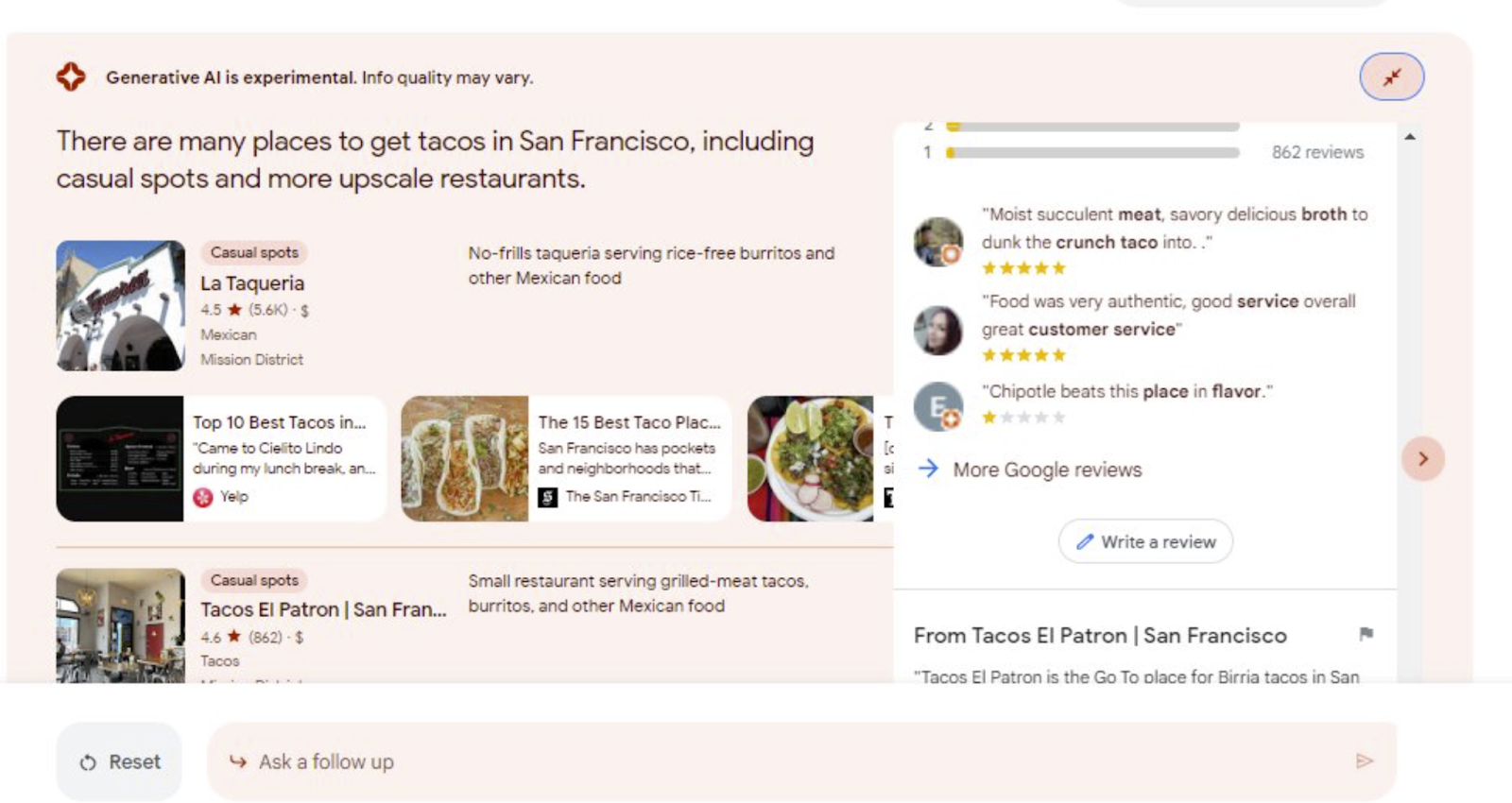
  • The interesting realization that once you are having a conversation, SGE remembers what you are talking about. In other words, if you search for “best tacos in san francisco” and then you follow up with something like “who has organic tacos?”, the bot still “knows” you are talking about San Francisco, even though you didn’t repeat the city name in your query. This is a quality of these chatty experiences that feels really novel to me.

  • An overall impression of this being even more of a closed loop/walled garden than the interfaces to which we’ve long been accustomed in local. Once inside this feature, you just stay inside it, which may be good for Google, but may not actually be best for users. Time will tell.

And as time is telling and you are waiting in line to get into SGE for your own look, I recommend reading:

Cool heads in the industry are refusing to give into the whole “SEO is dead thing” about AI, and I think local SEOs will be able to work with the SGE packs, should they roll out. My word to the wise local business owners out there: remember that not being robots may be your greatest asset. Even if automation brings customers to you via search/AI chat/SGE, polls consistently show that consumers shop locally for personalized service, and you can’t bot that.

2) Finalmente! A dedicated Google form for recovering missing reviews

Screenshot of Google's new review recovery form as shown in an article at NearMedia

Have you noticed an uptick in your Google Business Profile reviews disappearing since 2022? You’re not alone; experienced local SEOs like Mike Blumenthal have been reporting a high instance of legitimate review loss ever since Google switched to an AI-based review filter last year. The good news is, you can now follow along with Mike’s excellent tutorial for reporting missing reviews via a welcome new process.

Your workflow will start here and then continue through a series of steps that will hopefully result in your reviews being restored (no guarantees, of course!) As Mike points out, this development is an improvement, but the overall process is still rather onerous for business owners. I think AI-induced headaches should come with a bottle of AI-spirin for all users, especially when they involve reviews, due to the massive impact of this content on reputation, rankings and revenue.

3) Speaking of reviews, don’t acquire them via donations

Image of a sponsors page on a website for a festival

It’s always helpful when Google clarifies a grey area of their guidelines, and thanks to Joy Hawkins’ personal outreach, we now know that your local business should not ask for a review after giving a donation to a third party. In other words, if your grocery store donates $100 to the local no-kill animal shelter, Google says you must not ask them to “pay you back” with a review.

A much better idea is to view these philanthropic endeavors as a source of linked unstructured citations, of the kind picture above. It’s good business to be listed as a sponsor of local teams, events, and organizations, and it fits in very nicely with the “Authoritativeness” factor of Google’s E-E-A-T concept, with trusted local sites linking to and citing your company.

4) Video: the long and short of it

Screenshot of a tweet featuring a video in which animation causes a zooming in effect on a business storefront, turning a still shot into a video

Kudos to Andy Simpson for demoing this budget hack for using animation effects to turn local business photos into short videos. Videos are very hot in local right now, but the “short” part has been a cause of some recent puzzlement and parlaying.

Google’s guidelines for adding video to your GBPs state that your films should be 30 seconds long. However, experimentation by Darren Shaw indicates that it may actually be file size, not video length, which affects inclusion of your videos on your listings:

Darren Shaw's experimentation shows that he was able to add a video of more than 30 seconds in length by keeping the file size to 75 mb.

Note that, technically, videos over 30 seconds in length don’t meet the guidelines, but the worst thing that can happen to your business if you try for a longer length is that it won’t be approved. Could be worth a try, but safest best would be to film a 30-second version of your content, as well, just to be sure it has sticking power. Google definitely has its eye on video right now, and has launched YouTube shorts, which many see as a response to the TikTok phenomenon. Local businesses in competitive markets can easily film and upload to their GBPs dozens of aspects of their business premises, staff, inventory, community involvement and more!

5) Yes, that text could be from Google

Screenshot of Google texting a business owner to verify that their hours and open days are listed correctly.

Thanks to Molly Youngblood, we have the above screenshot of Google texting a business owner to verify some of their information, and Barry Schwartz lent a hand by confirming that text-based fact-checking communications are now, indeed, coming from Google. But please be careful with this. As Barry warns:

Google will never ask you to sign up for a service, make a payment, or provide sensitive personal information via calls or texts. Google will only text from phone numbers listed on this help page. Also if you want, you can opt-out by responding STOP to those messages (more on that here).”

6) Speaking of communications, how about chatting with a live agent?

Screenshot of Google Business Profile showing an option to 'chat with a live agent'

Joy Hawkins tweeted this capture of a Google Business Profile featuring a CTA to chat with a live agent and Joel Headley stepped up to explain that this catchy feature stems from Google BusinessMessages. Then, Aaron Weiche mentioned that if you’re using a third-party service like Leadferno to manage messaging, get in touch with them to coordinate making this appear on your listing. Any way you can be more accessible to your customers is worth investigating!

7) A mobile grid test packed with local results

Screenshot showing complex grid of local mobile results

This screenshot from a gentleman named Brandon (click to watch video capture) formed the basis of a blog post from Barry Schwartz in which he marveled at just how much local information is packed into this mobile grid display test. As we know, Google is always testing things and it’s honestly hard to know if you’ve seen a particular experiment before or if it’s truly new. This instance is certainly dense with local business results, to the point that I wonder how effectively users can navigate it. And, of course, I am really wondering where all this is headed if SGE rolls out to everyone’s phones.

8) Google Maps services button gets the spotlight

Screenshot showing services being shown before call buttons on some Google Maps listings

Allie Margeson has sharp eyes to have caught this slight but significant change in the ordering of CTA buttons on some maps listings, with the “services” button appearing to the left of the “call” button. When clicked on, that button can take your customers to a wealth of information about your business, if you’ve taken the time to provide it. Allie recommends:

  • Adding all your services with descriptions to your Google Business Profile

  • Adding any relevant predefined services Google suggests (remember, Joy Hawkins found these can impact rankings)

  • Adding all relevant categories to your listing so that you are offered as many predefined services as possible

  • Check back often to see if new services become available to you, or if any of your current ones have become outdated

Good advice!

9) A quick competitive analysis tip

The 'often searched together' section on a Google Business profile can list many of your competitors

There are many ways to suss out the businesses Google regards as your local competitors, including via the lengthy and thorough process of a formal audit, but for some very quick ideas, I think Mordy Oberstein’s tip is excellent.

If your Google Business Profile includes an “Often Searched Together” section, it’s inside information about what Google knows customers in your area are actually doing with search. If you click on this element, you will be taken to the local finder, with a “People also search for” heading (and you can see some debate in the Twitter thread over whether this is a re-branded People Also Asked segment):

when clicked on, the 'often searched together' feature goes to a local finder labeled 'people also search for'

Chances are, you should take a look at the businesses that come up in the format and study their marketing, SEO, and basic business operations, because you know your own customers are seeing them, too.

10) A bothersome Google Updates bug

Mike Blumenthal reports a bug relating to Google updates

In the real world, bugs are wonderful and support life on Earth in numerous ways and are never larger than your town, but in the Google world, a bug is no fun at all. Mike Blumenthal reported a bug in mid-May that caused listing owners to be unable to edit or remove their Google Updates (formerly known as Google Posts). This may have been confined to desktop devices because some respondents to his thread found a workaround in using their mobile phones to manage their updates. If you had trouble with a typo in a post that you couldn’t correct last month, try again. The bug appears to have been resolved.

And here’s hoping that Google again re-brands this useful feature with a little more thoughtfulness, because “updating” your “updates” is just a silly thing to have to say or contemplate. I don’t understand what the problem was with “posts”.

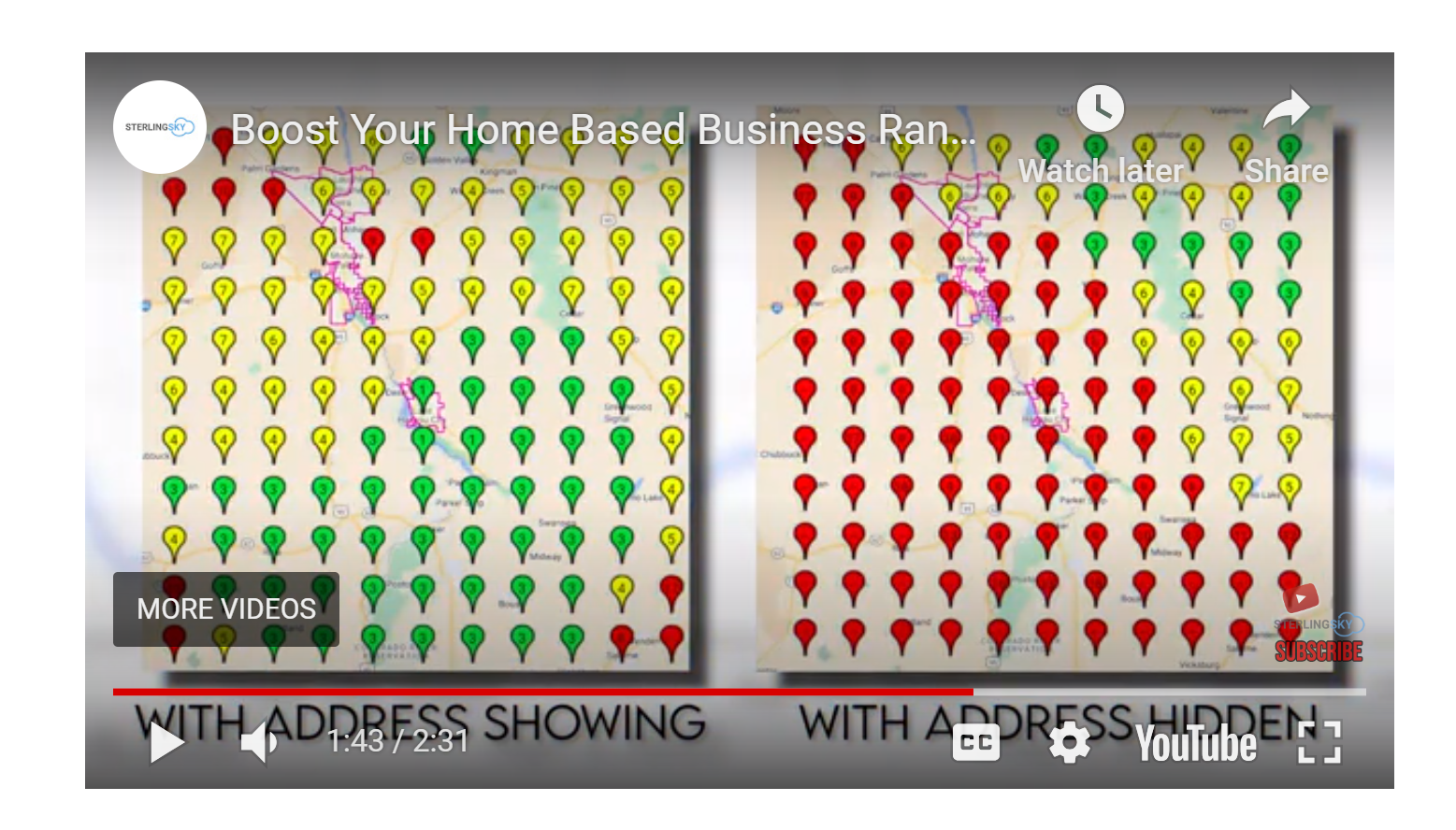
11) A confirmation that hiding your GBP address results in negative consequences

Screenshot of video showing side by side images of local pack rankings dropping as a result of hiding the GBP address

Anyone who has been reading my Moz column for any part of the past 12 years knows that I am a firm advocate of following the Guidelines for representing your business on Google when listing yourself in Google’s local product. Even when the guidelines don’t make good horse sense, I still advise sticking to them. But there is one instance of this in which Google makes it so very hard to go along with their thinking: the edict that home-based businesses should hide their addresses. Google says this of home-based service area business:

Guidelines instructing home-based service area businesses to hide their address on the GBP listings.

Watch this video and read this post to see how Joy Hawkins and her team at SterlingSky tested hiding the address for home-based businesses and confirmed that:

  • This resulted in a massive drop in local rankings

  • Which, of course, led to a significant drop in phone calls to the business

  • And it even made a local pack completely disappear until Joy’s agency added the address back in!

It’s long been speculated that compliance with Google’s ruling on this negatively impacts visibility, and this is doubtless why so many business owners list their addresses and hope not to be caught at it.

There is no good reason I can think of for Google to put home-based businesses at a disadvantage like this. I’d like to ask:

  1. Why should the plumber, the landscaper, the mobile auto repair specialist, the contractor, the mobile notary public, the therapist, the dog walker, and all the other small business professionals who are counted upon by whole communities be punished with lower rankings for adhering to Google’s guidelines?

  2. Why do these helpful businesses deserve less visibility and fewer phone calls if they operate from home instead of an office? This is a senseless bias on Google’s part.

  3. Where is the awareness from Google that the ongoing COVID-19 pandemic has caused a mass transition to working from home for safety’s sake? Why have the guidelines not been updated to reflect this world-changing reality that is very much still affecting both business owners and customers? This lack of currentness makes the guidelines feel as neglected as a GBP with a Christmas tree as its profile pic in July. Ignoring the real-world impacts of the pandemic doesn’t make them go away.

  4. How is it a better user experience for no local pack to show for queries if, as in Joy’s test, an address is hidden? How are towns better-resourced and better served by not being shown a list of local service providers?

  5. And, finally, what is the logic behind making any business hide its address in the first place? All of us have needed to hire an emergency plumber, locksmith, or towing service at some point, and we definitely want to see the addresses of the providers so that a) we can estimate how quickly the pros can get to us and b) we won’t be charged extra for them having to come a long way to our house or remote location. When we need help, we don’t care if the helper is coming from their living room or their office, but we do want to know exactly where they’re located so that we can make the most informed decision.

I’d urge Google to reconsider this section of their policy. It doesn’t match today’s reality of so many helpful folks working from home, and it just doesn’t feel right that compliance with the guidelines results in such negative consequences for both providers and customers. 

12) A local session with an adept

screenshot of a video uploaded to Twitter in which Darren Shaw performs a short local business audit

While this isn’t an update, per se, I want to invite you to spend eight minutes today watching Darren Shaw audit a Google Business Profile and website. If you’re just getting started with local search marketing, this short video will teach you a ton, and even if you’re more experienced, it’s a good thing to watch a recognized pro at work. As I mentioned to Darren:

Screenshot of Miriam Ellis celebrating seasoned local SEOs and Darren Shaw thanking her.

And thank you, Darren, and all of the local SEOs featured in today’s column, for the daily work you put in, sharing your findings with the community. Q2 has had some of the usual glitches and tests, but it also bears signs of significant potential change ahead. Let’s all keep learning together!

We hope you’re as excited as we are for August 7th and 8th to hurry up and get here. And again, if you haven’t grabbed your ticket yet and need help making a case we have a handy template to convince your boss!

Night Owl pricing is on through Jun 30th.

Register for MozCon

The MozCon 2023 Final Agenda Has Touched Down!

It’s hard to believe that this year’s MozCon is less than two months away, and we couldn’t be more excited to dive into the future of search from our brand new venue, the Seattle Convention Center’s Summit building.

On August 7 and 8, join Roger Mozbot at MozCon for insights and tactical presentations from industry leaders, plus the opportunity to connect and network with fellow attendees!

Tickets are already 90% sold out, but there’s still a little bit of time to snag your spot before they’re gone. Night Owl pricing is on until June 30, and tickets are just $999 for Moz subscribers. Can’t make the in-person event? Grab yourself a Livestream pass + video bundle for $449 or just the Livestream pass as a standalone for $199.

Save my spot at MozCon!

We previously shared our Speaker lineup sneak peek in December, the Initial Agenda drop in April, and our Community Speaker reveal in May, but today, we’re ready to share the full and complete Final Agenda*. With our speakers putting the final polish on their presentations, here’s a look at the two action-packed days we have planned. (*exact start times subject to change)

Sunday, August 6

12:00pm–4:00pm – Optional early registration & badge pick up

Arriving in Seattle early and want to get a jump on picking up your badge? Drop by registration to check in and pick up your badge.

Monday, August 7

7:30am – Breakfast & Registration

9:00am – Opening remarks + state of the Industry

Cheryl Draper

Moz’s own Senior Growth Marketing Manager will be kicking things off early on the first day with a warm welcome, laying out all the pertinent details of the conference and setting the stage for what’s to come over the two days of MozCon.

9:15am – Google’s Just Not That Into You: Intent Switches During Core Updates

Lily Ray

If your website has been negatively impacted by a Google core update, it is common to immediately assume that there is something wrong with your site. However, there are many other factors that could explain why rankings changed during a core update, and understanding these are key to improving performance. You’ll walk away from this session understanding how Google core updates work, how and why the results change, how to respond to being hit by an update, and how to future-proof your site.

9:45am – Why SEOs Need to Start Playing Offense Instead of Defense

Chris Long

In an industry overloaded with data, tools, algorithm changes, and a constantly evolving landscape, it’s tough to know what to prioritize. Often, this leads SEO initiatives and strategies to be more reactive instead of proactive. In this session, Chris will show you how to shift to an offensive SEO mindset. This will help you better prioritize key initiatives, get stakeholder buy-in, and navigate a successful long-term SEO strategy. You’ll leave this session understanding how to identify new markets to break into, leverage SEO data around key recommendations, utilize keyword segmentation to better inform your SEO strategy, and build a framework for setting up SEO experiments.

10:20am – A special announcement from Moz you’re not gonna want to miss!

10:25am – Morning networking break

10:40am – SEO Co-Conspirators: Navigating Complex Systems

Jackie Chu

SEOs have self-reported that the #1 challenge to their SEO program being successful is getting changes implemented. Additionally, we’re often faced with constantly having to prove the value of SEO as a channel. In this talk, Jackie will focus on how you can source and uncover allies, enlist your coworkers, and successfully navigate the political landscape to get your project prioritized.

11:10am – Search Data at Scale

Daniel Waisberg

Are you using Search data effectively and at scale? In this presentation, Google Search Advocate Daniel Waisberg will present the data available today, and demonstrate the best methods of using Search Console bulk exports for scaling your SEO efforts. After this talk, you’ll understand the challenges of using data to steer your strategy, and get the scoop on analyzing and visualizing this data to drive your product decisions!

11:45am – Community Speaker – Beyond the Written Word: Future-Proofing Your Content Strategy by Leveraging Multimedia Formats

Azeem Ahmad

In today’s rapidly changing digital world, marketers must go beyond just written content to engage with their target audience in the right way. Consumers, including marketers themselves, now expect content that is visually appealing, easily digestible, and interactive. If you want to ensure the longevity of your content strategy and also be more adaptable to the changing landscape digitally, you’ll need to leverage multimedia formats such as video, audio, and more. This talk will explore the benefits of incorporating these formats into your marketing strategy, including tips on how to create engaging content that resonates with your audience and boosts conversions/sales. By the end of this session, you’ll have a clear understanding of how to future-proof your content strategy and stay ahead of the competition.

12:00pm – Birds of a Feather lunch discussion tables

1:30pm – From Fear to Forward Motion: Navigating the Future of Analytics with Confidence

Brie E. Anderson

What the heck even is GA4 and why are you being forced to use it? Get ready to explore the rapidly changing landscape of analytics! In this talk, we will explore the future of analytics and provide a step-by-step guide to adjusting to the big changes that lie ahead. We will discuss how to move from fear and resistance to embracing the transformation that is already taking place. You will leave with a blueprint for success that will help you future-proof your analytics strategy and unlock new possibilities for growth and innovation.

2:00pm – Down the Mountain

Noah Learner

Struggling to find your place in SEO? Want to break through to the next level, but feel like you’ve hit the wall? Join Noah Learner on the journey “Down the Mountain”, as he shares his evergreen framework for optimizing your career in any market. This framework – built on craft, people, critical thinking skills, and synthesizing data – will help you now and in the future, as you look for what’s next. You’ll learn a repeatable process and specific skills that will help you accelerate your career and make you impossible to ignore.

2:30pm – The SERP Is Dead, Long Live the SERP

Tom Capper

SEOs have complained for many years now, that the SERP just isn’t what it used to be. We yearn for the simpler days of 10 blue links. But Google is changing for a reason, and SEOs have reason to be invested in its survival. Besides, not all SERP features are bad news. In this talk, Tom will look at Google’s direction and the strategic imperatives that are forcing its hand. You’ll walk away with a plan to unearth happiness (and organic revenue) in the brave new world.

3:05pm – Afternoon networking break

3:25pm – Headless SEO: I’m Sorry, But This Is Happening

Lidia Infante

Headless CMSes are on the rise, and headless SEO is quickly becoming an essential skill for SEOs. In this talk, Lidia will explain the concept of content modeling with RAL examples, which lies at the core of headless CMSes. By the end of this presentation, you will have a firm grasp of the limitations and advantages of headless SEO, and possess a checklist of 7 implementations you need to request from your development team.

4:00pm – Views on Views of Video SEO

Crystal Carter

Fifty-four percent of consumers report that they’d like to see more videos from brands, and video SERPs account for an average of 20% of untapped keyword opportunities. There’s never been a better time to improve your video SEO! From on-page embeds to SERP visibility, and even in your backlink profile, video is an unrivaled tool for adding value to your content and improving your website’s SEO outcomes. In this talk, Crystal explores what matters on the Google SERP, and what leads to success when optimizing the videos on your site.

4:30pm – The Evolution of Content & the Future of Our Industry

Ross Simmonds

Is it all over? Is the world as we knew it a wrap? With the rise of AI – is it realistic to assume that the world of SEO and content will stay the same? Or should we all start dusting off our resumes to try something new? In this presentation, Ross is going to share a blend of both the realities of how AI can be incorporated into our work (maybe to give us additional runway) and answer the question as to whether or not AI is actually coming for our jobs and what we can do to ensure that we’re ahead of the curve when it comes to using these tools, embracing the technology and finding edges amidst rapid change.

5:00pm – Day 1 Closing address

5:15pm–7:00pm – Welcome reception happy hour brought to you by Moz + Kickbox

Join us at the Summit private rooftop garden terrace. Meet with fellow attendees and speakers over light refreshments and snacks, music, and stunning views of the city skyline. We look forward to bringing our community together to kick off MozCon 2023. See you there!

Tuesday, August 8

7:30am – Breakfast & Registration

9:00am – Back to the Future: What Lessons From Marketing History Can Tell Us About the Future

Andi Jarvis

“Marketing has changed more in the last decade than at any time in history.” There’s a blog published that features a version of this line roughly every 0.5 seconds* – but does anyone stop to consider if it’s accurate? Andi will demonstrate how marketing and audiences aren’t really changing, and that the future of marketing is much the same as the past. Why is this important? Because people, not robots, sit at the heart of marketing. By the end of this talk, you’ll understand how you get your customers back to the center of what you do, and how that will turbocharge your marketing efforts. Strap yourself into the MozCon time machine for a journey Back to the Future. *Stats entirely made up… much like the results used in most content marketing efforts.

9:30am – Lower Your Sheilds: The Bord Are Here* (* Written By ChapGPT)

Dr. Pete Meyers

From ChatGPT to Bing’s Prometheus to Google’s Bard, AI (specifically, Large Language Models) is disrupting search as we know it. We can fight the inevitable, or we can put these tools to work. Learn where AI chat excels, where it fails (sometimes spectacularly), and how to use these tools to not only keep your SEO job but also level up your SEO career.

10:00am – How to Use Brand SEO to Future-Proof Your Online Visibility

Miracle Inameti-Archibong

With digital ad spending projected to reach $701 billion in 2023, generic CTR dropping by 12% between position 1 and 2, the increase in no-click searches (+60%), and the constant rolling out of updates, it’s more important than ever to build a sustainable online brand presence to algorithm-proof your traffic. This talk will explore how SEOs can contribute to brand building, and how it can help future-proof your online visibility.

10:35am – Morning networking break

10:55am – Build Better Backlinks for Local Brands

Amanda Jordan

As with everything in local SEO, backlinks are just a little different. What do local pack rankers typically have in common? To answer that question, we’ve collected backlink data across several home services businesses across the USA and categorized them. We’ll share our findings, and how you can build better backlinks for local clients! By the end of this session, you’ll be able to list the different types of backlinks local businesses typically have, identify which link types correlate with stronger rankings, and most importantly, how to apply this to your clients!

11:25am – Community Speaker – Rethink Your Industry Pages – They’re Not What You Think

Jason Dodge

B2B marketers, and SEOs alike, are all too quick to create industry-specific landing pages for every single vertical we serve. In reality, these pages have very little relevance to what your customers are actually searching for, or what it is that you actually do in that space – limiting the reach and missing out on potential customers who would benefit from your solutions. Are you ready to reimagine your entire industry vertical proposition? Jason will explain the ins and outs of industry pages, their role in content marketing, and – more importantly – how optimizing content around the pain points and direct needs of your customers is more relevant now in B2B marketing than ever before.

11:40am – Hiring the Perfect Agency: How to Avoid Getting Burned

Duane Brown

A 2022 Upwork study shows that 39% of the U.S. workforce freelances. Just think about how many more ad agencies exist today, as compared to 2019. You’d think that hiring would be easier with all of these options, but nothing could be further from the truth. Hiring is a valuable skill, and we are going to give you the skills to hire that next agency. By the end of this session, you’ll be able to identify agencies that are the best fit for your brand, effectively interview prospects, avoid pricing ambiguity and pitfalls, partake in productive onboarding, and look for meaningful results and metrics. Let’s get you the skills to hire better next time!

12:15pm – Birds of a Feather lunch discussion tables

1:45pm – Dominating TikTok, YouTube, Pinterest, and Amazon SERPs as Consumer Behavior Changes

Carrie Rose

As search volumes rapidly change and users use new platforms such as TikTok for search, how should SEOs respond? Carrie will share her process of dominating all SERPS – not just Google! Discover how SEO fits within the user journey, and the role content can play for both offsite and onsite content, generating links and search demand. You’ll learn how advertising and SEO overlap, and what we can learn from award-winning advertising as part of search strategies.

2:15pm – Entities Are the Past: Search Is Going Multidimensional

Tom Anthony

For years, “keywords” were everything in search, and then came the rise of ‘the entity’. Tom believes that the time of the entity will soon be over, and will explain how Deep Learning ‘latent spaces’ are highlighting that entities were 1-dimensional thinking. The future of search is going to be about context, and it isn’t far off. You’ll walk away from this session with a new technique that will replace keyword research so that you can prepare, and ideally, get ahead of the competition.

2:50pm – Mind the Gap: Bridging Generational Differences in SEO

Jes Scholz

To keep up with the ever-evolving needs of users, Google is transforming from being a search engine to an ecosystem of experiences that often reach people before they need to search. Discover, Google Lens, YouTube Shorts, and Bard are just a few examples of this shift towards richer, more engaging surfaces. By the end of this talk, you’ll be able to leverage these new visibility platforms to improve organic performance and future-proof your brand.

3:20pm – Afternoon networking break

3:40pm – Talk Title To Be Announced

Speaker To Be Announced

4:15pm – Talk Title To Be Announced

Wil Reynolds

5:00pm – Closing remarks: Farewell & thank You

7:00pm–10:00pm – MozCon bash at MoPOP brought to you by Moz + CopyPress

Karaoke: check! Photo booth: check! DJL check! Join us for one last hurrah as we take over MoPOP. You won’t want to miss our legendary closing night bash — we’ll have plenty of games, food, and fun as we mix and mingle, say “see ya soon” to friends new and old, and reminisce over our favorite lessons from the past 2 days.

See you there?

Chatting with speakers, connecting with peers and potential partners at a Birds of a Feather lunch table, absorbing all the knowledge for another fruitful year of marketing… we can’t wait to share it with you! Get your ticket now and we’ll see you in August!

We hope you’re as excited as we are for August 7th and 8th to hurry up and get here. And again, if you haven’t grabbed your ticket yet and need help making a case we have a handy template to convince your boss!

Night Owl pricing is on through Jun 30th.

Image starting that MozCon tickets are 90% sold out.

Register for MozCon

How to Create Kick-Ass Local Landing Pages Whiteboard Friday

Learn all about how to create kick-ass local landing pages in this Whiteboard Friday with Amanda Jordan. Discover the most popular features and get to know the dos and don’ts when creating local landing pages.

How to generate 8 million SEO test ideas using ChatGPT

Click on the whiteboard image above to open a high-resolution version in a new tab!

Video Transcription

Hi, I’m Amanda Jordan at RicketyRoo, and today I’m going to be talking about how to create kickass local landing pages. I talked about this topic at MozCon in 2022. I did some research on the top 50 pages in the U.S. and home services businesses that ranked on the first page, and then I reviewed those pages and analyzed the features that they were using on those pages to determine what makes a winning location landing page.

Most popular features of local landing pages

Most popular features of local landing pages

So the most popular features are listed here. Sixty-one percent of the home services businesses that ranked on the first page had reviews on their location landing pages. I think that’s pretty much a given now, even though only 61%, there is 39% who were not doing it. But that’s pretty much a given in my opinion that you should have reviews on that page, if for any other sake other than being able to use the structured data for it, for the conversion rate optimization, just providing users with a reason to trust you and believe that you’re good at your job.

So like just for any other reasons, that would be the basic reasons why you want to do that. Thirty-two percent had a unique value proposition, so something to set them apart from their competitors. I think that’s actually very low, and that should be something that really all businesses should be striving for is setting themselves apart. You don’t want to just be another site that’s saying, “Hey, you can give me money for my services.”

You would want them to know why they want to choose you, and that is something that you do in your unique value proposition. Only a quarter of them included any type of sale or a coupon, which is a huge missed opportunity. So if you’re seeing that your competitors aren’t offering a coupon or sale, that’s an opportunity for you to snag business from them. If they’re shopping around and going to multiple websites, if you’re the only one that is offering a coupon, they don’t know that you might be, I don’t know, 10% more expensive from your competitor until they call and get a quote.

So if you’re offering 15% off, you may actually snag a customer and only have to give them 5% off because they don’t know what your prices are compared to your competitor. So that is a good way to get more clients in and get more conversions. Then only 18% had awards or recognitions mentioned on the page. I think that’s a missed opportunity as well because those are trust signals. Those show people that they can trust your business, that you’re recognized in your industry, that you do good work.

So these are the features that I found on those businesses in the top 50 most populated cities in the United States. Where they ranked on the first page, these are the features they were using the most. There were some standouts where they had almost everything you could think of as far as features, and then there were others where they were getting lucky, like low competition. Their business has been around for a really long time, so they didn’t have to put in that much effort to rank well because everyone knew them and they’re almost like a fixture in their community.

So if you look for plumbing in that city, that’s just what’s going to show up.

Answer these questions when thinking about your pages

Answer these questions when thinking about your pages

So really, when you’re thinking about your location pages, you should be trying to answer these questions. I put them here because I think like a detective a lot of times when I review sites, and I like “True Crime” a lot, so I think about it as kind of putting together what am I looking for, almost like Clue.

You want to know what’s going on. Who did what, where, when, why, how? So when you look at your competitors, answer these questions, and when you’re thinking about your own location landing pages, answer these questions too. Who are you trying to reach out to? Who are you? What’s your business? What are you trying to offer them?

What are their concerns? Why should they choose you over competitors? When are you the best choice for them? Where can they contact you, and how can they contact you? All of these questions should be answered on every location landing page. If you’re not answering all these questions, then people are going to have to search around on your website to find those answers, or they’re just going to leave and go to a competitor who can more easily answer those questions.

If you think about it, this is a lot of what Google tries to answer in your Google Business profile as well. So you should be matching up not necessarily word for word what’s on it, but think about the features that Google is trying to show in their own tool and make sure that those features also exist on your location landing page.

To answer those questions, look at the data

To answer your questions, look at these kinds of data

So you want to answer these questions, and how you want to answer them, you want to use these types of data.

You want to use first-party data. So you know your customers. You’ve worked with them. You likely have a CRM that you use. You want to use that CRM to accumulate valuable data and use it on your pages. If you know that at certain times of the year certain issues exist for a certain amount of houses and you’re in home services, say the summer months, you already know in the summer months AC units are going to need maintenance and repair.

Put the percentage of homes that you serve with those issues during those months on that page in that area. That’s automatically adding unique content that no one else has and that Google is going to see too as unique content, that’s data-driven content, that’s interesting content. So not only is it something that is unique to your page and not more generic than content that people are used to seeing, but it’s also something that may be interesting enough that people will share with others, that may be used for other reasons as a source for other things as well.

Third-party data. So you want to use statistics, FAQs, things that you can find around the internet that you know is true, that is relevant to your business and is relevant to that specific location so that you can be as unique as possible within your content without being duplicative at all. Then user- generated content.

Your users should be leaving you reviews. If they’re not leaving you reviews, you should be asking them to leave reviews. So that’s one of the things that you can do. Comment sections on websites. There are lots of clients that I’ve had, especially in e-commerce, where they have e-commerce and local together, where they have a comment section where people can talk about their experiences, not like in a review place, would ask questions, give feedback on some things, things like that, communicate with each other, almost like a forum sometimes too.

That’s a ton of user-generated content that’s right there that you didn’t have to write, that’s about your products and services in your business. It will show up in Google as well. So it’s more usable content that you could have someone else produce for you.

Dos and don’ts of creating local landing pages

Dos and don'ts of creating local landing pages

Here are my do’s and don’ts of creating a location landing page. I’m going to start with the don’ts because I see these issues frequently.

Even when businesses have the best intention, when they’ve hired an SEO, when they’ve hired a marketing director, I see that they run into these issues a lot, and they’re hard to overcome. Not to belittle, they are difficult. Duplicate content is a huge issue for location landing pages. Thin and generic content are huge issues. But if you look at your data sources that you could actually pull from easily with scalability, so you don’t have to worry about someone having to go through and write about unclogging a toilet 200 different ways.

You can pull your data about how many house calls you’ve gotten about unclogging toilets seasonally, by area, by ZIP code. Use that data on that page instead. That’s so much more interesting than saying like, “Hey, if you have a clogged toilet, come call us.” Everyone knows that you want them to do that. You can make that page more interesting.

You could have reviews about people who called you for specific types of issues on that page as well to facilitate that uniqueness and personalization for the user. So really the duplicate content and the thin and generic content issues are solved if you use first-party, third-party, and user-generated content. They will solve those issues for you, and it doesn’t have to be something extremely labor intensive.

A lot of this data can be pulled from Google Sheets into your website. Don’t treat it like a blog. That is another issue I see very commonly is that a business will say, “We need a ton of content to get people to come to our location landing page. We want this page to rank really well.” But they forget that it’s also about bringing someone in and making them want to make a decision to work with you on that one page.

It’s the landing page, so they shouldn’t have to go anywhere else to determine if they want to work with you or not. By answering these questions, you give them all the information they need to decide that they want to work with you, and you want to do it in a way that’s engaging and interesting. So you don’t want to have a huge block of text with nothing breaking it up. You want to include any sales or coupons, awards, reviews, and unique value propositions throughout that content to break it up and give them multiple opportunities to decide that they’ve read enough, they’ve heard enough, and they’re ready to work with you.

So these are my steps and recommendations for creating a kickass local landing page. If you want to discuss more, you can find me on Twitter @amandatjordan.

Video transcription by Speechpad.com

We hope you’re as excited as we are for August 7th and 8th to hurry up and get here. And again, if you haven’t grabbed your ticket yet and need help making a case we have a handy template to convince your boss!

Register for MozCon

MozCon Field Guide: Exploring Summertime Seattle

MozCon 2023 is fast approaching (taking place August 7 & 8), and we here at Moz are so excited to see all the IRL and virtual attendees! As the event draws closer, we think it’s a great time to remind folks of everything you can do while visiting the Emerald City.

Nestled up in the corner of Washington state, surrounded by forests, mountains, and the Puget Sound, Seattle is the largest city in the Pacific Northwest (PNW). It is home to industry giants like Amazon, Microsoft, Starbucks, and Boeing and is the birthplace of Grunge music (think Nirvana, Soundgarden, and Pearl Jam — all from Seattle).

Whether you’re traveling from near or far, we’ve compiled a list of some of the amazingly fun, educational, and sometimes weird activities around the city. And if you haven’t bought your tickets yet, don’t worry! It’s not too late. Head on over to the MozCon hub to explore purchase options. Night Owl savings are available through June 30!

For the sightseers

If this is your first time visiting Seattle, or if you love more traditional “tourist” attractions, these stops should definitely be on your list.

The Space Needle

Often synonymous with Seattle, you can’t find a photo or piece of video footage of the Seattle skyline without this iconic landmark included. Originally built for the 1962 World’s Fair (the inspiration for this year’s MozCon theme), the Space Needle now operates daily for visitors to take in a 360º view of the city. It is also home to the world’s first rotating glass floor.

image of Seattle skyline
Photo by Jared Lung

Columbia Center Tower

The Sky View Observatory of the Columbia Center is located on the 73rd floor of the “tallest public viewing area in the Pacific Northwest.” You can take in views of everything from Mt. Rainier to Bellevue from the viewing area and then grab a snack at the café.

Pike Place Market

This market is quintessential Seattle. Located near the downtown waterfront and founded in 1907, Pike Place is a must-see stop. It features local businesses of all kinds, including the infamous flying fish of the Pike Place Fish Market (featured in the opening credits of Real World: Seattle) and the first Starbucks. And for those with more time to explore, below the stalls of the street level is a maze of brick-and-mortar stores like Golden Age Collectibles (the world’s oldest comic book shop).

Image of Seattle's Pike Place Market
Photo by Farid Briones

Kerry Park

Located in the Queen Anne neighborhood of Seattle, Kerry Park is the go-to place for majestic views of the city and Mt. Rainier. Commonly used for shots in TV and film that establish Seattle as the location, it’s a great place to catch the sunrise or sunset.

The Seattle Great Wheel

At 60 meters tall, this ferris wheel is the largest of its kind on the west coast. And if you’re scared of heights (like me!), it’s still a great site to see. Especially Friday through Saturday night when they light it up with a fun light show!

For the lovers of learning

Seattle is home to a plethora of places to help expand your knowledge! Whether you’re into art, books, or history, there is something for everyone.

SAM

The Seattle Art Museum features art from around the world with both ongoing and featured exhibits. The featured exhibit for August will be Amoako Boafo: Soul of Black Folks, which officially opens on July 13. If you’re planning a visit to SAM, be sure to keep in mind that they are closed on Mondays and Tuesdays.

Seattle Asian Art Museum

Located at Volunteer Park in the Capitol Hill neighborhood of Seattle, the Seattle Asian Art Museum is another location of SAM. The upcoming Renegade Edo and Paris: Japanese Prints and Toulouse-Lautrec exhibit officially opens on July 21. This museum is open Friday through Sunday.

Northwest African American Museum

Self-described as “… an anti-racist, pro-equity, affirming gathering place of hope, help, and healing for the entire Northwest region that is building intergenerational cultural wealth,” the Northwest African American Museum is open Thursday through Sunday. Be sure to check out the Freedom of Expression exhibit on display until September 3.

Museum of Flight

Seattle has a rich aerospace history, and you can learn all about it at the Museum of Flight. This museum is larger than life, featuring exhibits about space and air travel which include real planes (and a space shuttle full fuselage trainer!).

Image of airplanes on display at the Seattle Museum of Flight
Photo by DreamArtist

MoPop

Located below the Space Needle, the Museum of Pop Culture, aka MoPop, will be the location of this year’s MozCon Closing Party. This museum is such a fun experience! It features exhibits about music, science fiction, indie games, and the world of fantasy. These exhibits are filled with relics, props, costumes, and more from your favorite films and TV shows. It is a must-see for any pop culture fan! You can even make your own music in the Sound Lab. And guess what? You’ll get to explore some of these exhibits at the after-party!

MOHAI

The Museum of History and Industry is located on the edge of Lake Union, and features exhibits all about Seattle’s history.

University of Washington

Seattle is home to the University of Washington, which has a beautiful campus ready to explore. Check out Drumheller Fountain, the quad, and Suzzallo Library before heading over to the Burke Museum of Natural History and Culture or Frye Art Museum.

Seattle Central Library

The stunning Seattle Central Library is located in the middle of downtown Seattle. The glass building was designed by Dutch architect Rem Koolhaas and features art throughout – a must-see for any book lover!

Image of the Seattle Central Library
Photo by Edward Palm

For the foodies

Seattle and its surrounding areas are chock full of amazing restaurants, cafés, breweries, wineries, and more.

Food

No matter what you’re craving, there’s a restaurant for you somewhere in Seattle. If you’re looking for a place to start, check out Seattle Met’s 100 Best Restaurants list. Some personal recommendations:Rocco’s Pizza, Cactus (Southwest), and Barrio (Mexican), Mighty O Donuts (Vegan & delicious!), and Dick’s Drive-In (a Seattle staple). If you’re looking for ideas of where to eat while at the conference, be sure to ask a Mozzer!

Coffee

Although Seattle is home to Starbucks headquarters, there are tons of independent and locally owned coffee spots to check out. Some include Fuel Coffee, Caffe Ladro, Cherry Street Coffee House, and Herkimer Coffee. Looking for more suggestions? Check out Eater’s list of Essential Coffee Shops.

If you’re interested in learning about the science and history of coffee and brewing, Seattle has you covered! Check out the Coffee Chemistry event at the Starbucks Reserve Roastery in Capitol Hill. They also offer various tasting events if you’re looking to try something new.

Breweries

Breweries are abundant in this area. And whether you’re looking to do a tasting flight or just grab a pint, the possibilities are endless. Right downtown, you have the Pike Brewing Company, and just up on Capitol Hill you have Optimism Brewing Company. If you’re able to venture beyond downtown, you have options like Reuben’s Brews and Fremont Brewing. More into cider? Seattle Cider Company and The Woods Tasting Room has you covered.

For the outdoor adventurers

When people think of the PNW, they often think of the great outdoors. And for those who enjoy spending time outside, we sure do have a lot of opportunities to soak up the sun! There are lots of hiking and walking trails around Seattle, including the Washington Park Arboretum (which also features a Japanese garden!).

If you prefer the water, you can rent paddle boards and kayaks to explore Lake Union and Lake Washington. Or, if you’re planning on attending MozCon in a larger group, you may want to think about renting a small electric boat to tool around in.

Have a picnic overlooking the water at Gas Works Park – featured in the iconic paintball scene from the film 10 Things I Hate About You.

Image of the Seattle Gas Works Park
Photo by Fernando Reyes

If you’re looking for places to explore that offer an outdoor experience, be sure to check out the Chihuly Garden and Glass at the Seattle Center or the Olympic Sculpture Park. Or take a stroll near the Ballard Locks to see one of the busiest lock systems in the country. You can also spend some time at their botanical garden and see the fish ladder. Pro tip! Wondering how the locks work? You can learn all about it at MOHAI!

Image of the Chihuly Garden and Glass museum in Seattle
Photo by Chris F

For the sports fans

Want to catch a game in a different city? Seattle is home to plenty of professional sports teams!

Baseball

T-Mobile Park is home to the Seattle Mariners. They’ll be in town playing the San Diego Padres and the Baltimore Orioles.

Soccer

OL Reign (Seattle’s Women’s Soccer team) will be playing Portland Thorns FC the Sunday before MozCon if you’d like to catch a match. They will be playing at Lumen Field, which is where Seattle Sounders FC (men’s soccer) and the Seattle Seahawks (football) also play.

Basketball

The Seattle Storm will be home at Climate Pledge Arena to play the Atlanta Dream on August 10 in case you want to check out the four-time WNBA Champions.

Football

Preseason will have started just in time for MozCon! The Seattle Seahawks will be playing the Minnesota Vikings on August 10 if you’re looking to root your heart out.

For the pop culture aficionados

If you’re into pop culture and are looking for some interesting stops to add to your Seattle tour list, we’ve got a few ideas for you.

Jimi Hendrix Statue

Although its real name is The Electric Lady Studio Guitar, it’s fondly referred to as the Jimi Hendrix Statue, and you can check it out in the Capitol Hill neighborhood on the corner of Pine and Broadway.

Fremont Troll

This infamous statue is located under the George Washington Memorial Bridge in the Fremont neighborhood of Seattle. It’s been featured in films like 10 Things I Hate About You and the TV show Once Upon a Time.

Image of the Fremont Troll in Seattle
Fremont Troll. (2023, May 30). In Wikipedia.

Bruce Lee’s resting place

If you’re a martial arts fan (or a fan of The Crow), you can pay tribute to Bruce Lee and his son Brandon in Volunteer Park.

Kurt Cobain’s bench

Are you a Nirvana fan? Then be sure to add Viretta Park to your list of places to visit. This park is near the home of Kurt Cobain, and although you can’t see his house, there is a bench there that has become a memorial to the musician and is covered in fan messages.

KEXP Gathering Space

KEXP is a beloved non-profit radio station here in Seattle. You can stream them anywhere in the world through their app (and I highly recommend you check them out – they have amazing themed shows each night of the week). They have a public gathering space in Seattle Center which features a café, record shop, and a window into their studio. It’s a great place to relax and have a cup of coffee.

SIFF Cinema

Movie buff? Seattle is home to one of the largest film festivals in the world – Seattle International Film Festival (SIFF). Although the festival won’t be at the same time as MozCon, they offer year-round showings of movies from around the world. If you’re looking to check out a unique film that you may not get to see on the big screen elsewhere, check out the showtimes of the SIFF Cinema Uptown Theater or SIFF Cinema Egyptian Theater.

For the eccentric explorers

We can’t wrap up this list without including some of the outside-the-box activities and locales. So here are a few things to check out if you’re looking for something outside the standard fare.

Gum Wall

Although technically part of Pike Place Market, this attraction deserves its own entry on our list. The Seattle Gum Wall is exactly what it sounds like – a wall of gum. People come from all over to stick their gum to this brick wall hidden down an alley of the market. Fun (or maybe gross?) fact: the wall has only been cleaned off twice in its history – in 2015 and 2018. The cleaning occurred to help preserve the wall itself.

Fremont neighborhood

We’ve mentioned a few places in Fremont already (the Fremont Troll and Fremont Brewing Company) but if you have time to explore this neighborhood more fully, it is a fun and quirky area that doesn’t disappoint. Not only is it home to lots of fun shops and restaurants, but also a statue of Lenin, the Center of the Universe sign, a rocket, and dinosaur topiaries. Be sure to take a walk by the Waiting for the Interurban statue, too. It’s tradition to dress up the figures for different occasions and holidays.

Image of a rocket sculpture in Seattle
Photo by Meghan Pahinui

Underground Seattle Tour

Back in 1889, a fire destroyed a large section of Seattle’s downtown. The citizens of the city opted to rebuild – on top of the existing city! Now there is a network of buildings and tunnels below present-day Seattle from the original city. You can take tours of Underground Seattle in Pioneer Square.

Seattle Pinball Museum

Like pinball? Feeling nostalgic? Check out the Seattle Pinball Museum — and bring some quarters!

Hat n’ Boots

Hat n’ Boots is a set of statues in Oxbow Park that include a 44-foot wide cowboy hat and a pair of 22-foot tall cowboy boots.

Image of two large cowboy boot statues at Oxbow Park
Photo by Meghan Pahinui

Photo by Meghan Pahinui

Final Thoughts

Whether you’re from the Seattle area or you’re coming in from out of town (or country!) we hope you discovered some fun ideas to bookend your MozCon adventure. If you haven’t purchased your tickets just yet, be sure to check out soon so you don’t miss out. And if you’re having trouble convincing your boss (or yourself) to send you to the beautiful Pacific Northwest, check out our Convince Your Boss blog post and initial agenda to learn even more about the event. Hope to see you in August!

We hope you’re as excited as we are for August 7th and 8th to hurry up and get here. And again, if you haven’t grabbed your ticket yet and need help making a case we have a handy template to convince your boss!

Register for MozCon

How and Why You Should Create Informational Content with POVs

Informational SEO content, by itself, only drives traffic.

It’s the ideas you put inside that determine whether it’ll drive anything else besides that (say, conversions, revenue, etc.).

But unless you’re a media outlet where the goal is to get views and clicks for ads, you don’t just want traffic.

You want your content to persuade your readers to do something — whether it’s to sign up for a product trial, buy your product, or contact you for a consultation.

That’s where points of view (POVs) come in. We’ll go into more detail about how POVs help your informational content drive sales, but first, let’s define what they mean and see an example.

Note: informational content is simply content you create to inform your readers about something. It doesn’t necessarily contain an opinion, call to action, or a sales pitch, just helpful information about a certain topic or object.

What’s a POV? And what does it look like?

As the term implies, a POV is your unique perspective or view about a topic. It’s how you see a particular concept — and it’s often formed by your experience or observations (or both).

A good example of a POV is something Kick Point’s president Dana DiTomaso did with a recent Whiteboard Friday, titled: “GA4 Audiences: Not Just for Ads!”

Right within the introduction, Dana shared her perspective (POV) on one of the features she thinks people weren’t using as much as they should:

Screenshot of text from Dana DiTomaso's Whiteboard Friday blog post

Other articles on the same topic might be preaching other ideas, but Dana’s POV is that Google Analytics 4’s Audiences are more capable than just using them for ads.

And throughout the article, she continued sharing her unique perspectives on every point she raised in the article and video.

I’ll share why POVs like this are super important in the next section, but what Dana did with that piece is an example of what a POV in an informational content piece looks like.

Put another way, a POV is what you think as a person or as an organization about any given topic. It represents YOU. When asked, “What are your thoughts on {insert topic}?” Your response is your POV, and it is unique to you and your brand.

But why are POVs relevant for creating informational content?

There are probably many other reasons to use POVs in informational SEO content, but these five stand out:

Reason 1: Form deeper connections with search visitors

By providing your point of view on a topic, you’re offering your audience a glimpse into your thoughts, values, and viewpoints. You’re sharing a piece of yourself.

You’ll often need to dig into your personal experiences, thoughts, or even the experiences of other people and share your opinion on the topic.

As your audience consumes your “POV-driven” content, they’ll feel as if they’re getting to know you. And that, right there, is the connection you want to create — because people often prefer buying from people they know.

A good example of content forming a connection with the reader is the Moz piece I shared earlier by Dana. Another one is an article by ConvertKit on “How (and why) to build your first email marketing funnel.”

Screenshot of text from an article by ConvertKit

It immediately starts with the writer (Kayla Hollatz) sharing her experience about when she first heard the term “email funnel.”

This intro immediately shows the writer’s POV or viewpoint: email funnel is easy; doesn’t require an MBA to understand or use.

It eases the reader’s mind into the piece and encourages them to keep reading. And the more they do that, the better your chances of them taking the action you want them to take.

Reason 2: Become the go-to for “serial searchers”

Ever met people who have a strong habit of googling for answers to every question they have? (Hint: I’m one of them)

I call them (well, us) “serial searchers.” Once a question pops into our heads, it doesn’t take us too long to plug it into a search engine for answers.

And as we do that, we’d find that there are certain brands or publishers in specific industries/niches that often deliver the answers that:

  • aren’t fluff,

  • have been written by subject matter experts, and

  • actually solve our problem.

Over time, we recognize these brands as “thought leaders,” and they’re often going to keep getting our clicks when we see them in the SERPs (search engine result pages).

But I wanted to see if this is just me or if other search engine users have similar habits of recognizing certain brands as “go-to” sources for answers.

So I asked my LinkedIn connections if they typically click results from certain brands more than others. The result:

Screenshot of Victor Ijidola polling their LinkedIn audience on search engine usage

Apparently, 80% of search engine users in my network tend to recognize certain trusted brands as the go-to source for information or answers.

The bottom line here is, you want to be that website — or better yet, THAT AUTHOR — for your audience. And sharing unique and helpful POVs in your SEO content is one effective way to do that. And this is even more important now that Google rewards Experience, Expertise, Authoritativeness, and Trustworthiness (E-E-A-T) in its search algorithm.

Reason 3: Hold attention for longer

If you share POVs that are helpful and unique, you’ll get readers excited about your content and make them more likely to stay on your page longer.

One time, I wrote an article featuring a couple of B2B marketers.

I asked them how long it typically took them to determine whether they’ll read an entire content piece. Here are some of their responses:

Screenshot stating that the person takes 5 seconds to determine if they will read an entire piece of content
Screenshot stating that the person knows within 10 sentences if they will continue reading a piece of content

In essence, they’re saying: It takes only a few seconds to decide whether a content piece, likely to consume 10 minutes of our time, is worth our attention.

If your POV is strong enough, chances are high they’ll wait. They’ll read your headline and then your intro. So if your POV resonates with them, they’ll keep reading.

Reason 4: Drive more conversions

Think about this for a second: Imagine you’re selling CRM software. A potential customer who doesn’t even know they need a CRM tool goes to Google and searches for “how to manage customer relationships.”

Your content is on the first page, so they click it. Once they’re in, the first line reads, “Customer relationship management isn’t about customer relationships. It’s about driving more revenue and conversions.”

Right there and there, you’ve introduced a POV that’ll likely pique their interest. Now, they’re in a “tell me more” kind of mode.

And if you play your cards right (more on this in a bit) and convince them that a good customer relationship management tool will grow their revenue, they can get inclined to sign up for your product.

Reason 5: Become a socially relevant brand

SEO content (informational or not) is usually not designed to be shared on social media or other platforms. Marketers who create this type of content are often only looking to get organic traffic from search engines.

And that often results in creating content that’s not engaging enough to make people want to click and share with friends in the industry (or content that doesn’t help your brand be socially relevant).

But if you’re creating content with specific POVs, you are likely to build a social brand — aka a brand people want to talk about and share on social media. An exemplary demonstration of this is the approach revenue intelligence platform Gong uses with their blog content.

They’re almost always creating informational content that’s both search engine friendly and engaging enough for social platforms. For instance, their blog post on Value Selling is crushing it in the SERPs as well as on social media.

When they shared the content on LinkedIn, it garnered over 180 likes, seven comments, and 10 reposts (which is huge on LinkedIn).

Screenshot of a LinkedIn post by the company Gong

Meanwhile, it’s ranking on search engine results pages (SERPS) for 25 keywords, meaning it’s organically driving search traffic:

Screenshot showing the number of keywords Gong ranks for using Moz Pro tools

This is happening because they’re not just cranking out SEO content; they’re creating search-friendly content with POVs that help them build a brand that’s socially relevant.

Bottom line: creating informational SEO content doesn’t mean you can’t also create content with a point of view and personality — in fact, it’s often better to do so.

How to create POV-driven informational content

Here are some of my best tips for creating POV-driven content:

1) Find relevant product-related topics

There are lots of topics swirling around in your industry, but you don’t need all of them.

Instead, you want to pick the ones that are most closely related to your product; those are the ones that’ll attract your target customers.

Once you find them, you’ll need to narrow down your POVs on each of them.

But before that, here’s how to find your topics in the first place:

Plug in your main product-related topic or keyword into Moz Keyword Explorer and it’ll give you a list of related topics.

For instance, if you’re a B2B software company selling CRM software for real estate businesses, a major topic for your business would be “real estate CRM.”

Plug that into the tool and it’ll return a list of keywords and topics you can use in your content.

A list of keywords using Moz Pro, relating to 'real estate CRM'

Your primary job here is to be brutally honest with yourself about which of these related topics would:

  1. be the most interesting for your audience,

  2. give you an opportunity to share your POVs, and

  3. present opportunities to drive sales for your business.

For instance, as a CRM software brand for real estate vendors, you’ll need to ignore keywords like “real estate agents near me,” and focus on topics related to CRM software like “CRM for real estate agents.”

Resist the temptation to select any topic just because it has a high search volume or a low level of competition. Put your focus on topics that’ll interest your audience and bring value (leads, revenue, etc.) to your business.

Next, narrow down your POVs on each topic you pick.

2) Identify your POVs on selected topics/keywords

Once you have your topics and keywords selected, identify your distinct point of view on each one.

Nothing too complex here, just your true position on each topic that you can defend.

And you can make this POV-identification process easy by simply asking, “What do I, or we as a business, think about {topic}?”

For example, what does a brand like Drift think about AI marketing — or the role of AI in marketing? Here’s what their POV looks like:

creenshot of an article about AI marketing by the company Drift

It’s simple and to the point.

Having a POV doesn’t always mean having big, grandeur ideas to share. Sometimes it’s simple and represents what you truly think about a topic — based on your experience and observations.

That’s the crux of having a POV.

It should represent you and your brand. It shouldn’t be something you just hand off to interns or inexperienced content creators to figure out.

It should be something that gets shaped by your expertise, experience, and values. That’s what your audience will connect with. They’ll connect with you and your ideas.

3) Introduce unbiased, contrasting approaches

First, what are “contrasting approaches?”

It’s simply the practice of introducing different POVs or methods to a problem.

Done well, contrasting approaches help to showcase one important element: your credibility. It tells the reader, “I’m placing all the cards on the table. Make your choice.” And they love it; 72% of customers — from a Gartner survey — said they prefer completing their purchase without the help of sellers.

They want to decide on their own without being told what to do. And introducing contrasting approaches, and genuinely highlighting the pros and cons of each, helps them do that.

Drip comes to mind here. They created a series of articles on Drip vs. other email marketing platforms, and they’re decently unbiased. This is what Drip vs. MailChimp looks like, for instance:

Screenshot comparing the differences between Drip and MailChimp

Buyers often appreciate seeing different sides to an issue like this without feeling as though you’re trying to manipulate them, so Drip’s execution was on-point here.

With contrasting approaches like this, you get to demonstrate your knowledge and authority on the topic, while also inviting your readers to think critically and compare their own opinions with yours.

Important note: It’s important to truthfully provide both sides of an argument — not just the one that supports your POV. But of course, ‌it’s okay to be a bit biased here and say you prefer your product over others — but genuinely explain why.

4) Back your POVs with recent data & case studies

It’s not enough to just state your opinions and perspectives on a topic. You need to support them with credible and relevant evidence that shows why your POVs are valid and valuable.

One of the best ways to do that is to use recent data and/or case studies that reinforce your points and make them believable.

For example, if you’re writing about how to optimize your website for SEO, you can use data from Google Analytics or Moz to show how your strategies have improved your traffic and rankings.

When you back points or claims with data like this, you eliminate objections and make your content more believable. And the more people believe your POVs, the more likely they are to trust you and the strategies, products, or services you offer.

5) Infuse your POVs into all parts of your content

All parts of your content here means: the headline, introduction, body, and conclusion.

Make sure to weave POVs all throughout your content — from start to finish.

And this simply means instead of just stating facts and figures, share your thoughts and experience for every point you raise.

Remember my point earlier about how sharing POVs means sharing a part of yourself with your audience — i.e. your own thoughts and views?

When you infuse POVs, you’re doing just that, and it’s an effective way to build a strong connection with your audience.

POVs aren’t just opinions

They’re informed opinions based on data, research, experience, or insights.

They show that you know what you’re talking about and that you have something valuable to offer. They also help you stand out from the crowd and differentiate yourself from your competitors.

For example, if you’re writing a blog post about the best SEO tools for beginners, you could share your POV on why Moz is better than its competitors — from your real-life experience.

By sharing your POV, you’re not just providing information. You’re providing value. You’re showing your readers that you understand their problems and you have a solution for them.

Sharing POVs inside informational SEO content can help to drive conversions because it builds trust and rapport with your audience. It also shows that you’re confident and authoritative in your niche. And it makes your content more interesting and memorable.

So next time you write SEO content, don’t be afraid to share your POV. It could make a big difference in your results.

Crie um site como este com o WordPress.com
Comece agora