How to Align Your Blog with Your Organic Search Conversion Funnel

Business blogging is an interesting concept. Many businesses have a blog, and yet, in most cases, there isn’t much planning going into how those blogs fit into larger business goals. Someone on the team is just assigned to publish content regularly, and that’s what they do.

A business blog is usually an island within a company: There’s likely, not much measuring, so no one has any idea if it is generating any traffic, sales, or rankings.

And yet, despite a lack of planning or measuring, there may be some good traffic coming.

Blogging is a good way to achieve “aссidental rankings” (those you didn’t necessarily plan for) and discover more search-driven sales channels. But many business owners or marketing managers have no idea what their blogs are ranking for. Consequently, there’s no buying journey set up for someone who lands on a blog post.

Clicks may come, but a blog remains an island. So, how can you include your blog in your overall marketing strategy to convert those clicks?

Step 1: Identify your blog’s current rankings that may bring sales

In other words, let’s see if there’s anything to worry about in the first place. Normally, the good old 20/80 rule works for blogs as well: About 20% of your content will be bringing 80% of your traffic. So, you need to know what 20% of your blog content actually does bring traffic.

Here’s a quick way to do that in Google’s Search Console:

  • Navigate Performance > Create a filter to see all the pages that contain “blog” (or whatever domain or subdomain you have your blog at) and click on the “Pages” tab.

  • The list is going to be sorted by the number of clicks your blog is driving.

Don’t forget to use Moz Pro’s rank tracker to set up position monitoring of those pages that are driving organic traffic.

Step 2: Plan your buying journeys from your blog

Make sure your blog makes it clear that this is a business blog and you are selling something. Define the major conversion funnels for your readers to follow.

At the very least, there should be a site-wide call to action (CTA) inviting readers to check your product or products, but the best idea is to create contextual CTAs and lead generation forms, which could better align with the searchers’ intent.

Hubspot is a great example of contextual CTAs that differ in each article and engage readers by providing “upgrades” to the article content:

There are many more content-based B2B lead generation strategies, but contextual CTAs work in e-commerce and retail as well.

HomeDepot is another prime example of including contextual CTAs (and automating them). They always show related products right next to each of their guides. Not only are these products actually helpful for following the tutorial and solving the searcher’s problem, they also create the right expectation that this content has a business behind it:

Look at your blog and open any individual article. Do you offer readers ways from that blog to follow the sales funnel? You may also want to set up a heat-map and button click tracking to better understand what your blog readers interact with on your blog post.

Step 3: Revive lost rankings

An important reminder: Blogs inevitably lose rankings.

The essence of any blog is that the more content you add, the further your older content is moving down the archive, away from the home page. And gradually, but inevitably, that content is going to lose rankings.

Thus, checking your blog’s traffic and rankings should be done regularly because blogs tend to lose rankings over time. You can do that using the same tools. Search Console has a “Compare” option allowing you to see pages losing clicks…

Click the “Click difference” header twice to sort by pages that lost the most clicks. You can only go as far as 16 months back, though.

And again, once you set up tracking, the Moz Pro rank tracker will tell you exactly which keywords are losing rankings. You can compare your current positions to what you had when we first started recording any particular keyword.

So now that you have a list of articles that are losing rankings, what to do with those?

Is this something that can be saved?

First of all, figure out if this is something worth saving. There will always be rankings that you can just let go of. These include old news or press releases, articles that stand no chance of converting readers into buyers, expired product reviews or listicles, etc.

Update the content

If it looks like a page that is ranked for something with transactional potential, think about whether you should update that content to align it better to those keywords as well as relevant contextual CTAs. Maybe there’s a new video you created after writing that article, so now you can add it there.

Also, study your organic competitors to see where they might be better. You can use IMN’s Side-by-Side Tool to see the content of pages that gained rankings that you lost. The tool will compare various important on-page elements like titles, subheadings, keyword usage, etc. This will give you lots of clues about what needs to be expanded, added to, and improved.

SE Ranking on-page SEO checker is another great tool to see where your content needs to be updated and optimized better based on your competitor research:

Using SEO change monitoring, you can also be on top of your competitors’ content updates so that you can timely update yours and avoid losing rankings.

WebCEO is another cool tool that analyzes around 30 competing URLs for your target search queries and suggests what needs to be added for your content to catch up with your competitors:

I’ve also done a very detailed guide on identifying and refreshing your old content with many more tips and tricks, and here are even more tips on conducting a content audit.

Next, republish your refreshed content with a new date to push that article back to the top of your blog’s archive. For seasonal content, it’s especially important to time those content updates with the upcoming holiday or season.

Depending on those keywords (i.e. their relevancy and search volume), you may want to make that page more evergreen and prevent it from ever getting lost in your blog’s archives. Internal linking is one way to do that.

You can link to that page from relevant static landing pages that always remain at the same level in the site structure. Or include static site-wide or blog-wide “Featured guides” sections linking to those important blog posts. Here’s an example of a product category page linking to related guides:

Not only do these links help buyers make more informed decisions, they also help those linked guides maintain more consistent and long-term rankings.

What if your blog has no traffic at all?

But there’s another possibility, a bigger and broader one that probably deserves a separate discussion: What if your blog doesn’t rank at all, and there’s no organic traffic to convert? Sometimes those unexpected rankings never come, so what can you do?

Ask yourself why you have a blog in the first place and what you’d like to achieve with it. Is it sales? Then research your keywords and create effective contextual CTAs. If it’s links and connections? Then research journalists in your niche and what they are interested in, to better create content for successful outreach.

Researching your keywords and aligning your content to your goals is a huge topic, which is covered in-depth in Moz’s Keyword Research Master Guide, so start there.

Make your blog part of your whole company

The above steps help you revive and improve your blog’s rankings and utilize those clicks better. But without solving an underlying issue, you won’t see your blogging strategy succeed in the long run.

You need to integrate blogging into your company’s life and marketing strategy. Let your whole company submit content ideas for your blog, encourage everyone to share those articles that go live, and invite your current employees to write articles and create graphics for your blog.

Make sure your blog writers talk to your customer support and sales teams because those talk to your actual customers, so they will have a lot of insight into what those people are struggling with and how to help them. Give your blog writers access to your CRM to be able to assign certain clients’ questions and interactions to them as content ideas.

Keep an eye on your blog’s metrics and share important milestones with your company. A blog can make a big difference to your company’s bottom line, but only if you are taking it seriously.

Three Ways to Evolve Your Link Building in 2023 — Whiteboard Friday

Welcome to 2023! In the first Whiteboard Friday of the new year, Paddy walks through three methods to evolve your link building efforts — not reinventing the wheel, but by improving what you currently do.

infographic outlining Paddy's three methods for evolving your current link building efforts

Click on the whiteboard image above to open a high resolution version in a new tab!

Video Transcription

Hi, Moz fans. Welcome to another edition of Whiteboard Friday. I’m Paddy Moogan. I’m the CEO of Aira. Today, we’re going to talk about link building and how to evolve your link building to its next phase and to improve what you do at the moment.

So we’re going to talk through three methods to improve your link building and evolve it and improve the results you get for clients. 

1. Use the customer journey to generate ideas

So firstly, number one, there is a bit of an issue sometimes with link building and the relevance of the content that we produce for link building. So one way we can actually improve that and make our content as relevant as possible is to use the customer journey to generate link building ideas.

Now, there’s lots of different ways of thinking about the customer journey, different funnels, different methodologies. One thing we use at Aira for this is the awareness, consideration, and decision phases, where the customer goes from being aware of the problem, the pain points, something they want to fix, then looking at their options and trying to figure out, “Okay, who should I choose to solve that problem?”

And then, finally, maybe getting their credit card out, picking up the phone, emailing, that kind of stuff to actually decide who they’re going to go with. Now, we can use this model to actually come up with link building ideas. I’m going to share how we do this at Aira. So there’s four pillars we can use to try and figure out content ideas that are relevant to our customers. Firstly, we start with the audience themselves.

So who are our audience? Who are we trying to speak to? Who are our ideal buyers for the products and services that we sell? So that’s where we start. We then move on to the pain points of our audience. So what kinds of things do they struggle with? What kind of triggers can actually make them start to look for a product such as yours or a service such as yours?

And then thirdly, what solutions do you offer as a brand or a website to try and fix those pain points for those customers and trying to connect those things together? Fourthly, what keywords are you trying to rank for? What are you trying to rank for in Google? How does that connect back to your service and your product? And what that allows you to do is to tie together these stages into actual rankings, actual keywords that you’re trying to improve with your link building and your content.

The nice thing about using these four areas to try and come up with content ideas for link building is that it forces relevance. It’s really hard to actually do this. If you stray too far away from it, you come up with ideas that aren’t very relevant. So if you stick really closer to it, it’s a bit harder. That’s kind of the point. What you’re trying to do here is strike that balance between ideas that can get links, but also content ideas that are very relevant to your audience and who you’re trying to sell your products or your services to.

So try and use these four points here to come up with your ideas, and make sure the ideas you come up with are truly relevant to your customer and not just being done purely for link building. 

2. Move beyond campaigns

Second point, second thing we can do to evolve our link building is to move beyond big, shiny, interactive link building campaigns. Now, we’ve built hundreds of these over the years at Aira. We will continue to build them.

I love a good, shiny, interactive hero campaign. But I believe there’s more we can do when it comes to content-led link building. So there’s four things we can do here. So firstly, try and make any campaigns, any content that you come up with evergreen. What I mean by that is it shouldn’t be a start and a stop campaign, where you launch a campaign, do your outreach, and then forget about it and move on to the next one.

Try and create ideas and campaigns that you can outreach and promote over and over and over again. If you can do that, it continues to be relevant throughout the year, across multiple years. It isn’t just a one-off campaign that you’re hoping will get links before you move on to the next one. The second thing you can do is actually not to stop the outreach. So most SEOs actually will outreach a campaign and then stop once that campaign is finished and move on to the next one.

What you should be trying to do instead is create campaigns that you can always outreach and always promote. So try not to stop your outreach, and what happens over time is you build up multiple campaigns, multiple content pieces, and you end up with a nice, big bank of content that you can continually outreach and get links to. It’s not relying upon one campaign after another to get links. 

3. Aim for links you didn’t ask for

Third point we can do is to look at existing content.

So again, when you’re thinking about creating link building campaigns, the natural tendency is to think of something new, to think about, “Okay, what can we create that’s brand new, hasn’t been done before, completely new campaign for a website or a client?” Well, actually, that’s absolutely fine, but there may be some existing content on that website that is link-worthy. So make sure, when you start working with a website or a new brand, look at what they’ve got already, see which content they’ve got that might be link-worthy, may have gotten links in the past, and try and outreach and promote that content whilst you’re building new campaigns.

This works really well particularly for agencies, because when you’re launching a campaign, it takes a bit of time to come up with ideas, do the production, do the design. Whilst you’re doing all of that, if you can find existing content on that website that is link-worthy, you can promote that and get links to that whilst you’re building the big campaign. And you’re offsetting the risk there as well and getting links in the short term as well as the long term.

Fourthly, simplify your execution. Not every content piece has to be big, shiny, interactive, full-page takeovers. It can be as simple as a blog post. It could be a small, mini infographic. Try not to worry too much about big, fancy executions. Let the idea lead the execution. And if that means that you write just a very, very simple blog post with a couple of images, maybe lots of copy and bullet points, that’s absolutely fine.

If that’s the best way to execute your idea, then that’s what you should go with and not worry too much about making something interactive or big just for the sake of it. So thirdly, the third thing we can do to elevate our link building is to aim for links that you didn’t ask for. So a lot of the time with link building techniques they rely upon outreach, and outreach means sending emails, trying to get in touch with webmasters and link prospects and get links from them.

That’s absolutely fine. We should continue doing that. But one place you want to try and get to is to create content where it naturally gets links on its own. So you may well do outreach and get links for that content. But as well as that, you’re also getting people who link to that content naturally, so you’re not relying too much just on the outreach. Now there’s three examples here of content you can create that actually will do this. Now the first thing to remember is actually content that ranks tends to get links, because when people are doing research into different areas and trying to write about certain industries, they may look for content they can also link to.

So, for example, if you have a page that’s about statistics and trends in your industry, and someone is writing an article about your industry and trends in 2022, if they find your content, there’s a good chance that they will link to it as well in the content they’re producing. But if it ranks, they’ve got more chance of finding it. The second area is long-form guides, really in-depth, really detailed content. If you can find some good topic ideas to write about in the long-form way, long-form guides tend to rank for a lot of long-tail and mid-tail keywords.

Again, if it ranks really well, it’s very detailed, very techy, this works really well for very technical products and very technical services. If you can create content about your product or service that’s quite technical, it’s got a good chance of ranking well and also being referenced and linked to by other websites. And thirdly, industry reports. So actually, we do this ourselves at Aira.

We produced a State of Link Building Report a few months ago. It’s a report that gets referenced a lot by our industry because it’s a standard in the industry for link building and people think of it when they’re writing their own content. So in your industry, if you can create industry benchmark reports, state of industry reports, surveys, that kind of stuff, that actually shares knowledge and shares information with the industry, it’s easy for people to reference that in their own content that they produce as well.

But again, it needs to rank well for people to find it in the first place. So there’s three ways to actually evolve your link building and try to elevate it to the next level beyond campaigns, beyond outreach, and actually trying to get links that you didn’t ask for. So that’s Whiteboard Friday for me. I’m Paddy Moogan. If you’ve got any questions, drop them into the comments below. I’ll be happy to get back to you.

Video transcription by Speechpad.com

5 Times ChatGPT Steered Me Wrong in Local SEO

If it looks like a cat and sits like a cat, it must be…

OpenAI’s ChatGPT is a novelty that most SEOs are exploring right now for its ability to have a conversation with us about complex questions. It may be a major search disruptor and a threat to Google, a useful tool, a source of inspiration, and a societal ill, all rolled into one, but what I want to highlight today is that there is a very good reason the content generated by this system comes with lots of disclaimers.

Over the past twenty years, I’ve probably answered tens of thousands of questions relating to local search marketing. I’m sure I’ve gotten it wrong lots of times, but one thing that’s never happened is that the people requesting my consultation have mistaken me for an omniscient entity. Local business owners and marketers in fora, email, DM, and on the phone understand that I am just a person doing my best to give them good advice. Concerns arise when I consider what applications like ChatGPT may be mistaken for – an expert, a genius, a demigod?

Let’s do an experiment today to see what happens when we ask ChatGPT some of the commonest local SEO questions that humans like me are used to fielding, and let’s imagine what would happen to local business owners if they built their marketing strategy on the advice received.

The Local SEO ChatGPT Experiment

  1. In which ChatGPT merrily instructs me to set about building GBPs for virtual offices

Contrary to ChatGPT’s answer, the guidelines for representing your business on Google prohibit the creation of listings for virtual offices. Unfortunately, our hypothetical local business owner has just built one on the strength of this bot’s advice.

2. In which ChatGPT encourages me to violate Yelp’s guidelines

Yelp specifically states, “Don’t ask for reviews,” but our hypothetical local business owner is out there right now disregarding this policy, thanks to ChatGPT’s advice.

3. In which ChatGPT promulgates one of the most persistent local SEO myths of all time

It must be one of the oldest myths in local SEO, and it’s one that marketers have to keep refuting because it keeps floating around out there in the ether. With AI promoting this myth, our hypothetical local business owner will now spend hours geotagging all of their imagery for its promised ranking benefits.

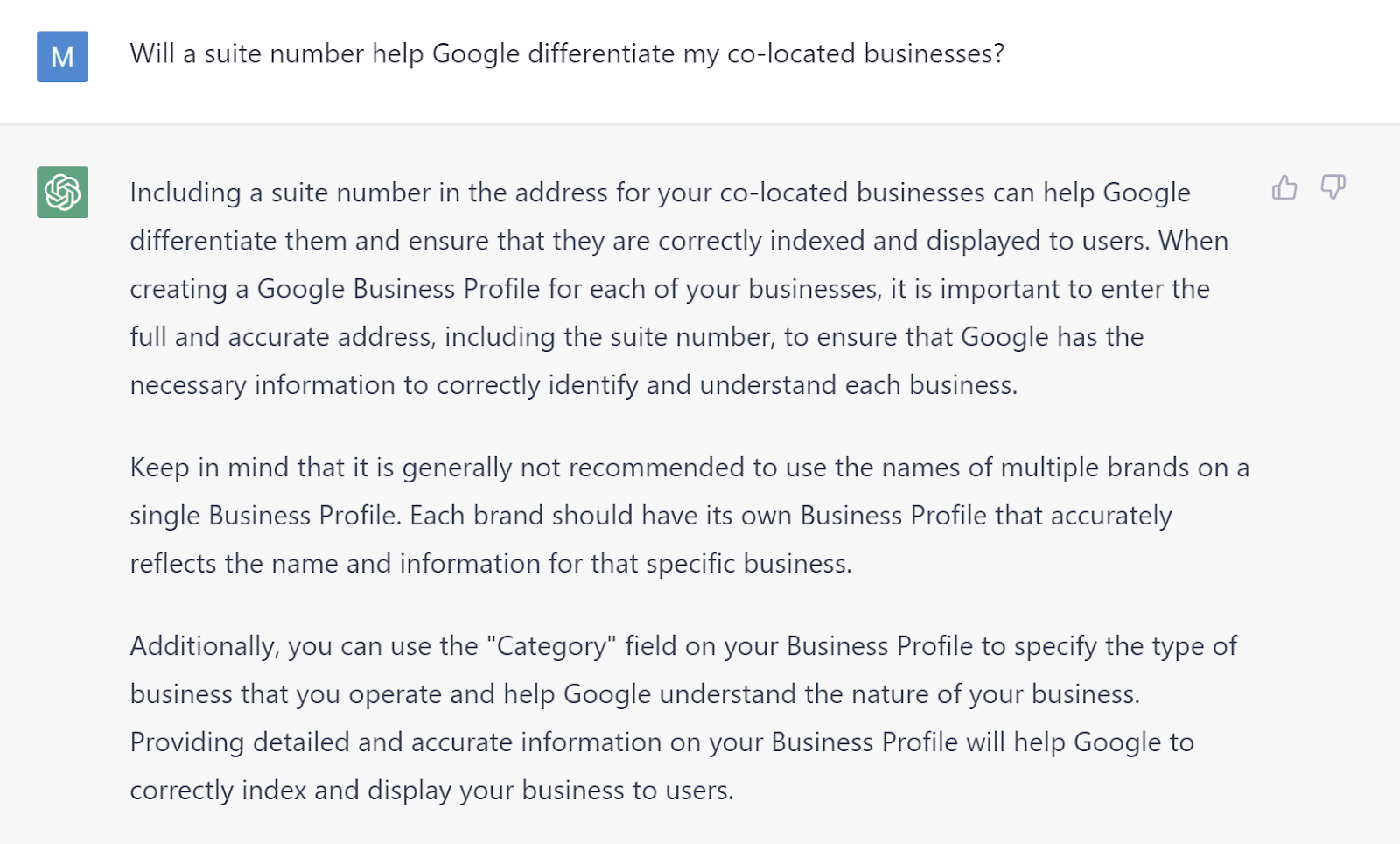
4. In which the suite number myth lives on

Every local SEO will immediately recognize this situational question in which the inquirer is trying to differentiate one business from another at the same address, and wanting to know if adding a real or fictitious suite number will help Google separate out the entities. What people like Joy Hawkins know that ChatGPT doesn’t is that Google ignores suite numbers, but the myths persist.

5. In which the robot starts to head down a better path and then goes totally awry

Initially, I was worried that our hypothetical local business owner asking whether they can create a Google Business Profile for a lead gen business wasn’t receiving a ChatGPT answer that began with, “No!” Google’s guidelines specifically list lead gen companies as being ineligible. ChatGPT ignores this, and proceeds to instruct the inquirer on how to create a forbidden listing.

A brief ray of hope shone out for me when the ten-step instructions were followed by the warning that (correctly) explains that you shouldn’t create GBPs for businesses that lack physical locations. “Good,” I thought. “This will cause the lead gen practitioner to pause and adhere to guidelines.”

My hopes, however, were short-lived when the bot followed this up with the head-slapping suggestion that the lead gen brand resolve their dilemma with the creation of a virtual office! We’re back to square one with ChatGPT causing users to fall afoul of Google’s most basic guidelines.

The Results of a ChatGPT-led Local SEO Strategy

Let’s imagine that our fictitious local business owner has mistaken ChatGPT for an expert, and has acted on this advice. What happens next:

  • The Google Business Profile for the virtual office is hard-suspended and likely permanently removed for guideline violations, negating any investment the owner had made in creating the listing.

  • The hours invested in geotagging images are all wasted, and have eaten up valuable time the business owner could have spent in pursuing tactics that do influence search engine rankings.

  • The business owner who may already have been heading down the wrong path in hoping that fictitious suite numbers will make Google believe that the separate categories of a single business each deserve to have their own listing will experience suspension of one or both listings sooner or later.

  • The lead gen business owner will be suspended on two counts: 1) for listing a lead gen business in the first place, and 2) for listing a virtual office.

  • Once they are caught, the business name is mud on Yelp, where their profile is stamped with an ugly public warning for engaging in prohibited practices.

What we have here, then, is not a local SEO strategy, but the shreds and tatters of disinformation that could result in reputational damage, loss of time, and wasted marketing budget. These are significant real-world consequences.

A Mind of Metal and Wheels

Last year, I was invited to contribute an article to a large publication, commenting on the subject of how writers like myself feel about the intrusion of AI into our craft. I wrote a thoughtful essay entitled Art Vs. The Machine, in which I drew on J.R.R. Tolkien’s philosophy of the gifted human use of tools vs. the coercion of wills that underlie the development of much machinery. My essay remains unpublished, as yet, because the publisher rejected it in favor of an ode to AI that admonished writers to sublimate our fears and get with the program.

My heartfelt sentiments were clearly not a good match for the publisher’s agenda, and the debate about AI should absolutely include all voices and viewpoints – some people are very excited about the arrival of ChatGPT and will laud Google’s analog, if and when it arrives, but others are not applauding. Teachers, for example, appear not to feel that you get the world’s next Tolkien when machines do the “thinking”. My own take at present is that, if I were to use the present incarnation of ChatGPT to write my Moz Blog column, all of you would be reading local search marketing disinformation right now. I strongly hold that you deserve better than that from me.

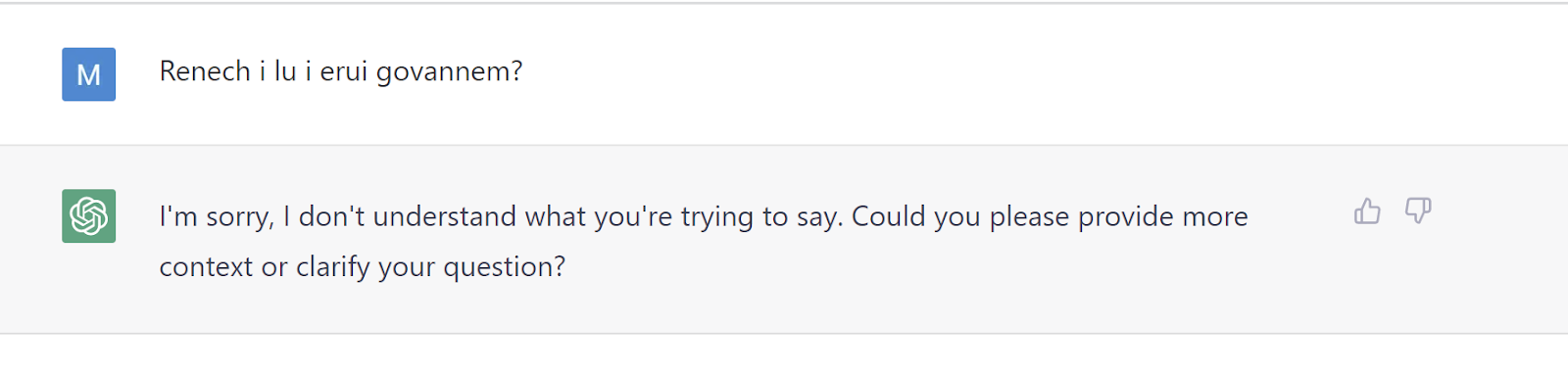
In fairness, I want to conclude that ChatGPT got some answers to my local SEO questions right, correctly referencing sections of the all-powerful Google guidelines. I was pleased when it was able to talk to me in Swedish, and was surprised when it managed to respond to me in Irish Gaelic. But the bot lacks the art of Elvish. I asked a question in Sindarin, and ChatGPT had no idea what I was saying:

When I translated my question into English (Westron, for all you Tolkien philologists), ChatGPT understood what I wanted, and its reply contained a revealing proviso that should be a reminder to all AI users about a critical difference between the machines and us.

For now, I’ll be continuing to write my column in the old-fashioned human way, remembering specific (and wonderful!) interactions I’ve had with local business owners and industry colleagues, and drawing continuously on my personal experiences.

How to Repair and Improve Local Business Reputation via Google Star Ratings and Reviews

Six in ten consumers require a minimum 4+ star rating in order to consider patronizing a local business and over ⅓ say it’s the star rating that is the key differentiator between local brands. If you’re marketing a company that is just starting out or an established business that has hit a reputational rough patch and your overall ratings fall below this magic threshold, revenue is being lost.

But hope is not lost!

In today’s column, you will find a set of sensible, actionable steps you can take to raise your Google Business Profile star ratings, improve your reviews, and begin developing the good online reputation you need in order to realize the full profit potential of the local businesses you market.

Defining local business reputation

In this context, a local business has both an offline reputation that resides in the word-of-mouth sentiments expressed by members of the community it serves and an online reputation that is most visible within the rating and review systems of platforms like Google Business Profile, Yelp, Nextdoor, TripAdvisor, etc. This article focuses specifically on Google, but its advice can be applied to most platforms that host local business reviews.

For detailed, original data on the many dynamic aspects of online reviews, read Moz’s formal review survey report but for today’s topic, it’s important to know that just 13% of consumers insist on a perfect 5-star rating to consider doing business with a company and that a dominant 51% will consider a brand with a 4-star overall rating. Thus, both 4 and 5-star ratings are considered a great or good reputation by the majority of consumers.

Yet, hope can be found in the fact that about ⅓ of consumers may still give you a try if your organization’s overall reputation is only 3 stars. This could give you the grace period you need to keep the lights on while you strategically improve your operations to start winning more trust and business in your community. We’ll grade a 3-star reputation as “needs improvement”. The work involved will be harder if the reputation has dropped to 2-or-less stars, as only 2% of the public is likely to consider patronizing you. This rating would be considered poor, but you can improve it with a serious commitment.

Task 1: Look your business up on Google and note down its overall rating and number of reviews.

How do Google ratings and reviews work?

A 1-star Google review and a 5 -star Google review creating an average rating of 3.0 stars.

Before you begin the necessary tasks for improving your reputation, it’s important to understand how Google’s system works. Local business ratings and reviews are part and parcel of Google Business Profiles as well as Local Finders and Google Maps. Reviews are text-based sentiments left by consumers, as shown above. Ratings are the 1-5 star symbology Google uses so that people can gauge a company’s reputation at a glance. The overall rating a business receives is based on Google’s average of all the individual ratings customers have left. As our example demonstrates, if a business has just two reviews, and one has a 1-star rating and the other has a 5-star rating, this averages out to an overall rating of 3.0 stars. Google users have the option to leave both a rating and text, or just a rating.

Because of Google’s averages, local business owners with less than a 4-star total rating frequently ask how many higher-star ratings they will need to earn before they see their overall rating improve. The answer depends on the total number of ratings the company has already earned, but by my calculation, if a business with ten reviews has earned an overall 3.0 star rating and wants to see that bump up to a much better 4.0 star average, they will need to earn ten new 5-star reviews to move the needle. Similarly, if the business begins with one hundred reviews and a 3.0 star rating, they will need to earn one hundred new 5-star reviews to move up to a 4.0 star average.

Over the years, different surveys have measured how conversions increase when star ratings improve, with a very good recent report finding that when a business succeeds in increasing its overall rating by one whole star (such as moving up from 3.0 to 4.0 stars), it can expect a 44% increase in Google Business Profile conversions. That’s a big number!

Improving the rating is work that must be paced over time to avoid having too many new reviews come in at once, triggering Google to filter them out. Note, too, that it can take up to two weeks for incoming reviews to update the overall average. Local businesses suffering from a poor online reputation, then, can look at the averages and estimate how many new high-star reviews they will need to earn to begin seeing the benefits to their conversions, transactions, revenue, and overall good name.

Identifying causes of reputational damage

There are at least 9 common contributors to the erosion of star ratings and reputation.

  • Too few reviews giving too much power to a small number of voices

  • Neglect of review responses

  • Neglect of local business listings resulting in false information online

  • Bad/rude customer service

  • Bad products

  • Poor work on a job

  • Spam from competitors, past employees, and personal adversaries

  • Spam from the business owner and their staff or marketers

  • Scandals

For all but the last of these bullet points, achievable fixes are right within reach. For the last bullet point, though, the degree of the scandal may take the business outside the scope of this article. When a local business scandal is severe, the owner may end up having to cope with litigation and damage too permanent to continue operations. For the other eight very common scenarios, however, all the steps for determined remediation are yours to take.

Task 2: Determine the key contributors to your low rating and document them. Read through the whole body of your reviews and make a note of each complaint, categorizing them based on the 9 types of problems listed above.

How to improve your local business reputation, step-by-step

Blue infographic explaining 9 common reputation problems and how to solve them, detailed in text below.

In your first and second tasks, you noted down your overall rating and number of reviews, and you categorized the complaints you’ve received into some of the nine different categories. Now, you’re ready to start addressing any of the categories that fit your scenario.

Too few reviews giving too much power to a small number of voices

This is often the first and most obvious cause of a poor overall star rating. When a business has too few reviews, the weight given to each review is extraordinary. As we saw earlier, if your company has just one 1-star review and one 5-star review, your overall reputation is just 3.0 stars.

28% of consumers lose trust in a business when it has too few reviews compared to its competitors, and 70% will read between 5-20 reviews before deciding your company is worth a try. One of the best and most sensible efforts you can make, then, is to launch a review acquisition strategy that ensures you have a steady stream of incoming sentiment and that no single customer has too large a share of voice in your reputation narrative.

Neglect of review responses

40% of your customers expect you to write an owner response when they leave you a positive review. When the review is negative, 64% of your customers expect you to respond. The truth is, these expectations are low, and local businesses should be responding to every single review as it comes in. Just as you would never ignore a customer visiting your physical premises, don’t neglect anyone who is speaking to you online.

11% of people expect your response within 2 hours of their writing a review. 21% expect to hear back within 24 hours, and an additional 28% expect to hear back within 48 hours. From this day forward, make it a priority to use the owner response functionality either as soon as you realize you’ve received a new review or at a given time each day. If you are having trouble keeping on top of this, Moz Local will alert you to incoming reviews across multiple platforms. This is a good plan for going forward.

However, if your review corpus currently consists of months’ or years’ worth of reviews that have received no response, take the time now to go back through the last six months of your reviews and respond to them. While delayed responses are unlikely to re-engage the customers who left the reviews, you can at least begin signaling to the general public that you are implementing a new plan of active responsiveness.

If further coaching in how to respond well to both positive and negative reviews would help, read Chapter 4 of the Essential Local SEO Strategy Guide, but in the meantime, here are quick facts to help you write excellent responses to negative reviews:

  • Do everything you can to solve a problem cited in a negative review, or 54% of consumers will avoid your business.

  • If you accuse a consumer of lying, 33% of customers will avoid your business, and if you argue with the reviewer, 46% will avoid your business. Keep your responses positive and professional, even if you think the customer is wrong.

  • Be sure your response to a negative review includes an apology, or 47% will avoid your business.

  • Know that 38% of consumers write reviews specifically to tell your business how it needs to improve – by fixing stated problems you are taking direct action to improve customer service and reputation.

Neglect of local business listings resulting in false information online

52% of local business review writers say they have written negative reviews as a result of encountering false or inaccurate information about local businesses online, including on local business listings. When business names, addresses, phone numbers, hours of operation, and other essential data are incorrect, it inconveniences, disappoints, and frustrates the public.

Fortunately, actively managing local business listings is one of the easiest steps you can take to safeguard and improve your reputation so that you are receiving zero negative reviews and poor ratings due to avoidable, basic errors. You have two options for this work:

1) Do a manual audit of Google’s organic search engine results for your business name and services, discover all the local business listing and review platforms on which you have a profile, audit those profiles for errors, claim and update them, and track them in a spreadsheet for regular updating whenever your business information changes. It’s a considerable workload.

2) Subscribe to a service like Moz Local which is designed to let you manage all of your listings on key platforms very quickly and effectively from a single dashboard, protecting accuracy and reducing negative customer experiences.

In addition to ensuring that your business information is accurate on formal listing platforms, it’s a good idea to see if other online mentions of your business (known as unstructured citations) contain inaccuracies. For example, if a local blogger wrote about your business two years ago and referenced your street address, and you have since moved, it’s important to search for such references and contact the publishers to request an update of their content whenever your business experiences a significant change.

Bad/rude customer service

65% of review writers have written negative reviews due to bad or rude customer service, making this scenario the dominant cause of negative online sentiment and low ratings. Unfortunately, if your worst reviews fall into this category, it may require structural rather than simple fixes. Every business scenario is different, but here are eight key questions to ask to help you determine the root causes of customers feeling poorly treated at a place of business:

  1. Has every member of my public-facing staff received adequate training in company products, services and policies?

  2. Are ongoing training sessions part of our program so that skills can be developed and improved?

  3. Has every member of my staff received training in complaint identification and resolution so that problems are resolved at the time of service, rather than ending up online?

  4. Is every member of my staff trusted and empowered to use their own initiative and creativity to relieve customer pain, and do they know the correct hierarchy of escalation for problems beyond their direct control?

  5. Does every member of my staff earn a living wage, enabling them to bring resources of inner stability and happiness to the workplace?

  6. Does every member of leadership role model company values to be emulated by employees?

  7. Is a formal DEI council or policy in place to ensure that all staff and customers receive equal consideration, treatment, and service?

  8. Has a policy of customer rights been created by the business, and is it adequately distributed to both the staff and the public?

If any of the answers you gave to the above questions is a “no”, then you have identified a possible cause of negative reviewers feeling that they have been treated poorly or rudely. By addressing the underlying causes of staff failing to convey professionalism, respect and happiness to customers, you will be fixing serious structural problems in your organization. When solutions are implemented, new higher ratings and better reviews should begin to outweigh negative ones over time. For a more in-depth look at the complete customer service ecosystem, return to chapter four of the Essential Local SEO Strategy Guide.

Bad products

Planned obsolescence (manufacturing products that are intended to break) is making headlines and being outlawed in different places around the world, and it’s clear that paying good money for bad products is a sting keenly felt by consumers. 63% of reviewers say its a cause of them writing negative reviews, and for consumers aged 18-29, it is the #1 cause of such sentiment. In America, youngest people are also poorest, and it makes perfect sense that they would be the most distressed by spending hard-earned money on shoddy merchandise.

Supply chain breakages over the past few years have doubtless exacerbated this scenario, with local businesses often having to stock whatever they can access rather than what they know to be top quality. Sustainability, too, plays a key part in this conversation, as the public is reevaluating the climate impacts and pollution that result from a throwaway culture.

If some of your negative reviews fall into the “bad products” category, it could help to know that the latest marketing thought leadership envisions business owners as guardians and stewards who are responsible for offering the highest quality, most sustainable products to their communities. For local businesses, this could mean replacing remotely-sourced goods with more local inventory when better resources are available nearby. It could mean adding new steps to quality control processes. This is not an easy fix, particularly due to the effects of the pandemic on manufacturing, but it’s a problem that takes on extra relevance if you discover that your worst ratings stem from an inventory of poor-quality products that are undermining your reputation.

Poor work on a job

Even if weeks or months have gone by since a customer wrote a review complaining of something like a botched home improvement, an unsuccessful repair, or an unmet deadline, your best course for reputation restoration will be to directly contact the unhappy client and see if there is anything you can do to make them feel better. You may have to redo the work. You may have to refund their money. Or, a simple, heartfelt apology and request for a second chance to “get it right” may be enough to transform the relationship.

While you cannot offer any type of incentive to prompt a formerly-unhappy customer to update their negative rating and review, what you should look out for is the point at which your follow-up has resulted in customer satisfaction to the degree that they might amend their online sentiment if asked. You’ll enjoy two victories if you succeed. First, the original customer will think well of you again and hopefully continue to do business with you. Second, when a negative review is updated to reflect a subsequent better experience, it is no longer a barrier to further leads from the general public.

These two statistics should give you tremendous confidence for the uphill work ahead: 67% of negative reviewers had an improved opinion of a brand when the owner responded well, and 62% of negative reviewers would give a local brand a second chance after an owner response solves their problem.

Spam from competitors, past employees, and personal adversaries

Of all of the major review platforms, it has been proposed that Google has the biggest problem with review spam, with an estimated 10.7% of its review content being fraudulent. Every review platform has its own guidelines, and many countries have rulings regarding what constitutes review fraud, but a general definition of it would include these factors:

  • Reviews written in exchange for money, gifts, discounts, or other incentives.

  • Reviews that stem from competitors, owners of the business being reviewed, staff, and former staff, or other non-customers of the business

  • Reviews that are left on behalf of anyone instead of directly by the customer

  • Reviews that are manipulated (gated) so that only positive sentiment is displayed

  • Review removal requests in exchange for money, discounts, or other incentives

In the United States, review fraud is illegal. It is considered an unfair competitive practice that impacts consumers and businesses under section 5(a) of the US Federal Trade Commission Act. Unfortunately, Moz’s recent survey found that 40% of consumers have been offered money, discounts, or gifts in exchange for writing reviews. This could include brands and agencies paying members of the public to both positively review them and negatively review their competitors. An additional 11% admit to leaving negative reviews of their former employers. All of these practices are prohibited.

It’s important to know that Google will only consider removal of spam reviews if they demonstrably violate their stated guidelines, and Google typically won’t remove textless ratings. If you strongly believe that the erosion of your overall Google star rating is due, in part, to the presence of review fraud, you have three possible avenues toward resolution:

  1. Log into your Google account and look up your business by name. Using the New Merchant Experience interface that should appear in the organic results, click on the “read reviews” tab. Find the fake review, and click the three dots to the right of it to report the review. Wait at least three days and then check to see if the review is gone. If not, you can try to report the problem via this live chat form. For more information on reporting review fraud, read this Google help doc.

  2. If review fraud is stemming from a personal adversary or other known bad actor, you may need to seek legal advice regarding how to proceed toward resolution.

  3. If Google fails to protect you from a large-scale review spam attack, a PR campaign may be your only hope of resolution. While Google will sometimes ignore individual reports of review spam, they have often acted once the scenario becomes a publicized scandal picked up by mainstream media. There have even been instances in which Google has shut off reviews during negative review attacks.

Spam from the business owner and their staff or marketers

50% of consumers lose trust if it looks like an owner or their employees are reviewing their own business. 44% are suspicious when an overall review profile consists of all-five-star reviews without any complaints. 39% are mistrustful when the profiles of those leaving reviews look suspect and 20% are wary when a local brand has too many reviews compared to its competitor.

A poor reputation doesn’t always equal a low star rating. It can, instead, stem from customers quietly walking away because they rightly suspect that the review profile is filled with fraud instigated by the business, itself. If the business you are marketing falls into this category, the above statistics paired with the illegality of these actions are all the persuasion that should be necessary to take immediate action to remove any reviews that violate platform guidelines and government regulations. Any review left by the business or its staff should be deleted. If fraudulent reviews stem from having hired a marketing firm that implemented this practice, your brand may need to seek legal advice in order to prompt the organization to delete this content. Only when you have removed as many spam reviews as possible will you be able to start building the legitimate reputation that supports customer satisfaction and brand longevity.

Task 3: Begin implementing the fixes for each category into which your negative reviews fall, prioritize acquiring new reviews, and then give it time for the expected rating improvements to materialize. If all goes well, you should start tracking a lift in engagements and revenue as the result of your higher overall rating.

Summing up

A low-star overall rating doesn’t feel good, and stands as a major obstacle to you running and marketing the local business of your dreams. However, because you can categorize the roots of negative consumer sentiment, you will typically have considerable powers of improvement on your side. It may take weeks, months, or even a year to implement better practices, services, and acquisition campaigns that culminate in a sterling rating, but such work has become primary to basic local business operations over the past twenty years.

For local businesses currently struggling with a reputation of 3-or-less stars, the main challenge will be to make improvements quickly and then actively acquire new sentiment at a steady rate so that future customers stop being turned away by the sight of a poor rating. It’s good to know that very few customers are looking for 5-star perfection and that, in fact, lots of people find flawlessness suspicious.

The ideal outlook is to utilize negative consumer sentiment as a valuable source of business intelligence which, at its best, tells you exactly what needs to be fixed so that customers are more satisfied. This is what makes review management an ongoing local search marketing task, and even a business with a good or great rating today can never stop working at reputational maintenance via stewardship of reviews.

Eager to learn more about local search and local business reputation? These resources are at your fingertips:

Get formal training via the Moz Academy Local SEO Certification

2023 Local SEO Success: Human Power in a Year of Change

Hero image with GBP menu, title saying

2023 will be a run-up to the Olympics for the world’s top athletes who will be competing in a variety of events to prove themselves ready to represent their countries in the Paris Games, and I have a strong hunch that the coming months will be a strenuous exercise in fortitude for local business owners and their marketers, as well.

Having weathered the extraordinary events that occurred in local search in the second half of 2022 – most particularly the deprecation of the historic Google Business Profile Manager Dashboard and a slew of business-impacting bugs – it’s my prediction that 2023 is going to be a year of notable change for the millions of local brands for whom Google’s local search interfaces have become integral to discovery, communications, and sales. Meanwhile, ChatGPT is stirring up the whole SEO industry, with many wondering how long a shadow AI will cast over work and life.

It’s my gut feeling that the developments we’ve seen over the past few months presage greater change ahead driven by Google’s attitude toward and handling of local and general search philosophy. Let’s prepare ourselves by getting an outlook on organic SEO (which bounds our local world) from Moz’s own Tom Capper and Dr. Peter J. Meyers. Then, let’s gather local wisdom from thoughtful industry commentators including Amanda Jordan, Ben Fisher, David Mihm, Garrett Sussman, Greg Sterling, and Mike Blumenthal. Finally, I’ll offer 3 areas of local search marketing I recommend focusing on in 2023.

Citius, Altius, Fortius

Image of four men running along a tree-lined road.
Image credit: St Dennis Band

Educating the mind without educating the heart is no education at all.” ― Aristotle

We come running into the arena of 2023 carrying, as always, the bright torch of human intelligence, but this year, our steps are a little dogged; AI is on everyone’s mind. On our road to Paris, we can reflect on the Olympic motto that was first introduced in that city in the 1924 games: Swifter, Higher, Stronger. As a species, we are always hoping for improvements in ourselves and society. But, it was Aristotle who said that the mark of an educated mind was to be able to entertain a thought without accepting it, and right now, many of my SEO colleagues are questioning whether the rise of artificial intelligence and a life so ordered by machines is, in fact, anyone’s idea of a smart move. Simply said, just because people can do something, it doesn’t mean that they should.

I asked my fellow Subject Matter Experts here at Moz what is on their minds in organic SEO for the new year, and their answers help shed a particular light by which we can better see the larger stadium in which all businesses are competing.

From Tom Capper:

The big SEO topic in the tail end of 2022 has been AI content – both ChatGPT and before that Google’s Helpful Content update bringing this topic to the front of people’s minds. Said update now looks rather prescient, with a new wave of increasingly coherent bot-written content surely to follow. Expect this to be a major battleground for Google in 2023. As I am writing this in the first week of December 2022, there is already an update to Google’s “Helpful Content system” rolling out – and that brings me to the other big change we’ll see more of. Ranking system updates. This is likely more of a terminology change than a practice change from Google, but I’d still expect it to somewhat shake up how SEOs think about and contextualise these updates — in my opinion, a shake-up that is long overdue.

Lastly, a carry over from my predictions for 2022 — I predicted an increasingly volatile SERP feature landscape, and I think that prediction has aged well. But it still stands. Again, as I write this, Google has just rolled out continuous scroll desktop SERPs in the US, and numerous feature changes in the last few weeks. There is nothing sacred here, from Google’s perspective, and with increasing threat from dissimilar competitors like Apple or AI assistants, they may feel like slightly less gradual change is justified.”

From Dr. Pete Meyers:

Echoing Tom, because it’s so important that I’m forced to agree with Tom, expect a flood of low-quality, machine-generated content in 2023 and a corresponding pushback from Google. Whether this will be part of the Helpful Content system updates or something entirely new remains to be seen, but creating Machine Learning content that doesn’t look like ML content will likely (and sadly) become a new obsession of some corners of the SEO industry.

This trend may force Google to re-evaluate E-A-T and/or more clearly define how they measure Expertise, Authority, and Trust, in order to encourage positive best practices. Google is aggressively experimenting with product listings, including the large-format product “grid” that seems to blur the lines between free and paid product listings. As Google seeks to compete with Amazon and other product searches (including an increasing amount of purchases driven by social platforms like TikTok), expect these lines to blur even more. Some competitive product search results are going to be unrecognizable from a traditional, organic SEO perspective.

My riskiest prediction — Expect Google to re-evaluate Featured Snippets, especially given quality concerns, both around trustworthiness of content (including disinformation) and the impact of low-value ML content. We’ve already seen snippets being pulled from a chunk of competitive queries in 2022, and I suspect Google may substantially re-invent the Featured Snippet or set a higher bar on when and how often they’re displayed.”

In sum, Tom and Pete are expecting volatility in the SERPs, including SERP features like local packs, which Moz has been tracking a decrease in the visibility of for some months. Both SMEs are looking closely at the disruption of AI and how it may impact search and searchers. 

Local SEOs may well be feeling like they’ve already experienced quite enough change in recent times with the loss of the dashboard for managing Google listings and an onslaught of bugs, but when I asked my peers to look ahead, many of them predict significant challenges yet to come for local businesses and their marketers.

From Mike Blumenthal:

“I would say that while a lot of levers are being pulled getting the Search Interface (NMX) off the ground, it was a change that was totally unnecessary and brought with it both bugs and an attitude of total apathy towards the multi user/agency dashboard.

The other big, hardly reported on changes were the move to AI first moderation of reviews AND images, introducing GPB behaviors that are perceived as totally illogical by the small business community.

If the intention of the NMX was to simplify and engage, why layer on totally obtuse moderation decisions for reviews and images while providing no clear guidance as to what was happening and how to deal with it?”

From David Mihm:

“What Google is doing in Local is officially anyone’s guess at this point.

Regardless of the level of internal resources devoted to Google Business Profiles as a product (which clearly fell off a cliff beginning in late 2021), the current NMX/skeleton dashboard version of GBP lacks a coherent vision and a poor (any?) understanding of user needs and pain points. Not to mention myriad functional bugs including 404 errors when trying to upload photos, inability to save store codes on newly-created locations, and inability to deny (or even confirm, in many cases!) user-suggested edits.

As usual, there seems to be no institutional knowledge of Google’s long history of internal failures and weak spots in its Local product or Maps data, or anyone with power making a strong case for the centrality of GBP in the marketing ecosystem — even for large multi-location brands which are spending millions of dollars annually on Ads.

It feels to me as if Google’s “strategy,” such as it is, is to simply ignore SMBs as a meaningful source of data for Maps and Universal results, and to force multi-location brands to work with a partner like Yext/Uberall/etc. for a real product interface. Given that Big Tech is cutting headcount and investment across the board, I can’t imagine the situation will change for the better in 2023.” 

From Amanda Jordan:

“I expect to continue to see pretty drastic changes for local for at least the next couple of years. I think local has been under the radar for Google for awhile and COVID has really brought Google’s shortcomings for local to light. Now they are correcting the experience for SMBs who may have been neglecting SEO until they depended on it during COVID and were overwhelmed by GBP management. I think we’re going to see Google testing a lot of changes for local in SERPs. Local mobile SERPs will be one of the most interesting places to watch next year.” 

Meanwhile, Greg Sterling offers a candid theory on why some of the local changes may be taking place:

“Google recognizes local content and maps remain critical for its users, especially mobile users. But the company is disappointed by the number of SMBs engaging with GBP, and GMB before it. Hence the move from the app to the web. In many ways Google has been less successful monetizing small businesses than Facebook, which doesn’t have a consumer-facing local product. GBP isn’t the onramp to ads Google had hoped. I believe, internally, there are now reduced expectations and support for local on the B2B side. NMX comes out of this larger context.”

I find all of the above comments to be probable, realistic, and insightful, but I also want to be sure to mention that there isn’t a complete consensus on trends. At least one respected colleague, Ben Fisher, has a more comforting view that we may already have weathered the biggest changes:

“The big stuff is behind us for now I think. Mainly the name change and in-Search experience.

The in-Search experience was planned for a long time and Google in their infinite wisdom decided it was the best route to go based on data. I think that with the rollout of this new in-Search experience that new ‘bugs’ and aggressive ‘features’ will come to pass.

Next year I think we are going to see ongoing tweaks. I would predict that the review filtering will probably get worse as we have seen with reviews leaking on a daily basis. Also it took over three months for reinstatements to go back to a normal timeframe. Next year I think we can expect this to go haywire again. It feels like it happens yearly.

One thing I think is certain: Google looks to fix problems at scale and all but ignores the little guy, and in some cases can cause horrible consequences to non-guilty merchants. That being said, one other thing is constant, they will do their best to ‘fix’ the issue.”

Finally, Garrett Sussman’s take on the impact of MUM should not be missed:

“In 2022, Local SEO has felt the impact of Google’s MUM algorithm more than anyone. A local search on a mobile device is sliced and diced by various contextual query refinements:

• Places
• ‘Find places through photos’
• Google Explore
• Deals

They’re all showing up and influencing every single local result. It forces local business owners to improve their content on their own site, build out their listings on review sites, and earn mentions in local media.

You can’t only focus on your Google Business Profile. But when people do search for your business specifically, you need to provide as much information as possible, because people expect it:

• You need your office hours to be accurate
• You need fresh and positive reviews
• You need photos of your business

It’s never been more important for a local business owner to have a digital presence on Google.”

Taken altogether, there is a high level of dissatisfaction with Google’s handling of local as we throw the discus into 2023, and there is a definite sense that there will be bug and feature hurdles all along our lane. Our expert commentary depicts Google local search in a marked state of flux. I personally find it counterintuitive that Google is shortchanging local right now, given that local data is the biggest ace the search titan has up its sleeve in its contest with Amazon. Whatever their motives, It’s not great news for our industry, but it’s vital to be real about the present state of local so that we can cut our coat to suit our cloth. Even amid volatility, good strategy is absolutely still possible.

Harnessing the human power of local in 2023

Image of two men in white track suits passing the Olympic fire from golden torches in front of a crowd and cloudy sky.
Image credit: Memories of Days Gone By

“Be kind, for everyone you meet is fighting a hard battle.” ― Socrates

When I consider the level of concern currently being expressed in the SEO industry over the rise of disinformation that may ensue as a result of inventions like ChatGPT, the pitfalls of programmatic moderation of key local content like reviews and images, and the failure of Google to adequately support the millions of local brands they represent on their platform, I think we have to dig deep into human resources to counterbalance the shortcomings of machines. Here are my top three recommendations for a smart local business strategy for 2023.

1. Shortcut the path to a real human in every way you can

I see signs everywhere that people are at a tipping point of fatigue over being “handled” by robots. Multi-step phone trees and long hold times are truly wearing. Chat functions that never result in human contact feel cold and impersonal. Websites that hinder rather than assist customer journeys are no-win on both sides of transactions.

In 2023, achieve the least possible distance between customers and live customer service with the following methodologies:

  • 69% of surveyed American consumers prefer talking to a live person by phone for customer support. The majority list their top pain points as being long hold times, disconnects, and having to start over again with each phone agent so that issues take too long to get resolved. If short staffing is causing long hold times at your business, implement call-back technology so that the customer can go about their life while waiting to hear from a live person, and be sure that every public-facing staff member is well-trained in your products, services and policies so that a customer has to talk to the fewest possible people in your organization to get answers to their questions.

  • 46% of customers believe businesses use chatbots to prevent them from reaching a live person and 60% would rather wait for a live person than talk to a bot. However, if you are using chatbots as after-hours support, it can be a useful tool. Just be sure your interface clearly identifies that it is automated, covers FAQs so that answers are provided in a pinch, and then capture customer contact information so that a human engagement can begin as quickly as possible following the chat.

  • If you’re using livechat, know that over ½ of customers expect a response within minutes. Applications like this must be staffed just as you would staff your phones to avoid customers feeling ignored and abandoning the brand.

  • 44.5% of customers aged 35-54 say that texting is their preferred method of communicating with businesses and the previously-cited Leadferno study found that about ⅓ of people expect a response within a day when they text a company. Given the difference in expected response times, texting may be a better option for brands with minimal staff, so that customers aren’t being lost to unfulfilled expectations.

  • Email remains a key channel for customer support, but one survey found that 62% of companies don’t respond to email-based customer service requests, 90% don’t send an email confirming that the question has been received, and just 20% of businesses are able to provide a complete answer on the first reply. These are startling statistics that speak to the need to staff your inbox so that customers are receiving prompt, well-informed emails to every inquiry.

  • Finally, one of the greatest challenges of the past few years has been short staffing for local businesses due to the ongoing pandemic. Wherever doors are open, customers still want to be greeted and assisted by well-trained staff, but the realities of a labor shortage, COVID, and Long COVID mean businesses and customers need to lean more heavily on additional, non-human resources such as the answering of FAQs on in-store and storefront signage, company websites, and local business listings. We’ll examine these points next.

2. Let good tools come to your rescue in tough times

Regardless of what AI fans may say, there is no replacement for the human relationships that are the basis of doing business locally. That being said, when external conditions cause staffing shortages, it’s time to consider the long history of humans’ ingenious use of tools to aid labor. Like the sea otter and the heron, we can select props to make it easier to achieve our goals, and in 2023, local business owners should ensure that customers are being served even when a staff member isn’t immediately available. Focus on these areas:

  • The New Merchant Experience that replaced the former Google Business Profile dashboard in 2022 was widely judged to be a usability fiasco, particularly for multi-location brands. Restore ease of management by using software like Moz Local to regain the quiet, dedicated workspace you need to manage your listing on Google and on the most prevalent local business listing platforms, all in one place.

  • Be sure the listings you’ve created are fully filled out with accurate information so that customers get fast answers to common questions about your location, contact info, hours, services, products, and policies. Add your products, take more photos this year, and set yourself up to begin filming aspects of your business. Google has finally started featuring local business videos and I would recommend filming 30 second videos in which a friendly person from your company answers your top FAQs.

  • 96% of your customers read reviews and 60% of review writers expect a response from your business within 2-or-less days. Make this the year you envision reviews as a two-way conversation, charged with the knowledge that when your responses resolve complaints, 63% of reviewers will update their negative review and 62% will give your business a second chance. Make 2023 your most communicative year yet by studying The Impact of Local Business Reviews on Consumer Behavior. But, do be careful how you are asking for reviews this year, given recent research from Mike Blumenthal on the startling causes of reviews being filtered out by Google.

  • Broaden your communications channels. Try an after-hours text hotline if you’ve never had one before. Experiment with video-based support, live chat, and callbacks. Make 2023 the year you emphatically decide whether channels like TikTok or Instagram are a good fit for your customers and brand. The easier it is for people to discover and reach your business, the better.

3. Faced with facelessness, buck trends

Why is it that Patagonia’s founder declared Earth its only shareholder? Why is it that when everyone was saying that bricks-and-mortar was dead and all sales would be happening via e-commerce, Warby Parker began doubling down on physical storefronts so that people lacking prescriptions could get an on-site eye exam? Why, despite looming recession, has someone opened a successful restaurant for dogs in San Francisco, betting that people will splurge on their animal friends even if they are budgeting for themselves?

These scenarios aren’t just about fighting the tide and daring to be different – they’re about daring to be human and to understand what people care about, need, and love. The people behind ideas like these really took time to understand the realities of a society longing to fight Climate Change, needing accessible vision care, and wanting to have low spirits raised by doing something special for a cherished pet. Having a real face (and a real heart behind it) in an increasingly automated, impersonalized world could be the thing that sets your local business apart in 2023.

In some executives’ strange dreams, human value is measured in the mass consumption of products, and now, of AI-driven content. Local business owners know better, from lived experience. In this new year, embrace the narrative of your business being operated by real people who serve real neighbors in real ways, with personality and charm that can’t be replaced by bots. This won’t be an easy race, but it’s worth running, whatever the odds.

In wishing you success in the local business year ahead, I’d like to close with the words of Wilma Rudolph, who overcame infantile paralysis caused by polio and went on to become an Olympic champion: “Never underestimate the power of dreams and the influence of the human spirit. We are all the same in this notion: The potential for greatness lives within each of us.”

Black and white photo of three women running on a race track with Wilma Rudolph in front.

They’re Simply the Best: The Top 25 Moz Blogs of 2022

We published 156 posts on the Moz Blog this year, and as is tradition, it’s time to look back at the most popular ones! You’ll find blogs on new findings in social media search, tips for e-commerce SEO, trends in technical and local SEO, and so much more.

Have a safe and happy new year, Moz friends! See you in 2023.

*The top 25 written posts published between January 1 – December 26, 2022, in order by pageviews generated during that timeframe.


1. How to Win Potential Consumers with Customer Journey Mapping on Google

By Christopher Hofman Laursen | April 20, 2022

If your website is like most others, there is likely a mismatch between the content you provide, and what your prospective customers search for on Google. This article is about understanding those potential customers and their conversation with Google by using the customer journey mapping method to provide them with the best content.

2. TikTok SEO: Understanding the TikTok Algorithm

By Lidia Infante | October 26, 2022

In the first chapter of this series, we dug into the search behavior on TikTok and why it should matter to SEOs. In this article, we are going to cover the ins and outs of the TikTok algorithm, and how to leverage it to get more users looking at your brand’s content.

3. Shopify SEO: The Guide to Optimizing Shopify [Updated for 2022]

By Christopher Long | January 25, 2022

Shopify is an increasingly popular platform for e-commerce sites, but it’s not fully SEO-friendly out of the box. What’s the best way to optimize your Shopify experience for SEO?

4. How to Prep Your SEO Strategy for a New Website

By Adriana Stein | March 16, 2022

Your SEO strategy should be one of the primary considerations before you even start your website. Instead of fighting to make your website SEO-ready later on, start with this holistic SEO checklist for new websites and save yourself valuable time and resources.

5. How to Use Chrome to View a Website as Googlebot

By Alex Harford | August 17, 2022

In this article, Alex shows you how and why to use Google Chrome (or Chrome Canary) to view a website as Googlebot. Viewing a website as Googlebot means we can see discrepancies between what a person sees and what a search bot sees – useful for technical SEO and content audits.

6. How to Optimize for Google’s Featured Snippets [Updated for 2022]

By Ann Smarty | November 14, 2022

Google’s featured snippets started as an experiment almost a decade ago. They have since become an integral part of Google’s SERPs, showing up for lots of queries. In fact, featured snippets are now considered organic position #1, so making them part of your SEO strategy is essential to build more traffic.

7. Protect the Hours of Operation on Your GBP from Unwanted Google Edits

By Miriam Ellis | May 9, 2022

Google wants to employ machine learning and AI to alter the hours of operation on twenty million Google Business Profiles as part of their project of creating a “self-updating map”. Google has good reason for pursuing accuracy in their local index, but local business owners have even better reason to be on top of this announcement and proactively safeguard the validity of their own data. 

8. The Top Tech SEO Strategies for 2022 and Beyond

By Crystal Carter | January 27, 2022

Last year was an incredible year for core updates, and for how SEOs improve page quality for users. Moving forward, we can expect to see increased diversification of SERPs — led by developments in Google’s algorithms — and new features from tools like Google Lens. These developments will change how we manage our SEO now and in the future.

9. TikTok SEO: Is TikTok Going to Replace Google?

By Lidia Infante | August 31, 2022

User behavior on TikTok has been evolving as its popularity grows. We’ve seen the app go from dancing teenagers to influencing shopping behavior across the world. Now, the next step for TikTok seems to be turning into the next big search engine. What does it mean for SEOs?

10. 5 Things I Learned About E-A-T by Analyzing 647 Search Results

By Molly Ploe | September 13, 2022

How can SEOs possibly prove to Google, amid all the noise and competition and other experts out there, that their clients deserve a place on Page 1? To find out, Molly compared the top results on hundreds of SERPs to determine what actually proves E-A-T.

11. What Are the Best Tools for Storytelling With Data Visualization?

By Jo Cameron | July 27, 2022

Charts and infographics can be pretty, but if they aren’t also properly breaking down data in a way that makes an impact on the audience, they are likely not worth the time and effort. Below, we discuss how storytelling ties into data visualization, and what tools can help you bring more data into your content.

12. Social Media Competitor Analysis: The Complete Guide

By Sally Ofuonyebi | July 26, 2022

Looking for the steps for performing social media competitor analysis? Here’s a detailed breakdown.

13. How to Improve Organic Clickthrough for Your Content

By Ann Smarty | January 13, 2022

Google search result pages are becoming more diverse and even interactive, which makes any click-through study out there much less reliable, because no two sets of search results are ever the same. So how much control do writers and content creators have over how their content is represented in search? As it turns out, quite a bit!

14. How We Increased Organic Traffic by 65% Using Keyword Research Working Sessions

By Daniel Wood | July 20, 2022

In this blog, Daniel shows you why you should do a keyword research working session with your clients to tap into their expert industry knowledge, and how these sessions helped his team deliver organic traffic growth for one of their new clients with low Domain Authority.

15. Understanding the Google Ads Auction & Why Ad Rank Is Important

By Tanuja Mahdavi | February 16, 2022

When there is a search query on Google, Google Ads runs a quick auction to determine which ads will show for that search query, and what the ad positions should be. This ad auction is repeated every time an ad is eligible to appear for a search term, and is an integral part of the SERP landscape. To help understand it, Tanuja covers the what, how, and why behind the Google Ads auction.

16. How to Earn Topical Authority in 2022 and Beyond

By Zoe Ashbridge | June 8, 2022

Zoe takes a deep dive into topical authority: what it is, how to earn it, and, importantly, how to strategically develop topical relevance.

17. How to Use Keywords to Combine the Power of SEO and Google Ads [Case Study]

By Adriana Stein | July 19, 2022

Both SEO and PPC are used for a common goal — search engine marketing (SEM) — and neither would survive without targeted keywords. Since both strategies have user intent and search demand in mind, you can use them to achieve both short-term and long-term business goals. When approached correctly, using SEO and PPC together can unlock significant opportunities for your brand, so let’s dig in!

18. How We Increased a Client’s Leads by 384% in Six Months by Focusing on One Topic Cluster [Case Study]

By Lydia German | September 26, 2022

Lydia shares the content update process she an her team at Tao Digital Marketing used to generate great results for a client in the financial services niche.

19. The 7-Day Quick Start Guide to SEO + Cheat Sheet

By Cyrus Shepard | October 31, 2022

Unless you work for an agency or want to make a lifelong career out of SEO (an excellent choice), most folks don’t learn SEO for the sake of learning SEO, but want the same quick wins that professional SEOs look for. That’s why we created the Quick Start Guide to SEO, which includes seven days of actions to check the SEO health of your site while putting you on the path of sustained improvement. If you want something even more compact, we also created the SEO Quick Start Guide Cheat Sheet.

20. Freshness & SEO: An Underrated Concept

By Christopher Long | July 6, 2022

After working with a news organization and testing the learnings from that work on other sites, Chris and his team started to see the immense power that freshness updates could produce in SEO. In this post, he explains why the entire SEO community has underrated the concept of “freshness”, and how to start optimizing for it.

21. 2022 Local SEO Success: The Year of Everywhere

By Miriam Ellis | January 4, 2022

Take a look back at Miriam’s seven local SEO precepts for the 2022, including some expert commentary.

22. The Top 5 Soft Skills SEOs Should Develop

By Petra Kis-Herczegh | September 6, 2022

When it comes to SEO, especially technical SEO, we often talk about the importance of hard skills. And while there’s no doubt that vlookup and regex can be your best friends, there are some essential soft skills to learn that will help you excel in your role and progress in your career.

23. How to Do Better, Lazier Keyword Research

By Tom Capper | September 5, 2022

In this post, Tom expands on one of the points from his 2022 MozCon talk: that a lot of time spent on keyword research is wasted. He’ll go over the three main ways SEOs turn what should be an involved piece of strategic thinking into an overly time-consuming routine, along with what to focus on instead.

24. Transitioning to GA4: Is this the Right Analytics Move for Your Team?

By Sam Torres | July 25, 2022

As you’ve likely heard, Google plans to fully retire Universal Analytics for GA4. Here’s what you should know before making any moves.

25. Beginner’s Guide to Google Business Profiles: What Are They, How To Use Them, and Why

By Miriam Ellis | October 17, 2022

Google Business Profile is both a free tool and a suite of interfaces that encompasses a dashboard, in-SERP editing, local business profiles, and a volunteer-driven support forum with this branding. Google Business Profiles and the associated Google Maps make up the core of Google’s free local search marketing options for eligible local businesses. In this guide, we’re doing foundational learning! Share this simple, comprehensive article with incoming clients and team members to get off on the right foot with this important local business digital asset.

The Best of Whiteboard Friday 2022

We had an amazing year of Whiteboard Friday episodes, ranging in topics from link building to content engines to even, basketball?

In case you missed them, here are the top 10 episodes from the year!

1. Estimating Search Opportunity with Robin Lord

Estimating the opportunities within your various SEO efforts is an important component of your analytics, not only to help determine where to focus your energy, but also to prove the potential value of your work to others. In this episode, Robin walks you through a good strategy for this all-important estimative work.

2. Advanced On-Page SEO Optimizations with Chris Long

Typically, when SEOs think about on-page optimizations, they’re thinking about core places to include their target keywords within their content. But how can you take your on-page optimizations to the next level and get beyond some of those basic tactics? In this Whiteboard Friday, Chris Long shows you how.

3. Moneyball is the Future of SEO with Will Critchlow

In our first episode of 2022, Will Critchlow shows you how, much like the NBA, SEO is undergoing an analytic revolution — and how you can make the most of it.

4. Top 4 Things to Know About GA4 with Dana DiTomaso

Dana brings you some details on the exciting new world of Google Analytics 4. Watch and learn how to talk about it when clients and coworkers are intimidated by the move.

5. A Content Engine that Drives Revenue with Ross Simmonds

In this episode, content marketing expert Ross Simmonds walks you through his method for creating a content marketing engine that will ultimately make you money, rooted in four simple steps: research, creation, distribution, and optimization.

6. How to Find Your Real SEO Competitors with Lidia Infante

Competitive research and analysis is a critical component of your SEO strategy. You may have an idea of who your business competitors are, but your real SEO competitors are the ones who target the same keywords, speak to the same audience, and solve for the same consumer needs. In this Whiteboard Friday, Lidia Infante walks you through two approaches to find out who those competitors are.

7. How to Measure Content Engagement with Dana DiTomaso

When it comes to content engagement, you can (and should) be measuring more than just page views. Analytics expert Dana DiTomaso summarizes her MozCon 2022 presentation by sharing the four things you should focus on to make sure your metrics are giving you the best picture of your content’s quality.

8. Metrics for Better Keyword Research with Tom Capper

Many SEOs think of keyword research as a very basic part of SEO, which can actually be a problem. In this episode, Tom explains some of the common mistakes SEOs make when doing keyword research that are easy to fix, many of which come from metrics like search volume, click-through rate, and difficulty.

9. Visual Search Optimization with Crystal Carter

In this episode, Crystal Carter talks you through the different optimizations that you can make for visual search, and the kinds of results that you might see for visual search content.

10. The Authoritative Content Funnel with Amanda Milligan

Finishing the top 10 list, digital marketing expert Amanda Milligan walks you through the three parts that make up a content funnel for building authority, as well as the types of content that fit into each one.

Daily SEO Fix: Monitoring Local Markets

Almost every search we make via Google includes some degree of localization. So, how can we keep an eye on our site’s performance within local markets to ensure we’re continuing to show up in relevant searches? 

In this edition of the Daily SEO Fix, we’ll look at how the Moz suite of tools can help you monitor how your site is performing in local markets.

Tracking Market-Based Rankings

The first step in monitoring local market performance is tracking keyword rankings locally. Within Moz Pro you can track market-based rankings by city name or postal code.

In this video, Emilie will walk through two ways to add locally tracked keywords to your Moz Pro Campaign.

Preview Localized SERPs

When actively monitoring a site’s performance in search results, it can be helpful to view the SERP itself to see how many of your pages are ranking, where they are ranking, and how this compares to your competitors’ performance.

In this video, Emilie will illustrate how to use the Analyze a Keyword tool within Moz Pro Campaigns to view the current, local SERP for your tracked keywords. This tool will show you the top 50 organic results for your locally tracked keywords along with their Domain Authority, Page Authority, and Page Optimization score for further analysis.

Segment Keywords By Market

Now you’re tracking keywords locally and you know how to view the current SERP, but what if you want to see and compare Search Visibility and rankings for multiple markets? Or what if you have markets which include multiple cities or postal codes? For example, let’s say you’ve opened up multiple stores in the San Francisco Bay Area and want to see how your site is performing in that region. There are multiple cities and postal codes within the wider San Francisco Bay Area. How can you monitor performance in this market and compare it to other markets?

In this video, Emilie will show you how to label and segment your keyword data by market within Moz Pro along with how to compare performance by market, side-by-side.

Track Competitors

As Lidia Infante recently noted in her SEO Gap Analysis edition of Whiteboard Friday, “ranking on Google is not ranking in a vacuum. Ranking is outranking your competitors.” So it stands to reason that tracking your competitors’ rankings on a local level is an important part of any strategy around monitoring local markets. But how do you do that with the Moz tools?

In this video, Arian will walk through how to view competitor rankings on a local level within your Moz Pro Campaign.

STAT: Accessing the Local Pack Report

Local Packs are local-specific SERP features which feature up to 3 local businesses. They are incredibly competitive and are a critical component of any local SEO strategy. So how can you keep an eye on how your business is showing up in a local pack?

In this video, Emilie will show you how the STAT tools can be instrumental in monitoring local pack performance. She will show you how to set up a Local Pack report right within the tool.

Now that you have the tools to start monitoring local markets, it’s time to get out there and try it for yourself! Be sure to check out the Moz Help Hub and STAT Knowledge Base for additional resources and help. And keep an eye out for our next edition of the Daily SEO Fix.

SEO Recap: PageRank

Have you ever wondered how Moz employees learn internally? Well, here’s your chance to get a sneak peek into never seen before, internal webinar footage with Tom Capper! Learning is important at Moz, and the sharing of information amongst employees is crucial in making sure we stay true to our core values. Knowledge sharing allows us to stay transparent, work together more easily, find better ways of doing things, and create even better tools and experiences for our customers.

Tom started these sessions when everyone was working remotely in 2020. It allowed us to come together again in a special, collaborative way. So, today, we give to you all the gift of learning! In this exclusive webinar, Tom Capper takes us through the crucial topic of PageRank.

Video Transcription

This is actually a topic that I used to put poor, innocent, new recruits through, particularly if they came from a non-marketing background. Even though this is considered by a lot people to be an advanced topic, I think it’s something that actually it makes sense for people who want to learn about SEO to learn first because it’s foundational. And if you think about a lot of other technical SEO and link building topics from this perspective, they make a lot more sense and are simpler and you kind of figure out the answers yourself rather than needing to read 10,000 word blog posts and patents and this kind of thing.

Anyway, hold that thought, because it’s 1998. I am 6 years old, and this is a glorious state-of-the-art video game, and internet browsing that I do in my computer club at school looks a bit like this. I actually didn’t use Yahoo!. I used Excite, which in hindsight was a mistake, but in my defense I was 6.

The one thing you’ll notice about this as a starting point for a journey on the internet, compared to something like Google or whatever you use today, maybe even like something that’s built into your browser these days, there is a lot of links on this page, and mostly there are links to pages with links on this page. It’s kind of like a taxonomy directory system. And this is important because if a lot of people browse the web using links, and links are primarily a navigational thing, then we can get some insights out of looking at links.

They’re a sort of proxy for popularity. If we assume that everyone starts their journey on the internet on Yahoo! in 1998, then the pages that are linked to from Yahoo! are going to get a lot of traffic. They are, by definition, popular, and the pages that those pages link to will also still get quite a lot and so on and so forth. And through this, we could build up some kind of picture of what websites are popular. And popularity is important because if you show popular websites to users in search results, then they will be more trustworthy and credible and likely to be good and this kind of thing.

This is massive oversimplification, bear with me, but this is kind of why Google won. Google recognized this fact, and they came up with an innovation called PageRank, which made their search engine better than other people’s search engines, and which every other search engine subsequently went on to imitate.

However, is anything I said just now relevant 23 years later? We definitely do not primarily navigate the word with links anymore. We use these things called search engines, which Google might know something about. But also we use newsfeeds, which are kind of dynamic and uncrawlable, and all sorts of other non-static, HTML link-based patterns. Links are probably not the majority even of how we navigate our way around the web, except maybe within websites. And Google has better data on popularity anyway. Like Google runs a mobile operating system. They run ISPs. They run a browser. They run YouTube. There are lots of ways for Google to figure out what is and isn’t popular without building some arcane link graph.

However, be that true or not, there still is a core methodology that underpins how Google works on a foundational level. In 1998, it was the case that PageRank was all of how Google worked really. It was just PageRank plus relevance. These days, there’s a lot of nuance and layers on top, and even PageRank itself probably isn’t even called that and probably has changed and been refined and tweaked around the edges. And it might be that PageRank is not used as a proxy for popularity anymore, but maybe as a proxy for trust or something like that and it has a slightly different role in the algorithm.

But the point is we still know purely through empirical evidence that changing how many and what pages link to a page has a big impact on organic performance. So we still know that something like this is happening. And the way that Google talks about how links work and their algorithms still reflects a broadly PageRank-based understanding as do developments in SEO directives and hreflang and rel and this kind of thing. It still all speaks to a PageRank-based ecosystem, if not a PageRank-only ecosystem.

Also, I’m calling it PageRank because that’s what Google calls it, but some other things you should be aware of that SEOs use, link equity I think is a good one to use because it kind of explains what you’re talking about in a useful way. Link flow, it’s not bad, but link flow is alluding to a different metaphor that you’ve probably seen before, where you think of links as being sent through big pipes of liquids that then pour in different amounts into different pages. It’s a different metaphor to the popularity one, and as a result it has some different implications if it’s overstretched, so use some caution. And then linking strength, I don’t really know what metaphor this is trying to do. It doesn’t seem as bad as link juice, at least fine, I guess.

More importantly, how does it work? And I don’t know if anyone here hates maths. If you do, I’m sorry, but there’s going to be maths.

So the initial sort of question is or the foundation of all this is imagine that, so A, in the red box here, that’s a web page to be clear in this diagram, imagine that the whole internet is represented in this diagram, that there’s only one web page, which means this is 1970 something, I guess, what is the probability that a random browser is on this page? We can probably say it’s one or something like that. If you want to have some other take on that, it kind of doesn’t matter because it’s all just going to be based on whatever number that is. From that though, we can sort of try to infer some other things.

So whatever probability you thought that was, and let’s say we thought that if there’s one page on the internet, everyone is on it, what’s the probability a random browser is on the one page, A, links to? So say that we’ve pictured the whole internet here. A is a page that links to another page which links nowhere. And we started by saying that everyone was on this page. Well, what’s the probability now, after a cycle, that everyone will be on this page? Well, we go with the assumption that there’s an 85% chance, and the 85% number comes from Google’s original 1998 white paper. There’s an 85% chance that they go onto this one page in their cycle, and a 15% chance that they do one of these non-browser-based activities. And the reason why we assume that there’s a chance on every cycle that people exit to do non-browser-based activities, it’s because otherwise we get some kind of infinite cycle later on. We don’t need to worry about that. But yeah, the point is that if you assume that people never leave their computers and that they just browse through links endlessly, then you end up assuming eventually that every page has infinite traffic, which is not the case.

That’s the starting point where we have this really simple internet, we have a page with a link on it, and a page without a link on it and that’s it. Something to bear in mind with these systems is, obviously, web pages don’t have our link on them and web pages with no links on them are virtually unheard of, like the one on the right. This gets really complex really fast. If we try to make a diagram just of two pages on the Moz website, it would not fit on the screen. So we’re talking with really simplified versions here, but it doesn’t matter because the principles are extensible.

So what if the page on the left actually linked to two pages, not one? What is the probability now that we’re on one of those two pages? We’re taking that 85% chance that they move on at all without exiting, because the house caught fire, they went for a bike ride or whatever, and we’re now dividing that by two. So we’re saying 42.5% chance that they were on this page, 42.5% chance they were on this page, and then nothing else happens because there are no more links in the world. That’s fine.

What about this page? So if this page now links to one more, how does this page’s strength relates to page A? So this one was 0.85/2, and this one is 0.85 times that number. So note that we are diluting as we go along because we’ve applied that 15% deterioration on every step. This is useful and interesting to us because we can imagine a model in which page A, on the left, is our homepage and the page on the right is some page we want to rank, and we’re diluting with every step that we have to jump to get there. And this is crawl depth, which is a metric that is exposed by Moz Pro and most other technical SEO tools. That’s why crawl depth is something that people are interested in is this, and part of it is discovery, which we won’t get into today, but part of it is also this dilution factor.

And then if this page actually linked to three, then again, each of these pages is only one-third as strong as when it only linked to one. So it’s being split up and diluted the further down we go.

So that all got very complicated very quick on a very simple, fictional website. Don’t panic. The lessons we want to take away from this are quite simple, even though the math becomes very arcane very quickly.

So the first lesson we want to take is that each additional link depth diluted value. So we talked about the reasons for that, but obviously it has implications for site structure. It also has implications in some other things, some other common technical SEO issues that I’ll cover in a bit.

So if I link to a page indirectly that is less effective than linking to a page directly, even in a world where every page only has one link on it, which is obviously an ideal scenario.

The other takeaway we can have is that more links means each link is less valuable. So if every additional link you add to your homepage, you’re reducing the effectiveness of the links that were already there. So this is very important because if you look on a lot of sites right now, you’ll find 600 link mega navs at the top of the page and the same at the bottom of the page and all this kind of thing. And that can be an okay choice. I’m not saying that’s always wrong, but it is a choice and it has dramatic implications.

Some of the biggest changes in SEO performance I’ve ever seen on websites came from cutting back the number of links on the homepage by a factor of 10. If you change a homepage so that it goes from linking to 600 pages to linking to the less than 100 that you actually want to rank, that will almost always have a massive difference, a massive impact, more so than external link building could ever dream of because you’re not going to get that 10 times difference through external link building, unless it’s a startup or something.

Some real-world scenarios. I want to talk about basically some things that SEO tools often flag, that we’re all familiar with talking about as SEO issues or optimizations or whatever, but often we don’t think about why and we definitely don’t think of them as being things that hark back quite so deep into Google’s history.

So a redirect is a link, the fictional idea of a page with one link on it is a redirect, because a redirect is just a page that links to exactly one other page. So in this scenario, the page on the left could have linked directly to the page on the top right, but because it didn’t, we’ve got this 0.85 squared here, which is 0.7225. The only thing you need to know about that is that it’s a smaller number than 0.85. Because we didn’t link directly, we went through this page here that redirected, which doesn’t feel like a link, but is a link in this ecosystem, we’ve just arbitrarily decided to dilute the page at the end of the cycle. And this is, obviously, particularly important when we think about chain redirects, which is another thing that’s often flagged by the SEO tools.

But when you look in an issue report in something like Moz Pro and it gives you a list of redirects as if they’re issues, that can be confusing because a redirect is something we’re also told is a good thing. Like if we have a URL that’s no longer in use, it should redirect. But the reason that issue is being flagged is we shouldn’t still be linking to the URL that redirects. We should be linking directly to the thing at the end of the chain. And this is why. It’s because of this arbitrary dilution that we’re inserting into our own website, which is basically just a dead weight loss. If you imagine that in reality, pages do tend to link back to each other, this will be a big complex web and cycle that is, and I think this is where the flow thing comes around because people can imagine a flow of buckets that drip round into each other but leak a little bit at every step, and then you get less and less water, unless there’s some external source. If you imagine these are looping back around, then inserting redirects is just dead weight loss. We’ve drilled a hole in the bottom of a bucket.

So, yeah, better is a direct link. Worse is a 302, although that’s a controversial subject, who knows. Google sometimes claim that they treat 302s as 301s these days. Let’s not get into that.

Canonicals, very similar, a canonical from a PageRank perspective. A canonical is actually a much later addition to search engines. But a canonical is basically equivalent to a 301 redirect. So if we have this badgers page, which has two versions, so you can access it by going to badgers?colour=brown. Or so imagine I have a website that sells live badgers for some reason in different colors, and then I might have these two different URL variants for my badger e-com page filtered to brown. And I’ve decided that this one without any parameters is the canonical version, literally and figuratively speaking. If the homepage links to it via this parameter page, which then has canonical tag pointing at the correct version, then I’ve arbitrarily weakened the correct version versus what I could have done, which would be the direct link through. Interestingly, if we do have this direct link through, note that this page now has no strength at all. It now has no inbound links, and also it probably wouldn’t get flagged as an error in the tool because the tool wouldn’t find it.

You’ll notice I put a tilde before the number zero. We’ll come to that.

PageRank sculpting is another thing that I think is interesting because people still try to do it even though it’s not worked for a really long time. So this is an imaginary scenario that is not imaginary at all. It’s really common, Moz probably has this exact scenario, where your homepage links to some pages you care about and also some pages you don’t really care about, certainly from an SEO perspective, such as your privacy policy. Kind of sucks because, in this extreme example here, having a privacy policy has just randomly halved the strength of a page you care about. No one wants that.

So what people used to do was they would use a link level nofollow. They use a link level nofollow, which . . . So the idea was, and it worked at the time, and by at the time, I mean like 2002 or something. But people still try this on new websites today. The idea was that effectively the link level nofollow removed this link, so it was as if your homepage only linked to one page. Great, everyone is a winner.

Side note I talked about before. So no page actually has zero PageRank. A page with no links in the PageRank model has the PageRank one over the number of pages on the internet. That’s the seeding probability that before everything starts going and cycles round and figures out what the stable equilibrium PageRank is, they assume that there’s an equal chance you’re on any page on the internet. One divided by the number of pages on the internet is a very small number, so we can think of it as zero.

This was changed, our level nofollow hack was changed again a very, very long time ago such that if you use a link level nofollow, and by the way, this is also true if you use robots.txt to do this, this second link will still be counted in when we go here and we have this divided by two to say we are halving, there’s an equal chance that you go to either of these pages. This page still gets that reduction because it was one of two links, but this page at the bottom now has no strength at all because it was only linked through a nofollow. So if you do this now, it’s a worst of both world scenario. And you might say, “Oh, I don’t actually care whether my privacy policy has zero strength,” whatever. But you do care because your privacy policy probably links through the top nav to every other page on your website. So you’re still doing yourself a disservice.

Second side note, I said link level nofollow, meaning nofollow in the HTML is an attribute to a link. There is also page level nofollow, which I struggled to think of a single good use case for. Basically, a page level nofollow means we are going to treat every single link on this page as nofollow. So we’re just going to create a PageRank dead-end. This is a strange thing to do. Sometimes people use robots.txt, which basically does the same thing. If I block this page with robota.txt, that’s the same in terms of the PageRank consequences, except there are other good reasons to do that, like I might not want Google to ever see this, or I might want to prevent a massive waste of Google’s crawlers’ time so that they spend more time crawling the rest of my site or something like this. There are reasons to use robots.txt. Page level nofollow is we’re going to create that dead-end, but also we’re going to waste Google’s time crawling it anyway.

Some of the extreme scenarios I just talked about, particularly the one with the privacy policy, changed a lot for the better for everyone in 2004 with something called reasonable surfer, which you occasionally still hear people talking about now, but mostly implicitly. And it is probably actually an under-discussed or underheld in mind topic.

So these days, and by these days, I mean for the last 17 years, if one of these links was that massive call to action and another one of these links was in the footer, like a privacy policy link often is, then Google will apply some sense and say the chance people click on this one . . . Google was trying to figure out probabilities here, remember. So we’ll split this. This 0.9 and 0.1 still have to add up to 1, but we’ll split them in a more reasonable fashion. Yeah, they were doing that a long time ago. They’ve probably got very, very good at it by now.

Noindex is an interesting one because, traditionally, you would think that has nothing to do with PageRank. So, yeah, a noindex tag just means this should never show up in search results, this page at the bottom, which is fine. There are some valid reasons to do that. Maybe you’re worried that it will show up for the wrong query that something else on your site is trying to show up for, or maybe it contains sensitive information or something like this. Okay, fine. However, when you put a noindex tag on something, Google eventually stops crawling it. Everyone sort of intuitively knew all the pieces of this puzzle, but Google only acknowledged that this behavior is what happens a couple of years ago.

So Google eventually stops crawling it, and when Google stops crawling on it, it stops passing PageRank. So noindex follow, which used to be quite a good thing or we thought quite a good thing to do for a page like an HTML sitemap page or something like that, like an HTML sitemap page, clearly you don’t want to show up in search results because it’s kind of crap and a poor reflection on your site and not a good UX and this kind of thing. But it is a good way to pass equity through to a bunch of deep pages, or so we thought. It turns out probably not. It was equivalent to that worst case scenario, page level nofollow in the long run that we talked about earlier. And again, this is probably why noindex is flagged as an error in tools like Moz Pro, although often it’s not well explained or understood.

My pet theory on how links work is that, at this stage, they’re no longer a popularity proxy because there’s better ways of doing that. But they are a brand proxy for a frequently cited brand. Citation and link are often used synonymously in this industry, so that kind of makes sense. However, once you actually start ranking in the top 5 or 10, my experience is that links become less and less relevant the more and more competitive a position you’re in because Google has increasingly better data to figure out whether people want to click on you or not. This is some data from 2009, contrasting ranking correlations in positions 6 to 10, versus positions 1 to 5. Basically, both brand and link become less relevant, or the easily measured versions become less relevant, which again is kind of exploring that theory that the higher up you rank, the more bespoke and user signal-based it might become.

This is some older data, where I basically looked at to what extent you can use Domain Authority to predict rankings, which is this blue bar, to what extent you could use branded search volume to predict rankings, which is this green bar, and to what extent you could use a model containing them both to predict rankings, which is not really any better than just using branded search volume. This is obviously simplified and flawed data, but this is some evidence towards the hypothesis that links are used as a brand proxy.

Video transcription by Speechpad.com

12 Local Search Developments You Need to Know About from Q4 2022

12 Local Search Developments You Need to Know About from Q4 2022

Hard to believe but neither Q1, nor Q2, nor Q3 can equal Q4 for the activity we’ve seen in local search, and the quarter isn’t even quite over yet! For all I know, Google could celebrate New Year’s Eve by renaming Google Business Profiles “Google Plus Places My Business Profiles Merchant Experience Listings” and we would just have to roll with that, too.

There has been so much going on, it’s small wonder if you haven’t caught every development, but here’s a list of some of the most interesting ones you should be aware of as we look towards 2023. We’ve got one new interface, two awful bugs, three new GBP features, four review developments, several guideline updates … all that’s missing is the partridge in the pear tree!

The new merchant experience breaks upon us like a thunderclap

Watch this space for a vast post from me on the NMX in the next few weeks, but for now, you need to know that the editing via the old Google Business Profile Manager dashboard is a thing of the past and you’ll need to manage your data in the new in-SERP interface that’s been dubbed the “New Merchant Experience”.

About a year ago, Google warned us that this was coming, but it must be said that they also intimated that this change would only impact single location businesses. In Q4, a hue and cry understandably went up from the local SEO community when everyone – including multi-location listings managers – woke up to find themselves summarily escorted out of the old dashboard and into the SERPs for management.

The good folks at Bright Local, Streetfight, and Online Ownership have done a great job of early reporting on the frustrations and discoveries surrounding the NMX, and for the most part, have concluded that if you click around enough within the new interface, you will relocate most features. A few new surprises have been noted so far. For example, Q&A is now part-and-parcel of the interface instead of being treated as a separate instance:

And check out Khushal Bherwani’s tweet capturing Google tagging the previous location of a business under the “locations” tab of the NMX when the company’s location has been changed.

We can get used to the NMX. We should also expect changes to it in the new year, but at the moment, my most interesting industry takeaway from the deprecation of the historic dashboard is that listings management software just became more appealing. BrightLocal’s informal poll captures how clunky many users will find the act of trying to manage listings amid the clutter of the organic SERPs:

In recent years, there has been some debate about whether local business should pay for listings management software. Google’s latest move is making experts like Mike Blumenthal and Carrie Hill say “yes” if you’ve got multiple listings and require the calm and quiet organization of a dedicated listings management dashboard instead of the awkward mess of the NMX.

Google bugs only an entomologist could love

David Mihm captures some of the industry angst many are feeling right now as a result of multiple Google bugs making work needlessly difficult for us in recent months. For the record, I love and appreciate all insects, but Google’s listing suspension spree has been about as fun as finding potato bugs in one’s bathtub. When even the smallest of normal edits to listings (like writing a post or editing a description) results in suspension, it can make local SEOs and local business owners very leery of keeping their listings updated:

Fortunately, about one month after reports of suspensions began flooding fora, Joy Hawkins announced the good news that Google had apparently resolved this bug.

This is a good time and place to mention Amy Toman’s reinstatement request tip:

And also, that Colan Nielsen spotted what appears to be a new notification from Google in the NMX of how long it should take for your edits to be reviewed:

Meanwhile, a second bug began chasing us all around the local picnic table in the form of a big wave of review loss. If you’ve recently lost a ton of reviews, Mike Blumenthal has done outstanding investigative reporting at Near Media on this latest aggravation, including his finding that Google had been auto-updating Google Business Profiles and changing their CID numbers right before reviews were thrown out. As he says,

“Changing the CID and losing reviews with a Suggested Edit update is a new and disturbing bug…You should always capture and store your Google CID and Place ID somewhere safe. Gatherup’s Google Review Link Generator Chrome extension helps you get those numbers easily as does Pleper’s free Google CID converter.”

I also highly recommend reading Mike’s article examining the difference between a review bug and a review filter and outlining steps you can take in the wake of review loss.

New Google features we don’t dislike

Barry Schwartz captured a new feature test that several people had noticed in which a speaker icon reads out the name and category of the local business. I’m not sure where Google is headed with this, but I am a fan of audio features as an alternative to too much screen time.

Stefan Somborac notes a nifty feature, referenced in this Google help doc, that lets dining establishments select their preferred menu. Also new for restaurants, Abner Li wrote up the “Nearby Dishes” US rollout from Google that can return a carousel of local options to you when you search for something like “pho near me”. I have yet to see this feature in the wild, but Abner’s article has screenshots.

Good review things!

Darren Shaw was jubilant at finding something truly new in local SEO – this time, a notation of the number of times a Google reviewer profile had published reviews in a specific city. This sparked a great discussion between Greg Sterling and Mike Blumenthal as to whether this signal will actually boost the authenticity of Google-based reviews, or whether location is too easy to spoof. I like this feature because it adds some transparency to the fact that Google is tracking your location when you leave a review – which might come as a surprise to some users. Perhaps this might be a minor deterrent to some forms of review spam?

Next up, an amazing find from Christina LeVasseur Brodzky for the hospitality industry of Google quantifying the positive and negative sentiment in association with place topics within reviews. In her example, 72% of reviewers favorably mentioned the bar at a hotel, while 17% were not so favorable. This rollout showcases the deepening levels Google is reaching in sentiment analysis.

And to round up review developments, Q4 saw the publication of two major review studies. Moz’s own, The Impact of Local Business Reviews on Consumer Behavior will take you through three chapters of insights into the habits of review readers, review writers, and successful owner responses based on a large-scale survey. Meanwhile, the good folks at SOCi have a gated report on The State of Google Reviews based on an analysis of nearly five million reviews. Also, the team over at Sterling Sky has been publishing a series of small and interesting studies on the impacts of review recency, number, text, and diversity on local pack rankings. If Google will just stop accidentally deleting local business reviews and let us get on with things, all of these reports will seriously power up your reputation strategy for 2023.

Guideline updates should always be noted

In the aforementioned Moz review survey, we learned that the next step 51% of consumers take after reading reviews will land them on local business websites. Given this, it’s quite relevant to local business owners and marketers that Google has replaced its historic Webmaster Guidelines with the overhauled, rebranded Google Search Essentials. This would be a good time to read through the refreshed guidelines to be sure your website is being understood by people and search engines alike.

And finally, Colan Nielsen took note of Google adding a stern warning against review gating back into their Prohibited and Restricted Content guidelines. In sum, don’t ever ask customers to specifically leave you a positive review, don’t use software that weeds out negative sentiment, and if you publish first-party reviews on your own website, don’t show only the good stuff. Be honest and authentic, and you should be fine.

And that puts a bow on local SEO 2022! I want to thank everyone who has read this new quarterly series this year and who has tweeted it, blogged about it, included it in your newsletters, and discussed it on your podcasts. Warmest gratitude, as well, to each of the local SEO community members giving time every month of every year to freely sharing your discoveries with all of us. I hope to continue this series in 2023 and to keep learning local with all of you!

Crie um site como este com o WordPress.com
Comece agora