Defense Against the Dark Arts: Why Negative SEO Matters, Even if Rankings Are Unaffected

Posted by rjonesx.

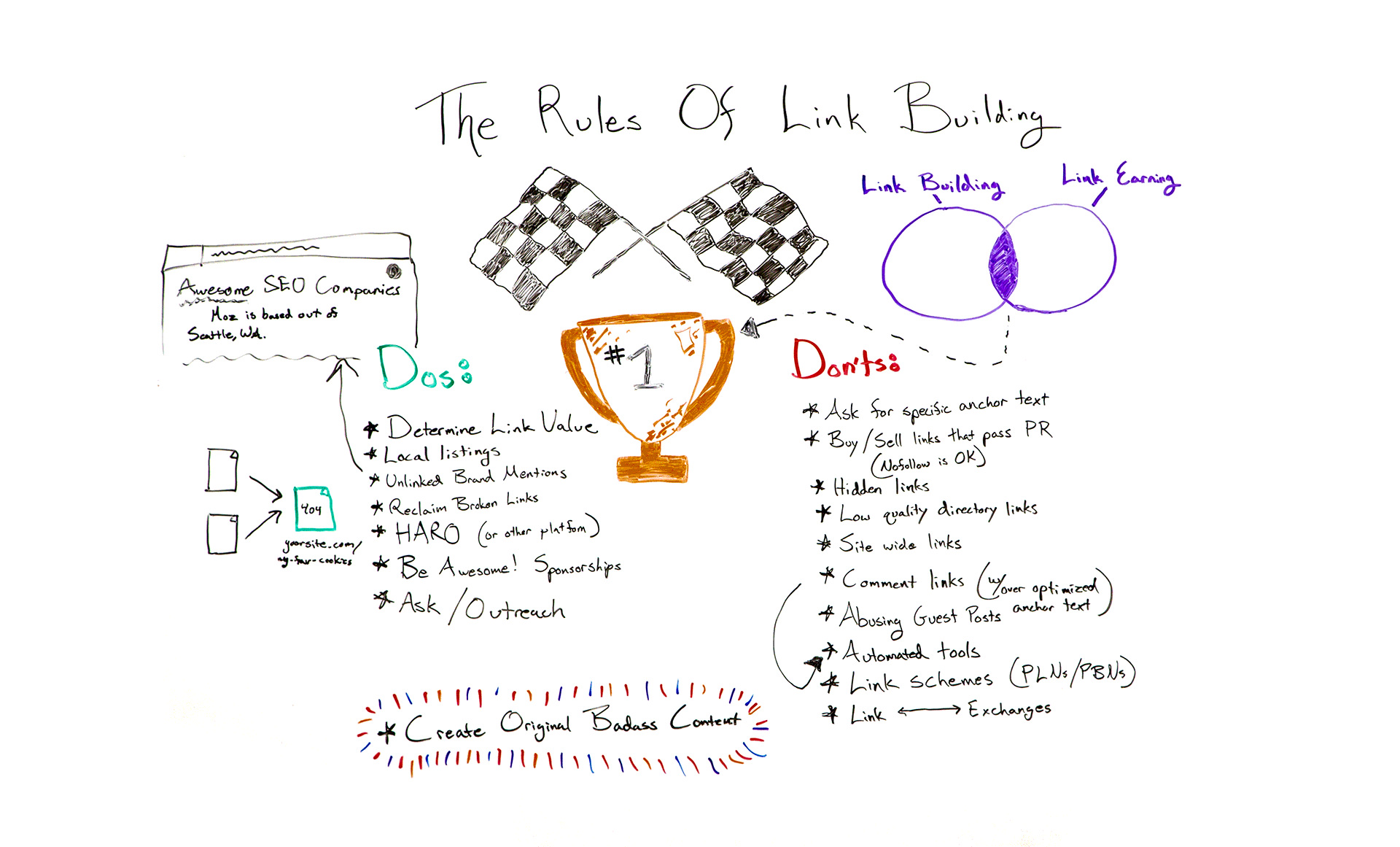
Negative SEO can hurt your website and your work in search, even when your rankings are unaffected by it. In this week’s Whiteboard Friday, search expert Russ Jones dives into what negative SEO is, what it can affect beyond rankings, and tips on how to fight it.
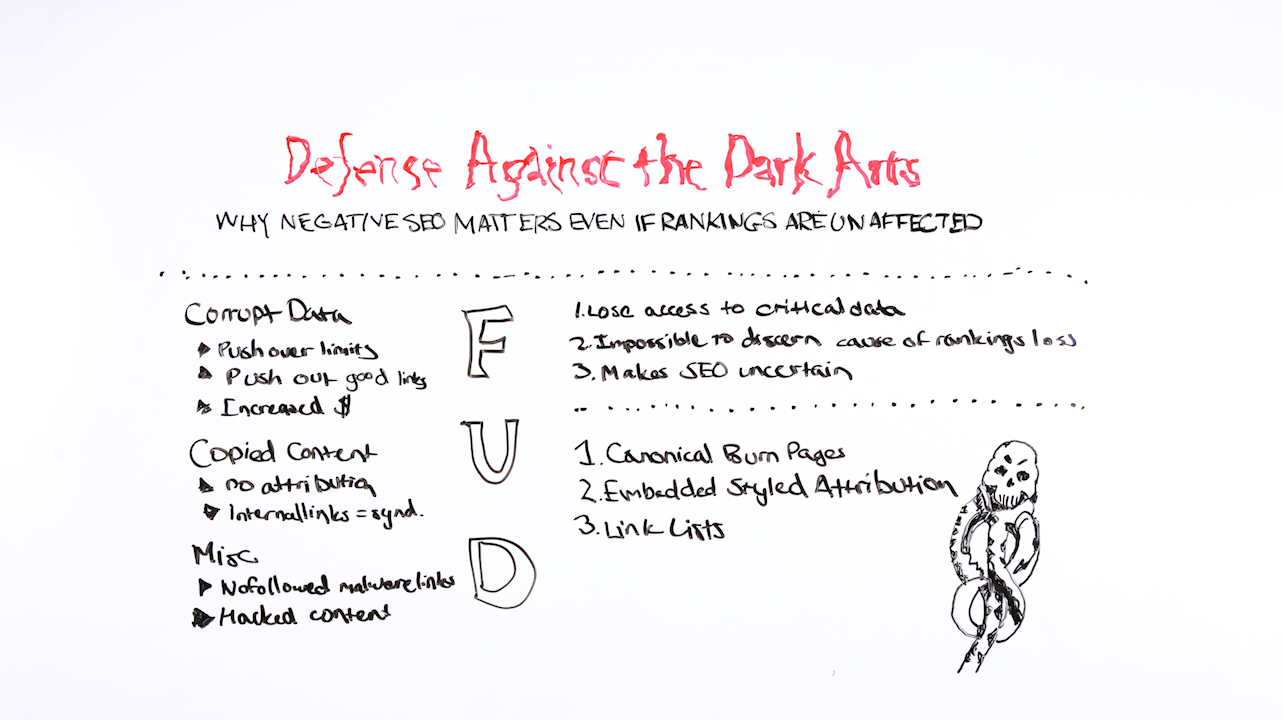
Click on the whiteboard image above to open a high resolution version in a new tab!

Video Transcription

All right, folks. Russ Jones here and I am so excited just to have the opportunity to do any kind of presentation with the title “Defense Against the Dark Arts.” I’m not going to pretend like I’m a huge Harry Potter fan, but anyway, this is just going to be fun.

But what I want to talk about today is actually pretty bad. It’s the reality that negative SEO, even if it is completely ineffective at doing its primary goal, which is to knock your website out of the rankings, will still play havoc on your website and the likelihood that you or your customers will be able to make correct decisions in the future and improve your rankings.

Today I’m going to talk about why negative SEO still matters even if your rankings are unaffected, and then I’m going to talk about a couple of techniques that you can use that will help abate some of the negative SEO techniques and also potentially make it so that whoever is attacking you gets hurt a little bit in the process, maybe. Let’s talk a little bit about negative SEO.

What is negative SEO?

The most common form of negative SEO is someone who would go out and purchase tens of thousands of spammy links or hundreds of thousands even, using all sorts of different software, and point them to your site with the hope of what we used to call “Google bowling,” which is to knock you out of the search results the same way you would knock down a pin with a bowling ball.

The hope is that it’s sort of like a false flag campaign, that Google thinks that you went out and got all of those spammy links to try to improve your rankings, and now Google has caught you and so you’re penalized. But in reality, it was someone else who acquired those links. Now to their credit, Google actually has done a pretty good job of ignoring those types of links.

It’s been my experience that, in most cases, negative SEO campaigns don’t really affect rankings the way they’re intended to in most cases, and I give a lot of caveats there because I’ve seen it be effective certainly. But in the majority of cases all of those spammy links are just ignored by Google. But that’s not it. That’s not the complete story. 

Problem #1: Corrupt data

You see, the first problem is that if you get 100,000 links pointing to your site, what’s really going on in the background is that there’s this corruption of data that’s important to making decisions about search results. 

Pushes you over data limits in GSC

For example, if you get 100,000 links pointing to your site, it is going to push you over the limit of the number of links that Google Search Console will give back to you in the various reports about links.

Pushes out the good links

This means that in the second case there are probably links, that you should know about or care about, that don’t show up in the report simply because Google cuts off at 100,000 total links in the export.

Well, that’s a big deal, because if you’re trying to make decisions about how to improve your rankings and you can’t get to the link data you need because it’s been replaced with hundreds of thousands of spammy links, then you’re not going to be able to make the right decision. 

Increased cost to see all your data

The other big issue here is that there are ways around it.

You can get the data for more than 100,000 links pointing to your site. You’re just going to have to pay for it. You could come to Moz and use our Link Explorer tool for example. But you’ll have to increase the amount of money that you’re spending in order to get access to the accounts that will actually deliver all of that data.

The one big issue sitting behind all of this is that even though we know Google is ignoring most of these links, they don’t label that for us in any kind of useful fashion. Even after we can get access to all of that link data, all of those hundreds of thousands of spammy links, we still can’t be certain which ones matter and which ones don’t.

Problem #2: Copied content

That’s not the only type of negative SEO that there is out there. It’s the most common by far, but there are other types. Another common type is to take the content that you have and distribute it across the web in the way that article syndication used to work. So if you’re fairly new to SEO, one of the old methodologies of improving rankings was to write an article on your site, but then syndicate that article to a number of article websites and these sites would then post your article and that article would link back to you.

Now the reason why these sites would do this is because they would hope that, in some cases, they would outrank your website and in doing so they would get some traffic and maybe earn some AdSense money. But for the most part, that kind of industry has died down because it hasn’t been effective in quite some time. But once again, that’s not the whole picture. 

No attribution

If all of your content is being distributed to all of these other sites, even if it doesn’t affect your rankings, it still means there’s the possibility that somebody is getting access to your quality content without any kind of attribution whatsoever.

If they’ve stripped out all of the links and stripped out all of the names and all of the bylines, then your hard earned work is actually getting taken advantage of, even if Google isn’t really the arbiter anymore of whether or not traffic gets to that article. 

Internal links become syndicated links

Then on the flip side of it, if they don’t remove the attribution, all the various internal links that you had in that article in the first place that point to other pages on your site, those now become syndicated links, which are part of the link schemes that Google has historically gone after.

In the same sort of situation, it’s not really just about the intent behind the type of negative SEO campaign. It’s the impact that it has on your data, because if somebody syndicates an article of yours that has let’s say eight links to other internal pages and they syndicate it to 10,000 websites, well, then you’ve just got 80,000 new what should have been internal links, now external links pointing to your site.

We actually do know just a couple of years back several pretty strong brands got in trouble for syndicating their news content to other news websites. Now I’m not saying that negative SEO would necessarily trigger that same sort of penalty, but there’s the possibility. Even if it doesn’t trigger that penalty, chances are it’s going to sully the waters in terms of your link data.

Problem #3: Nofollowed malware links & hacked content

There are a couple of other miscellaneous types of negative SEO that don’t get really talked about a lot. 

Nofollowed malware links in UGC

For example, if you have any kind of user-generated content on your site, like let’s say you have comments for example, even if you nofollow those comments, the links that are included in there might point to things like malware.

We know that Google will ultimately identify your site as not being safe if it finds these types of links. 

Hacked content

Unfortunately, in some cases, there are ways to make it look like there are links on your site that aren’t really under your control through things like HTML injection. For example, you can actually do this to Google right now.

You can inject HTML onto the page of part of their website that makes it look like they’re linking to someone else. If Google actually crawled itself, which luckily they don’t in this case, if they crawled that page and found that malware link, the whole domain in the Google search results would likely start to show that this site might not be safe.

Of course, there’s always the issue with hacked content, which is becoming more and more popular. 

Fear, uncertainty, and doubt

All of this really boils down to this concept of FUD — fear, uncertainty, and doubt. You see it’s not so much about bowling you out of the search engines. It’s about making it so that SEO just isn’t workable anymore.

1. Lose access to critical data

Now it’s been at least a decade since everybody started saying that they used data-driven SEO tactics, data-driven SEO strategies. Well, if your data is corrupted, if you lose access to critical data, you will not be able to make smart decisions. How will you know whether or not the reason your page has lost rankings to another has anything to do with links if you can’t get to the link data that you need because it’s been filled with 100,000 spammy links?

2. Impossible to discern the cause of rankings lost

This leads to number two. It’s impossible to discern the cause of rankings lost. It could be duplicate content. It could be an issue with these hundreds of thousands of links. It could be something completely different. But because the waters have been muddied so much, it makes it very difficult to determine exactly what’s going on, and this of course then makes SEO less certain.

3. Makes SEO uncertain

The less certain it becomes, the more other advertising channels become valuable. Paid search becomes more valuable. Social media becomes more valuable. That’s a problem if you’re a search engine optimization agency or a consultant, because you have the real likelihood of losing clients because you can’t make smart decisions for them anymore because their data has been damaged by negative SEO.

It would be really wonderful if Google would actually show us in Google Search Console what links they’re ignoring and then would allow us to export only the ones they care about. But something tells me that that’s probably beyond what Google is willing to share. So do we have any kind of way to fight back? There are a couple.

How do you fight back against negative SEO?

1. Canonical burn pages

Chances are if you’ve seen some of my other Whiteboard Fridays, you’ve heard me talk about canonical burn pages. Real simply, when you have an important page on your site that you intend to rank, you should create another version of it that is identical and that has a canonical link pointing back to the original. Any kind of link building that you do, you should point to that canonical page.

The reason is simple. If somebody does negative SEO, they’re going to have two choices. They’re either going to do it to the page that’s getting linked to, or they’re going to do it to the page that’s getting ranked. Normally, they’ll do it to the one that’s getting ranked. Well, if they do, then you can get rid of that page and just hold on to the canonical burn page because it doesn’t have any of these negative links.

Or if they choose the canonical burn page, you can get rid of that one and just keep your original page. Yes, it means you sacrifice the hard earned links that you acquired in the first place, but it’s better than losing the possibility in the future altogether. 

2. Embedded styled attribution

Another opportunity here, which I think is kind of sneaky and fun, is what I call embedded styled attribution.

You can imagine that my content might say “Russ Jones says so and so and so and so.” Well, imagine surrounding “Russ Jones” by H1 tags and then surrounding that by a span tag with a class that makes it so that the H1 tag that’s under it is the normal-sized text.

Well, chances are if they’re using one of these copied content techniques, they’re not copying your CSS style sheet as well. When that gets published to all of these other sites, in giant, big letters it has your name or any other phrase that you really want. Now this isn’t actually going to solve your problem, other than just really frustrate the hell out of whoever is trying to screw with you.

But sometimes that’s enough to get them to stop. 

3. Link Lists

The third one, the one that I really recommend is Link Lists. This is a feature inside of Moz’s Link Explorer, which allows you to track the links that are pointing to your site. As you get links, real links, good links, add them to a Link List, and that way you will always have a list of links that you know are good, that you can compare against the list of links that might be sullied by a negative SEO campaign.

By using the Link lists, you can discern the difference between what’s actually being ignored by Google, at least to some degree, and what actually matters. I hope this is helpful to some degree. But unfortunately, I’ve got to say, at the end of the day, a sufficiently well-run negative SEO campaign can make the difference in whether or not you use SEO in the future at all.

It might not knock you out of Google, but it might make it so that other types of marketing are just better choices. So hopefully this has been some help. I’d love to talk you in the comments about different ways of dealing with negative SEO, like how to track down who is responsible. So just go ahead and fill those comments up with any questions or ideas.

I would love to hear them. Thanks again and I look forward to talking to you in another Whiteboard Friday.

Video transcription by Speechpad.com

Sign up for The Moz Top 10, a semimonthly mailer updating you on the top ten hottest pieces of SEO news, tips, and rad links uncovered by the Moz team. Think of it as your exclusive digest of stuff you don’t have time to hunt down but want to read!

Benchmark for Success: What Your Vertical Can Achieve With Content Marketing

Posted by Domenica

You’ve produced a piece of content you thought was going to be a huge success, but the results were underwhelming.

You double and triple checked the content for all the crucial elements: it’s newsworthy, data-driven, emotional, and even a bit controversial, but it failed to “go viral”. Your digital PR team set out to pitch it, but writers didn’t bite.

So, what’s next?

Two questions you might ask yourself are:

  • Do I have unrealistic link expectations for my link-building content?
  • Is my definition of success backed by data-driven evidence?

Fractl has produced thousands of content marketing campaigns across every topic — sports, entertainment, fashion, home improvement, relationships — you name it. We also have several years’ worth of campaign performance data that we use to learn from our successes and mistakes.

In this article, I’m going to explain how businesses and agencies across seven different niches can set realistic expectations for their link-building content based on the performance of 626 content projects Fractl has produced and promoted in the last five years. I’ll also walk through some best practices for ensuring your content reaches its highest potential.

Managing expectations across verticals

You can’t compare apples to oranges. Each beat has its own unique challenges and advantages. Content for each vertical has to be produced with expert-level knowledge of how publishers within each vertical behave.

We selected the following common verticals for analysis:

  • Health and fitness
  • Travel
  • Sex and relationships
  • Finance
  • Technology
  • Sports
  • Food and drink

Across the entire sample of 626 content projects, on average, a project received 23 dofollow links and 88 press mentions in total. Some individual vertical averages didn’t deviate much from these averages, while others niches did.

Of course, you can’t necessarily expect these numbers when you just start dipping your toes in content marketing or digital PR. It’s a long-term investment, and it usually takes at least six months to a year before you get the results you’re looking for.

A “press mention” refers to any time a publisher wrote about the campaign. A press mention could involve any type of link (dofollow, nofollow, simple text attribution, etc.). We also looked at dofollow links individually, as they provide more value than a nofollow link or text attribution. For campaigns that went “viral” and performed well above the norm, we excluded them in the calculation so as not to skew the averages higher. 

Based on averages from these 626 campaigns, are your performance expectations too high or too low?

Vertical-specific content considerations

Of course, there are universal principles that you should apply to all content no matter the vertical. The data needs to be sound. The graphic assets need to be pleasing to the eye and easy to understand. The information needs to be surprising and informative.

But when it comes to vertical-specific content considerations, what should you pay attention to? What tactics or guidelines apply to one niche that you can disregard for other niches? I solicited advice from the senior team at Fractl and asked what they look out for when making content for different verticals. All have several years of experience producing and promoting content across every vertical and niche. Here’s what they said:

Sex and dating

For content relating to sex and relationships, it’s important to err on the side of caution.

“Be careful not to cross the line between ‘sexy’ content and raunchy content,” says Angela Skane, Creative Strategy. “The internet can be an exciting place, but if something is too out-there or too descriptive, publishers are going to be turned off from covering your content.”

Even magazine websites like Cosmopolitan — a publication known for its sex content — have editorial standards to make sure lines aren’t crossed. For example, when pitching a particularly risqué project exploring bedroom habits of men and women, we learned that just because a project is doing well over at Playboy or Maxim doesn’t mean it would resonate with the primarily female audience over at Cosmopolitan.

Especially be aware of anything that could be construed as misogynistic or pin women against each other. It’s likely not the message your client will want to promote, anyway.

Finance

Given the fact that money is frequently touted as one of the topics you avoid over polite dinner conversation, there’s no doubt that talking and thinking about money evokes a lot of emotion in people.

“Finance can seem dry at first glance, but mentions of money can evoke strong emotions. Tapping into financial frustrations, regrets, and mistakes makes for highly entertaining and even educational content,” says Corie Colliton, Creative Strategy. “For example, one of my best finance campaigns featured the purchases people felt their partners wasted money on. Another showed the amount people spend on holiday gifts — and the number who were in debt for a full year after the holidays as a result.”

Emotion is one of the drivers of social sharing, so use it to your advantage when producing finance-related content.

We also heard from Chris Lewis, Account Strategy: “Relate to your audience. Readers will often try to use financial content marketing campaigns as a way to benchmark their own financial well-being, so giving people lots of data about potential new norms helps readers relate to your content.”

People want to read content and be able to picture themselves within it. How do they compare to the rest of America, or their state, or their age group? Relatability is key in finance-related content.

Sports

A little healthy competition never hurt anyone, and that’s why Tyler Burchett, Promotions Strategy, thinks you should always utilize fan bases when creating sports content: “Get samples from different fan bases when possible. Writers like to pit fans against each other, and fans take pride in seeing how they rank.”

Food and drink

According to Chris Lewis, don’t forgo design when creating marketing campaigns about food: “Make sure to include good visuals. People eat with their eyes!”

If the topic for which you’re creating content typically has visual appeal, it’s best to take advantage of that to draw people into your content. Have you ever bought a recipe book that didn’t include photos of the food?

Technology

Think tech campaigns are just about tech? Think again. Matt Gillespie, Data Science, says: “Technology campaigns are always culture and human behavior campaigns. Comparing devices, social media usage, or more nuanced topics like privacy and security, can only resonate with a general audience if it ties to more common themes like connection, safety, or shared experience — tech savvy without being overly technical.”

Travel

When creating content for travel, it’s important to make sure there are actionable takeaways in the content. If there aren’t, it can be hard for publishers to justify covering it.

“Travel writers love to extract ‘tips’ from the content they’re provided. If your project provides helpful information to travelers or little-known statistics on flights and amenities, you’re likely to gain a lot of traction in the travel vertical,” says Delaney Kline, Brand Promotions. “Come up with these ideal statistics before creating your project and use them as a template for your work.”

Health and fitness

In the health and wellness world, it can seem like everyone is giving advice. If you’re not a doctor, however, err on the side of caution when speaking about specific topics. Try not to pit any particular standard against another. Be careful around diet culture and mental health topics, specifically.

“Try striking a balance between physical and mental well-being, particularly being careful to not glorify or objectify one standard while demeaning others,” says Matt Gillespie, Data Science. “Emphasize overall wellness as opposed to focus on a single area. In this vertical, you need to be especially careful with whatever is trending. Do the legwork to understand the research, or lack thereof, behind the big topics of the moment.”

Improving content in any vertical

While you can certainly tailor your content production and promotion to your specific niche, there are also some guidelines you can follow to improve the chances that you’ll get more media coverage for your content overall.

Create content with a headline in mind

When you begin mapping out your content, identify what you want the outcome to look like. Before you even begin, ask yourself: what do you want people to learn from your content? What are the elements of the content you’re producing that journalists will find compelling for their audiences?

For example, we wrote a survey in which we wanted to compare the levels of cooking experience across different generations. We hypothesized that we’d see some discrepancies between boomers and millennials specifically, and given that millennials ruin everything, it was a good time to join the discussion.

As it turns out, only 64% of millennials could correctly identify a butter knife. Publishers jumped at the stats revealing millennials have a tough time in the kitchen. Having a thesis and an idea of what we wanted the project to look like in advance had a tremendous positive impact on our results.

Appeal to the emotionality of people

In past research on the emotions that make content go viral, we learned that negative content may have a better chance of going viral if it is also surprising. Nothing embodies this combination of emotional drivers than a project we did for a travel client in which we used germ swabs to determine the dirtiest surfaces on airplanes.

This campaign did so well (and continues to earn links to this day) that it’s actually excluded from our vertical benchmarks analysis as we consider it a viral outlier.

Why did this idea work? Most people travel via plane at least once a year, and everyone wants to avoid getting sick while traveling. So, a data-backed report like this one that also yielded some click-worthy headlines is sure to exceed your outreach goals.

Evergreen content wins (sometimes)

You may have noticed from the analysis above that, of the seven topics we chose to look at, the sports vertical has the lowest average dofollows and total press mentions of any other category.

For seasoned content marketers, this is very understandable. Unlike the other verticals, the sports beat is an ever-changing and fast-paced news cycle that’s hard for content marketers to have a presence in. However, for our sports clients we achieve success by understanding this system and working with it — not trying to be louder than it.

One technique we’ve found that works for sports campaigns (as well as other sectors with fast-paced news cycles such as entertainment or politics) is to come up with content that is both timely and evergreen. By capitalizing on the current interests around major sporting events (timely) and creating an idea that would work on any given day of the year (evergreen) we can produce content that’s the best of both worlds, and that will still have legs once the timeliness wears off.

In a series of campaigns for one sports client, we took a look at the evolution of sports jerseys and chose teams with loyal fan bases such as the New York Yankees, Carolina Panthers, Denver Broncos, and Chicago Bears.

The sports niche has an ongoing, fast-paced news cycle that changes every day, if not every hour. Reporters are busy covering by-the-minute breaking news, games, statistics, rankings, trades, personal player news, and injuries. This makes it one of the most challenging verticals to compete in. By capitalizing on teams of interest throughout the year, we were able to squeeze projects into tight editorial calendars and earn our client some press.

For example, timing couldn’t have been better when we pitched “Evolution of the Football Jersey”. We pitched this campaign to USA Today right before the tenacious playoffs in which the Steelers and the Redskins played. Time was of the essence — the editor wrote and published this article within 24 hours and our client enjoyed a lot of good syndication from the powerful publication. In total, the one placement resulted in 15 dofollow links and over 45 press mentions. Not bad for a few transforming GIFs!

Top it off with the best practices in pitching

If you have great content and you have a set of realistic expectations for that content, all that’s left is to distribute it and collect those links and press mentions.

Moz has previously covered some of the best outreach practices for promoting your content to top-tier publishers, but I want to note that when it comes to PR, what you do is just as important as what you don’t do.

In a survey of over 500 journalists in 2019, I asked online editors and writers what their biggest PR pitch pet peeves were. When you conduct content marketing outreach, avoid these top-listed items and you’ll be good to go:


While you might get away with sending one too many follow-ups, most of the offenses on this list are just that — totally offensive to the writer you’re trying to pitch.

Avoid mass email blasts, personalize your pitch, and triple-check that the person you’re contacting is receptive to your content before you hit send.

Conclusion

While there are certainly some characteristics that all great content should have, there are ways to increase the chances your content will be engaging within a specific vertical. Research what your particular audience is interested in, and be sure to measure your results realistically based on how content generally performs in your space.

Sign up for The Moz Top 10, a semimonthly mailer updating you on the top ten hottest pieces of SEO news, tips, and rad links uncovered by the Moz team. Think of it as your exclusive digest of stuff you don’t have time to hunt down but want to read!

Heart, Ear, Eye, Mind, Mouth: Local SEO Exercises for Your Least Technical Clients

Posted by MiriamEllis

When was the last time you relaxed with a client?

As a local business consultant, I know that deeper marketing insights can be discovered when you set aside formality and share experiences: a moment, a laugh, a common bond. 

When I’m looking for ways to make life easier for a client, I sometimes reflect on ancient practices like yoga, tai chi, and mindful breathing, which are increasingly understood as beneficial to human health. For a space in time, they reduce the complex world we live in to a simpler one where being, breath, movement, and focus bring the practitioner to a more intuitive state. 

Local marketing agencies can empathize with the complex world their clients inhabit. Local business owners must manage everything from rent and employee benefits to customer service, business reviews, web content, and online listings. When you take on a new client, you expect them to onboard a ton of information about marketing their brand online. Sometimes, the most basic motivations go unaddressed and get lost in assumptions and jargon — instead of decreasing client stress for your least technical clients, you can accidentally increase it. 

Today, I’ll help you newly create an intuitive space by sharing five simple meditation exercises you can use with your agency’s clients. Instead of signaling via SEO, CTR, USPs, and GMB, let’s relax with clients by relating successful local search marketing practices to experiences people at any level of technical proficiency already understand.

Heart

To show their heart is in the right place, the Vermont Country Store publishes a customer bill of rights.

For a local business owner, there is no more important quality than having their heart in the right place when it comes to their motivation for running a company.

Yes, all of us work to earn money, but it’s the dedication to serving others that is felt by customers in every interaction with them. When customers feel that a business is there for them, it establishes the loyalty and reputation that secure local search marketing success. 

Heart meditation

Close your eyes for a few seconds and think of a time in your life when you most needed help from a business. Maybe you needed a tow truck, a veterinarian, a dentist, or a plumber. You really needed them to understand your plight, deliver the right help, and treat you as an important person who is worthy of respect. Whether you received what you required or not, remember the feeling of need. 

Now, extend that recognition beyond your own heart to the heart of every customer who feels a need for something your client can offer them.

A business owner with their heart in the right place can powerfully contribute to local search marketing by:

  • Running a customer-centric business.
  • Creating customer guarantees that are fair.
  • Creating an employee culture of respect and empowerment that extends to customers.
  • Creating a location that is clean, functional, and pleasant for all.
  • Honestly representing their products, services, location, and reputation.
  • Refraining from practices that negatively impact their customers and reputation.
  • Participating positively in the life of the community they serve.

A good local search marketing agency will help the business owner translate these basics into online content that meets customer needs, local business listings that accurately and richly represent the business, and genuine reviews that serve as a healthy and vital ongoing conversation between the brand and its customers. A trustworthy agency will ensure avoidance of any tactics that pollute the Internet with spam listings, spam reviews, negative attacks on competitors, and negative impacts on the service community. An excellent agency will also assist in finding and promoting community engagement opportunities, helping to win desirable online publicity from offline efforts.

Ear

Keter Salon of Berkeley, Calif. really listens to customers and it shows in its reviews.

Local business success is so linked to the art of listening, I sometimes think Google should replace their teardrop map markers with little ears. In the local SEO world, there are few things sadder than seeing local business profiles filled with disregarded reviews, questions, and negative photos. (Someone cue “The Sound of Silence”.)

From a business perspective, the sound of branded silence is also the sound of customers and profits trickling away. Why does it work this way? Because only 4% of your unhappy customers may actually make the effort to speak up, and if a business owner is not even hearing them, they’ve lost the ability to hear consumer demand. Let’s make sure this doesn’t happen.

Ear meditation

Close your eyes for a few seconds and listen closely to every noise within the range of your hearing. Ask yourself, “Where am I?”

The sound of typing, phone calls, and co-workers chatting might place you in an office. Sliding doors, footsteps on linoleum, and floor staff speaking might mean you’re at your client’s brick-and-mortar location. Maybe it’s birdsong outside and the baby in their crib that tell you you’re working from home today. Listen to every sound that tells you exactly where you are right now.

Now, commit to listening with this level of attention and intention to the signals of customer voices, telling you exactly where a local brand is right now in terms of faults and successes. 

A business owner who keeps their ears open can actively gauge how their business is really doing with its customers by:

  • Having one-on-one conversations with customers.
  • Recording and analyzing phone conversations with customers.
  • Reading reviews on platforms like Google My Business, Yelp, Facebook and sites that are specific to their industry (like Avvo for lawyers or Healthgrades for physicians).
  • Reading the Q&A questions of customers on their Google Business Profile.
  • Reading mentions of their brand on social media platforms like Twitter, Facebook, and Instagram.
  • Reading the responses to surveys they conduct.
  • Reading the emails and form submissions the company receives.

A good local search marketing agency will help their client amass, organize, and analyze all of this sentiment to discover the current reputation of the business. From this information, you and your client can chart a course for improvement. Consider that, in this study, a 1.5 star improvement in online reputation increased consumer activity by 10%-12% and generated 13,000 more leads for the brands included. The first step to a better reputation is simply listening. 

Eye

Moz’s Local Market Analytics (Beta) helps you see your market through customer location emulation.

When your clients choose their business locations, they weigh several factors. They compare how the mantra of “location, location, location” matches their budget, and whether a certain part of town is lacking something their business could provide. They also look at the local competitors to see if the competition would be hard to beat, or if they could do the job better. Success lies in truly seeing the lay of the land.

Local search mirrors the real world. The market on the Internet is made up of the physical locations of your clients’ customers at the time they search for what your client has to offer. 

Eye meditation

You already know most of the businesses on your street, and many of them in your neighborhood. Now, with eyes wide open, start searching Google for the things your listening work has told you customers need. Where appropriate, include attributes you’ve noticed them using like “best tacos near me”, “cheapest gym in North Beach”, or “shipping store downtown.”

See how your client is ranking when a person does these type of searches while at their location. Now, walk or drive a few blocks away and try again. Go to the city perimeter and try again. Where are they ranking, and who is outranking them as you move about their geographic market?

A local business keeping its eyes open never makes assumptions about who its true competitors are or how its customers search. Instead, it:

  • Regularly assesses the competition in its market, taking into account the distance from which customers are likely to come for goods and services.
  • Regularly reviews materials assembled in the listening phase to see how customers word their requests and sentiments.
  • Makes use of tools to analyze both markets and keyword searches.

A good local search marketing agency will help with the tools needed for market and search language analysis. These findings can inform everything from what a client names their business, to how they categorize it on their Google My Business listing, to what they write about to draw in customers from all geographic points in their market. Clear vision simultaneously enables you to analyze competitors who are outranking your client and assess why they’re doing so. It can empower your client to report spammers who are outranking them via forbidden tactics. An excellent agency will help their client see their competitive landscape with eyes on the prize.

Mind

When an independent Arizona appliance chain surprised three shoppers with $10,000, it made headlines.

With hearts ready for service, ears set on listening, and eyes determined to see, you and your client have now taken in useful information about their brand and the customers who make up their local market. You know now whether they’re doing a poor, moderate, or exceptional job of fulfilling needs, and are working with them to strategize next steps. But what are those next steps? 

Mind meditation

Sit back comfortably and think of a time a business completely surprised you, or a time when an owner or employee did something so unexpectedly great, it convinced you that you were in good hands. Maybe they comped your meal when it wasn’t prepared properly, or special-ordered an item just for you, or showed you how to do something you’d never thought of before.

Recall that lightbulb moment of delight. Ask yourself how your client’s brand could surprise customers in memorable ways they would love. Create a list of those ideas.

A creative local business gives full play to the awesome imaginative powers of the brain. It gives all staff permission to daydream and brainstorm questions like:

  • What is something unexpected the business could do that would come as a delightful surprise to customers?
  • What is the most impactful thing the business could do that would be felt as a positive force in the lives of its customers?
  • What risks can the business take for the sake of benevolence, social good, beauty, renown, or joy?

A good local search marketing agency will help sort through ideas that could truly differentiate their clients from the competition and bring them closer to making the kinds of impressions that turn local brands into household names. An excellent agency will bring ideas of their own. Study “surprise and delight marketing” as it’s done on the large, corporate scale, and get it going at a local level like this small coffee roaster in Alexandria, Va. selling ethical java while doubling as funding for LGBTQ+ organizations. 

Mouth

Put your best stories everywhere, like in this social media example. Moz Local can help with publishing those stories.

“Think before you speak” is an old adage that serves well as a marketing guideline. Another way we might say it is “research before you publish”. With heart, ear, eye, and mind, you and your client have committed, collected, analyzed, and ideated their brand to a point where it’s ready to address the public from a firm foundation.

Mouth meditation

Open your favorite word processor on your computer and type a few bars of the lyrics to your favorite song. Next, type the first three brand slogans that come to your mind. Next, type a memorable line from a movie or book. Finally, type out the the words of the nicest compliment or best advice someone ever gave you. 

Sit back and look at your screen. Look at how those words have stuck in your mind — you remember them all! The people who wrote and spoke those words have indelibly direct-messaged you. 

How will you message the public in a way that’s unforgettable?

A well-spoken local business masters the art of face-to-face customer conversation. In-store signage and offline media require great words, too, but local search marketing will take spoken skills onto the web, where they’ll be communicated via:

  • Every page of the website 
  • Every article or blog post 
  • Social media content
  • Review responses
  • Answers to questions like Google Business Profile Q&A
  • Business descriptions on local business listings
  • Google posts
  • Featured snippet content
  • Live chat
  • Email
  • Press releases
  • Interviews
  • Images on the website, business listings, and third-party platforms like Google Images and Pinterest
  • Videos on the website, YouTube, and other platforms

A good local search marketing agency will help their client find the best words, images, and videos based on all the research done together. An excellent agency will help a local business move beyond simply being discovered online to being remembered as a household name each time customer needs arise. An agency should help their clients earn links, unstructured citations, and other forms of publicity from those research efforts.

Determine to help your client be the “snap, crackle, pop”, “un-Cola”, “last honest pizza” with everything you publish for their local market, and to build an Internet presence that speaks well of their business 24-hours a day.

Closing pose


One of the most encouraging aspects of running and marketing a local business is that it’s based on things you already have some life experience doing: caring, listening, observing, imagining, and communicating. 

I personally should be better at technical tasks like diagnosing errors in Schema, configuring Google Search Console for local purposes, or troubleshooting bulk GMB uploads. I can work at improving in those areas, but I can also work at growing my heart, ear, eye, mind, and mouth to master serving clients and customers.

Business is technical. Business is transactional. But good business is also deeply human, with real rewards for well-rounded growth.

Sign up for The Moz Top 10, a semimonthly mailer updating you on the top ten hottest pieces of SEO news, tips, and rad links uncovered by the Moz team. Think of it as your exclusive digest of stuff you don’t have time to hunt down but want to read!

2020 Google Search Survey: How Much Do Users Trust Their Search Results?

Posted by LilyRayNYC

While Google’s mission has always been to surface high-quality content, over the past few years the company has worked especially hard to ensure that its search results are also consistently accurate, credible, and trustworthy.

Reducing false and misleading information has been a top priority for Google since concerns over misinformation surfaced during the 2016 US presidential election. The search giant is investing huge sums of money and brain power into organizing the ever-increasing amounts of content on the web in a way that prioritizes accuracy and credibility.

In a 30-page whitepaper published last year, Google delineates specifically how it fights against bad actors and misinformation across Google Search, News, Youtube, Ads, and other Google products.

In this whitepaper, Google explains how Knowledge Panels — a common organic search feature — are part of its initiative to show “context and diversity of perspectives to form their own views.” With Knowledge Panel results, Google provides answers to queries with content displayed directly in its organic search results (often without including a link to a corresponding organic result), potentially eliminating the need for users to click through to a website to find an answer to their query. While this feature benefits users by answering their questions even more quickly, it brings with it the danger of providing quick answers that might be misleading or incorrect.

Another feature with this issue is Featured Snippets, where Google pulls website content directly into the search results. Google maintains specific policies for Featured Snippets, prohibiting the display of content that is sexually explicit, hateful, violent, dangerous, or in violation of expert consensus on civic, medical, scientific, or historical topics. However, this doesn’t mean the content included in Featured Snippets is always entirely accurate.

According to data pulled by Dr. Pete Meyers, based on a sample set of 10,000 keywords, Google has increased the frequency with which it displays Featured Snippets as part of the search results. In the beginning of 2018, Google displayed Featured Snippets in approximately 12% of search results; in early 2020, that number hovers around 16%.

Google has also rolled out several core algorithm updates in the past two years, with the stated goal of “delivering on [their] mission to present relevant and authoritative content to searchers.” What makes these recent algorithm updates particularly interesting is how much E-A-T (expertise, authoritativeness, and trustworthiness) appears to be playing a role in website performance, particularly for YMYL (your money, your life) websites.

As a result of Google’s dedication to combating misinformation and fake news, we could reasonably expect searchers to agree that Google has improved in its ability to surface credible and trusted content. But does the average searcher actually feel that way? At Path Interactive, we conducted a survey to find out how users feel about the information they encounter in Google’s organic results.

About our survey respondents and methodology

Out of 1,100 respondents, 70% of live in the United States, 21% in India, and 5% in Europe. 63% of respondents are between the ages of 18 and 35, and 17% are over the age of 46. All respondent data is self-reported.

For all questions involving specific search results or types of SERP features, respondents were provided with screenshots of those features. For questions related to levels of trustworthiness or the extent to which the respondent agreed with the statement, respondents were presented with answers on a scale of 1-5.

Our findings

Trustworthiness in the medical, political, financial, and legal categories

Given how much fluctuation we’ve seen in the YMYL category of Google with recent algorithm updates, we thought it would be interesting to ask respondents how much they trust the medical, political, financial, and legal information they find on Google.

We started by asking respondents about the extent to which they have made important financial, legal, or medical decisions based on information they found in organic search. The majority (51%) of respondents indicated that they “very frequently” or “often” make important life decisions based on Google information, while 39% make important legal decisions, and 46% make important medical decisions. Only 10-13% of respondents indicated that they never make these types of important life decisions based on the information they’ve found on Google.

Medical searches

As it relates to medical searches, 72% of users agree or strongly agree that Google has improved at showing accurate medical results over time.

Breaking down these responses by age, a few interesting patterns emerge:

  • The youngest searchers (ages 18-25) are 94% more likely than the oldest searchers (65+) to strongly believe that Google’s medical results have improved over time.
  • 75% of the youngest searchers (ages 18-25) agree or strongly agree that Google has improved in showing accurate medical searches over time, whereas only 54% of the oldest searchers (65+) feel the same way.
  • Searchers ages 46-64 are the most likely to disagree that Google’s medical results are improving over time.

Next, we wanted to know if Google’s emphasis on surfacing medical content from trusted medical publications — such as WebMD and the Mayo Clinic — is resonating with its users. One outcome of recent core algorithm updates is that Google’s algorithms appear to be deprioritizing content that contradicts scientific and medical consensus (consistently described as a negative quality indicator throughout their Search Quality Guidelines).

The majority (66%) of respondents agree that it is very important to them that Google surfaces content from highly trusted medical websites. However, 14% indicated they would rather not see these results, and another 14% indicated they’d rather see more diverse results, such as content from natural medicine websites. These numbers suggest that more than a quarter of respondents may be unsatisfied with Google’s current health initiatives aimed at surfacing medical content from a set of acclaimed partners who support the scientific consensus.

We asked survey respondents about Symptom Cards, in which information related to medical symptoms or specific medical conditions is surfaced directly within the search results.

Examples of Symptom Cards. Source: https://blog.google/products/search/im-feeling-yucky-searching-for-symptoms/

Our question aimed to gather how much searchers felt the content within Symptom Cards can be trusted.

The vast majority (76%) of respondents indicated they trust or strongly trust the content within Symptom Cards.

When looking at the responses by age, younger searchers once again reveal that they are much more likely than older searchers to strongly trust the medical content found within Google. In fact, the youngest bracket of searchers (ages 18-25) are 138% more likely than the oldest searchers (65+) to strongly trust the medical content found in Symptom Cards.

News and political searches

The majority of respondents (61%) agree or strongly agree that Google has improved at showing high-quality, trustworthy news and political content over time. Only 13% disagree or strongly disagree with this statement.

Breaking the same question down by age reveals interesting trends:

  • The majority (67%) of the youngest searchers (ages 18-25) agree that the quality of Google’s news and political content has improved over time, whereas the majority (61%) of the oldest age group (65+) only somewhat agrees or disagrees.
  • The youngest searchers (ages 18-25) are 250% more likely than the oldest searchers to strongly agree that the quality of news and political content on Google is improving over time.

Misinformation

Given Google’s emphasis on combating misinformation in its search results, we also wanted to ask respondents about the extent to which they feel they still encounter dangerous or highly untrustworthy information on Google.

Interestingly, the vast majority of respondents (70%) feel that they have encountered misinformation on Google at least sometimes, although 29% indicate they rarely or never see misinformation in the results.

Segmenting the responses by age groups reveals a clear pattern that the older the searcher, the more likely they are to indicate that they have seen misinformation in Google’s search results. In fact, the oldest searchers (65+) are 138% more likely than the youngest searchers (18-25) to say they’ve encountered misinformation on Google either often or very frequently.

Throughout the responses to all questions related to YMYL topics such as health, politics, and news, a consistent pattern emerged that the youngest searchers appear to have more trust in the content Google displays for these queries, and that older searchers are more skeptical.

This aligns with our findings from a similar survey we conducted last year, which found that younger searchers were more likely to take much of the content displayed directly in the SERP at face value, whereas older searchers were more likely to browse deeper into the organic results to find answers to their queries.

This information is alarming, especially given another question we posed asking about the extent to which searchers believe the information they find on Google influences their political opinions and outlook on the world.

The question revealed some interesting trends related to the oldest searchers: according to the results, the oldest searchers (65+) are 450% more likely than the youngest searchers to strongly disagree that information they find on Google influences their worldview.

However, the oldest searchers are also most likely to agree with this statement; 11% of respondents ages 65+ strongly agree that Google information influences their worldview. On both ends of the spectrum, the oldest searchers appear to hold stronger opinions about the extent to which Google influences their political opinions and outlook than respondents from other age brackets.

Featured Snippets and the Knowledge Graph

We also wanted to understand the extent to which respondents found the content contained within Featured Snippets to be trustworthy, and to segment those responses by age brackets. As with the other scale-based questions, respondents were asked to indicate how much they trusted these features on a scale of 1-5 (Likert scale).

According to the results, the youngest searchers (ages 18-25) are 100% more likely than the oldest searchers (ages 65+) to find the content within Featured Snippets to be very trustworthy. This aligns with a similar discovery we found in our survey from last year: “The youngest searchers (13–18) are 220 percent more likely than the oldest searchers (70–100) to consider their question answered without clicking on the snippet (or any) result.”

For Knowledge Graph results, the results are less conclusive when segmented by age. 95% of respondents across all age groups find the Knowledge Panel results to be at least “trustworthy.”

Conclusion: Young users trust search results more than older users

In general, the majority of survey respondents appear to trust the information they find on Google — both in terms of the results themselves, as well as the content they find within SERP features such as the Knowledge Panel and Featured Snippets. However, there still appears to be a small subset of searchers who are dissatisfied with Google’s results. This subset consists of mostly older searchers who appear to be more skeptical about taking Google’s information at face value, especially for YMYL queries.

Across almost all survey questions, there is a clear pattern that the youngest searchers tend to trust the information they find on Google more so than the older respondents. This aligns with a similar survey we conducted last year, which indicated that younger searchers were more likely to accept the content in Featured Snippets and Knowledge Panels without needing to click on additional results on Google.

It is unclear whether younger searchers trust information from Google more because the information itself has improved, or because they are generally more trusting of information they find online. These results may also be due to older searchers not having grown up with the ability to rely on internet search engines to answer their questions. Either way, the results raise an interesting question about the future of information online: will searchers become less skeptical of online information over time?

Sign up for The Moz Top 10, a semimonthly mailer updating you on the top ten hottest pieces of SEO news, tips, and rad links uncovered by the Moz team. Think of it as your exclusive digest of stuff you don’t have time to hunt down but want to read!

The Rules of Link Building – Best of Whiteboard Friday

Posted by BritneyMuller

Are you building links the right way? Or are you still subscribing to outdated practices? Britney Muller clarifies which link building tactics still matter and which are a waste of time (or downright harmful) in one of our very favorite classic episodes of Whiteboard Friday.

The Rules of Link Building

Click on the whiteboard image above to open a high-resolution version in a new tab!

Video Transcription

Happy Friday, Moz fans! Welcome to another edition of Whiteboard Friday. Today we are going over the rules of link building. It’s no secret that links are one of the top three ranking factors in Google and can greatly benefit your website. But there is a little confusion around what’s okay to do as far as links and what’s not. So hopefully, this helps clear some of that up.

The Dos

All right. So what are the dos? What do you want to be doing? First and most importantly is just to…

I. Determine the value of that link. So aside from ranking potential, what kind of value will that link bring to your site? Is it potential traffic? Is it relevancy? Is it authority? Just start to weigh out your options and determine what’s really of value for your site. Our own tool, Moz Link Explorer, can 

II. Local listings still do very well. These local business citations are on a bunch of different platforms, and services like Moz Local or Yext can get you up and running a little bit quicker. They tend to show Google that this business is indeed located where it says it is. It has consistent business information — the name, address, phone number, you name it. But something that isn’t really talked about all that often is that some of these local listings never get indexed by Google. If you think about it, Yellowpages.com is probably populating thousands of new listings a day. Why would Google want to index all of those?

So if you’re doing business listings, an age-old thing that local SEOs have been doing for a while is create a page on your site that says where you can find us online. Link to those local listings to help Google get that indexed, and it sort of has this boomerang-like effect on your site. So hope that helps. If that’s confusing, I can clarify down below. Just wanted to include it because I think it’s important.

III. Unlinked brand mentions. One of the easiest ways you can get a link is by figuring out who is mentioning your brand or your company and not linking to it. Let’s say this article publishes about how awesome SEO companies are and they mention Moz, and they don’t link to us. That’s an easy way to reach out and say, “Hey, would you mind adding a link? It would be really helpful.”

IV. Reclaiming broken links is also a really great way to kind of get back some of your links in a short amount of time and little to no effort. What does this mean? This means that you had a link from a site that now your page currently 404s. So they were sending people to your site for a specific page that you’ve since deleted or updated somewhere else. Whatever that might be, you want to make sure that you 301 this broken link on your site so that it pushes the authority elsewhere. Definitely a great thing to do anyway.

V. HARO (Help a Reporter Out). Reporters will notify you of any questions or information they’re seeking for an article via this email service. So not only is it just good general PR, but it’s a great opportunity for you to get a link. I like to think of link building as really good PR anyway. It’s like digital PR. So this just takes it to the next level.

VI. Just be awesome. Be cool. Sponsor awesome things. I guarantee any one of you watching likely has incredible local charities or amazing nonprofits in your space that could use the sponsorship, however big or small that might be. But that also gives you an opportunity to get a link. So something to definitely consider.

VII. Ask/Outreach. There’s nothing wrong with asking. There’s nothing wrong with outreach, especially when done well. I know that link building outreach in general kind of gets a bad rap because the response rate is so painfully low. I think, on average, it’s around 4% to 7%, which is painful. But you can get that higher if you’re a little bit more strategic about it or if you outreach to people you already currently know. There’s a ton of resources available to help you do this better, so definitely check those out. We can link to some of those below.

VIII. COBC (create original badass content). We hear lots of people talk about this. When it comes to link building, it’s like, “Link building is dead. Just create great content and people will naturally link to you. It’s brilliant.” It is brilliant, but I also think that there is something to be said about having a healthy mix. There’s this idea of link building and then link earning. But there’s a really perfect sweet spot in the middle where you really do get the most bang for your buck.

The Don’ts

All right. So what not to do. The don’ts of today’s link building world are…

I. Don’t ask for specific anchor text. All of these things appear so spammy. The late Eric Ward talked about this and was a big advocate for never asking for anchor text. He said websites should be linked to however they see fit. That’s going to look more natural. Google is going to consider it to be more organic, and it will help your site in the long run. So that’s more of a suggestion. These other ones are definitely big no-no’s.

II. Don’t buy or sell links that pass PageRank. You can buy or sell links that have a no-follow attached, which attributes that this is paid-for, whether it be an advertisement or you don’t trust it. So definitely looking into those and understanding how that works.

III. Hidden links. We used to do this back in the day, the ridiculous white link on a white background. They were totally hidden, but crawlers would pick them up. Don’t do that. That’s so old and will not work anymore. Google is getting so much smarter at understanding these things.

IV. Low-quality directory links. Same with low-quality directory links. We remember those where it was just loads and loads of links and text and a random auto insurance link in there. You want to steer clear of those.

V. Site-wide links also look very spammy. Site-wide being whether it’s a footer link or a top-level navigation link, you definitely don’t want to go after those. They can appear really, really spammy. Avoid those.

VI. Comment links with over-optimized anchor link text, specifically, you want to avoid. Again, it’s just like any of these others. It looks spammy. It’s not going to help you long-term. Again, what’s the value of that overall? So avoid that.

VII. Abusing guest posts. You definitely don’t want to do this. You don’t want to guest post purely just for a link. However, I am still a huge advocate, as I know many others out there are, of guest posting and providing value. Whether there be a link or not, I think there is still a ton of value in guest posting. So don’t get rid of that altogether, but definitely don’t target it for potential link building opportunities.

VIII. Automated tools used to create links on all sorts of websites. ScrapeBox is an infamous one that would create the comment links on all sorts of blogs. You don’t want to do that.

IX. Link schemes, private link networks, and private blog networks. This is where you really get into trouble as well. Google will penalize or de-index you altogether. It looks so, so spammy, and you want to avoid this.

X. Link exchange. This is in the same vein as the link exchanges, where back in the day you used to submit a website to a link exchange and they wouldn’t grant you that link until you also linked to them. Super silly. This stuff does not work anymore, but there are tons of opportunities and quick wins for you to gain links naturally and more authoritatively.

So hopefully, this helps clear up some of the confusion. One question I would love to ask all of you is: To disavow or to not disavow? I have heard back-and-forth conversations on either side on this. Does the disavow file still work? Does it not? What are your thoughts? Please let me know down below in the comments.

Thank you so much for tuning in to this edition of Whiteboard Friday. I will see you all soon. Thanks.

Video transcription by Speechpad.com

Sign up for The Moz Top 10, a semimonthly mailer updating you on the top ten hottest pieces of SEO news, tips, and rad links uncovered by the Moz team. Think of it as your exclusive digest of stuff you don’t have time to hunt down but want to read!

How Low Can #1 Go? (2020 Edition)

Posted by Dr-Pete

Being #1 on Google isn’t what it used to be. Back in 2013, we analyzed 10,000 searches and found out that the average #1 ranking began at 375 pixels (px) down the page. The worst case scenario, a search for “Disney stock,” pushed #1 all the way down to 976px.

A lot has changed in seven years, including an explosion of rich SERP (Search Engine Results Page) features, like Featured Snippets, local packs, and video carousels. It feels like the plight of #1 is only getting worse. So, we decided to run the numbers again (over the same searches) and see if the data matches our perceptions. Is the #1 listing on Google being pushed even farther down the page?

I try to let the numbers speak for themselves, but before we dig into a lot of stats, here’s one that legitimately shocked me. In 2020, over 1,600 (16.6%) of the searches we analyzed had #1 positions that were worse than the worst-case scenario in 2013. Let’s dig into a few of these …

What’s the worst-case for #1?

Data is great, but sometimes it takes the visuals to really understand what’s going on. Here’s our big “winner” for 2020, a search for “lollipop” — the #1 ranking came in at an incredible 2,938px down. I’ve annotated the #1 position, along with the 1,000px and 2,000px marks …

At 2,938px, the 2020 winner comes in at just over three times 2013’s worst-case scenario. You may have noticed that the line is slightly above the organic link. For the sake of consistency and to be able to replicate the data later, we chose to use the HTML/CSS container position. This hits about halfway between the organic link and the URL breadcrumbs (which recently moved above the link). This is a slightly more conservative measure than our 2013 study.

You may also have noticed that this result contains a large-format video result, which really dominates page-one real estate. In fact, five of our top 10 lowest #1 results in 2020 contained large-format videos. Here’s the top contender without a large-format video, coming in at fourth place overall (a search for “vacuum cleaners”) …

Before the traditional #1 organic position, we have shopping results, a research carousel, a local pack, People Also Ask results, and a top products carousel with a massive vertical footprint. This is a relentlessly commercial result. While only a portion of it is direct advertising, most of the focus of the page above the organic results is on people looking to buy a vacuum.

What about the big picture?

It’s easy — and more than a little entertaining — to cherry-pick the worst-case scenarios, so let’s look at the data across all 10,000 results. In 2013, we only looked at the #1 position, but we’ve expanded our analysis in 2020 to consider all page-one organic positions. Here’s the breakdown …

The only direct comparison to 2013 is the position #1 row, and you can see that every metric increased, some substantially. If you look at the maximum Y-position by rank, you’ll notice that it peaks around #7 and then begins to decrease. This is easier to illustrate in a chart …

To understand this phenomenon, you have to realize that certain SERP features, like Top Stories and video carousels, take the place of a page-one organic result. At the same time, those features tend to be longer (vertically) than a typical organic result. So, a page with 10 traditional organic results will in many cases be shorter than a page with multiple rich SERP features.

What’s the worst-case overall?

Let’s dig into that seven-result page-one bucket and look at the worst-case organic position across all of the SERPs in the study, a #7 organic ranking coming in at 4,487px …

Congratulations, you’re finally done scrolling. This SERP has seven traditional organic positions (including one with FAQ links), plus an incredible seven rich features and a full seven ads (three are below the final result). Note that this page shows the older ad and organic design, which Google is still testing, so the position is measured as just above the link.

How much do ads matter?

Since our 2013 study (in early 2016), Google removed right-hand column ads on desktop and increased the maximum number of top-left ads from three to four. One notable point about ads is that they have prime placement over both organic results and SERP features. So, how does this impact organic Y-positions? Here’s a breakdown …

Not surprisingly, the mean and median increase as ad-count increases – on average, the more ads there are, the lower the #1 organic position is. So why does the maximum Y-position of #1 decrease with ad-count? This is because SERP features are tied closely to search intent, and results with more ads tend to be more commercial. This naturally rules out other features.

For example, while 1,270 SERPs on February 12 in our 10,000-SERP data set had four ads on top, and 1,584 had featured snippets, only 16 had both (just 1% of SERPs with featured snippets). Featured snippets naturally reflect informational intent (in other words, they provide answers), whereas the presence of four ads signals strong commercial intent.

Here’s the worst-case #1 position for a SERP with four ads on top in our data set …

The college results are a fairly rare feature, and local packs often appear on commercial results (as anyone who wants to buy something is looking for a place to buy it). Even with four ads, though, this result comes in significantly higher than our overall worst-case #1 position. While ads certainly push down organic results, they also tend to preclude other rich SERP features.

What about featured snippets?

In early 2014, a year after our original study, Google launched featured snippets, promoted results that combine organic links with answers extracted from featured pages. For example, Google can tell you that I am both a human who works for Moz and a Dr. Pepper knock-off available at Target …

While featured snippets are technically considered organic, they can impact click-through rates (CTR) and the extracted text naturally pushes down the organic link. On the other hand, Featured Snippets tend to appear above other rich SERP features (except for ads, of course). So, what’s the worst-case scenario for a #1 result inside a featured snippet in our data set?

Ads are still pushing this result down, and the bullet list extracted from the page takes up a fair amount of space, but the absence of other SERP features above the featured snippet puts this in a much better position than our overall worst-case scenario. This is an interesting example, as the “According to mashable.com …” text is linked to Mashable (but not considered the #1 result), but the images are all linked to more Google searches.

Overall in our study, the average Y-position of #1 results with featured snippets was 99px lower/worse (704px) than traditional #1 results (605px), suggesting a net disadvantage in most cases. In some cases, multiple SERP features can appear between the featured snippet and the #2 organic result. Here’s an example where the #1 and #2 result are 1,342px apart …

In cases like this, it’s a strategic advantage to work for the featured snippet, as there’s likely a substantial drop-off in clicks from #1 to #2. Featured snippets are going to continue to evolve, and examples like this show how critical it is to understand the entire landscape of your search results.

When is #2 not worth it?

Another interesting case that’s evolved quite a bit since 2013 is brand searches, or as Google is more likely to call them, “dominant intent” searches. Here’s a SERP for the company Mattress Firm …

While the #1 result has solid placement, the #2 result is pushed all the way down to 2,848px. Note that the #1 position has a search box plus six full site-links below it, taking up a massive amount of real estate. Even the brand’s ad has site-links. Below #1 is a local pack, People Also Ask results, Twitter results from the brand’s account, heavily branded image results, and then a product refinement carousel (which leads to more Google searches).

There are only five total, traditional organic results on this page, and they’re made up of the company’s website, the company’s Facebook page, the company’s YouTube channel, a Wikipedia page about the company, and a news article about the company’s 2018 bankruptcy filing.

This isn’t just about vertical position — unless you’re Mattress Firm, trying to compete on this search really doesn’t make much sense. They essentially own page one, and this is a situation we’re seeing more and more frequently for searches with clear dominant intent (i.e. most searchers are looking for a specific entity).

What’s a search marketer to do?

Search is changing, and change can certainly be scary. There’s no question that the SERP of 2020 is very different in some ways than the SERP of 2013, and traditional organic results are just one piece of a much larger picture. Realistically, as search marketers, we have to adapt — either that, or find a new career. I hear alpaca farming is nice.

I think there are three critical things to remember. First, the lion’s share of search traffic still comes from traditional organic results. Second, many rich features are really the evolution of vertical results, like news, videos, and images, that still have an organic component. In other words, these are results that we can potentially create content for and rank in, even if they’re not the ten blue links we traditionally think of as organic search.

Finally, it’s important to realize that many SERP features are driven by searcher intent and we need to target intent more strategically. Take the branded example above — it may be depressing that the #2 organic result is pushed down so far, but ask yourself a simple question. What’s the value of ranking for “mattress firm” if you’re not Mattress Firm? Even if you’re a direct competitor, you’re flying in the face of searchers with a very clear brand intent. Your effort is better spent on product searches, consumer questions, and other searches likely to support your own brand and sales.

If you’re the 11th person in line at the grocery checkout and the line next to you has no people, do you stand around complaining about how person #2, #7, and #9 aren’t as deserving of groceries as you are? No, you change lines. If you’re being pushed too far down the results, maybe it’s time to seek out different results where your goals and searcher goals are better aligned.

Brief notes on methodology

Not to get too deep in the weeds, but a couple of notes on our methodology. These results were based on a fixed set of 10,000 keywords that we track daily as part of the MozCast research project. All of the data in this study is based on page-one, Google.com, US, desktop results. While the keywords in this data set are distributed across a wide range of topics and industries, the set skews toward more competitive “head” terms. All of the data and images in this post were captured on February 12, 2020. Ironically, this blog post is over 26,000 pixels long. If you’re still reading, thank you, and may God have mercy on your soul.

Sign up for The Moz Top 10, a semimonthly mailer updating you on the top ten hottest pieces of SEO news, tips, and rad links uncovered by the Moz team. Think of it as your exclusive digest of stuff you don’t have time to hunt down but want to read!

Are H1 Tags Necessary for Ranking? [SEO Experiment]

Posted by Cyrus-Shepard

In earlier days of search marketing, SEOs often heard the same two best practices repeated so many times it became implanted in our brains:

  1. Wrap the title of your page in H1 tags
  2. Use one — and only one — H1 tag per page

These suggestions appeared in audits, SEO tools, and was the source of constant head shaking. Conversations would go like this:

“Silly CNN. The headline on that page is an H2. That’s not right!”

“Sure, but is it hurting them?”

“No idea, actually.”

    Over time, SEOs started to abandon these ideas, and the strict concept of using a single H1 was replaced by “large text near the top of the page.”

    Google grew better at content analysis and understanding how the pieces of the page fit together. Given how often publishers make mistakes with HTML markup, it makes sense that they would try to figure it out for themselves.

    The question comes up so often, Google’s John Muller addressed it in a Webmaster Hangout:

    “You can use H1 tags as often as you want on a page. There’s no limit — neither upper nor lower bound.

    H1 elements are a great way to give more structure to a page so that users and search engines can understand which parts of a page are kind of under different headings, so I would use them in the proper way on a page.

    And especially with HTML5, having multiple H1 elements on a page is completely normal and kind of expected. So it’s not something that you need to worry about. And some SEO tools flag this as an issue and say like ‘oh you don’t have any H1 tag’ or ‘you have two H1 tags.’ From our point of view, that’s not a critical issue. From a usability point of view, maybe it makes sense to improve that. So, it’s not that I would completely ignore those suggestions, but I wouldn’t see it as a critical issue.

    Your site can do perfectly fine with no H1 tags or with five H1 tags.”

    Despite these assertions from one of Google’s most trusted authorities, many SEOs remained skeptical, wanting to “trust but verify” instead.

    So of course, we decided to test it… with science!

    Craig Bradford of Distilled noticed that the Moz Blog — this very one — used H2s for headlines instead of H1s (a quirk of our CMS).

    H2 Header
    h1 SEO Test Experiment

    We devised a 50/50 split test of our titles using the newly branded SearchPilot (formerly DistilledODN). Half of our blog titles would be changed to H1s, and half kept as H2. We would then measure any difference in organic traffic between the two groups.

    After eight weeks, the results were in:

    To the uninitiated, these charts can be a little hard to decipher. Rida Abidi of Distilled broke down the data for us like this:

    Change breakdown – inconclusive

    • Predicted uplift: 6.2% (est. 6,200 monthly organic sessions)
    • We are 95% confident that the monthly increase in organic sessions is between:
      • Top: 13,800
      • Bottom: -4,100

    The results of this test were inconclusive in terms of organic traffic, therefore we recommend rolling it back.

    Result: Changing our H2s to H1s made no statistically significant difference

    Confirming their statements, Google’s algorithms didn’t seem to care if we used H1s or H2s for our titles. Presumably, we’d see the same result if we used H3s, H4s, or no heading tags at all.

    It should be noted that our titles still:

    • Used a large font
    • Sat at the top of each article
    • Were unambiguous and likely easy for Google to figure out

    Does this settle the debate? Should SEOs throw caution to the wind and throw away all those H1 recommendations?

    No, not completely…

    Why you should still use H1s

    Despite the fact that Google seems to be able to figure out the vast majority of titles one way or another, there are several good reasons to keep using H1s as an SEO best practice.

    Georgy Nguyen made some excellent points in an article over at Search Engine Land, which I’ll try to summarize and add to here.

    1. H1s help accessibility

    Screen reading technology can use H1s to help users navigate your content, both in display and the ability to search.

    2. Google may use H1s in place of title tags

    In some rare instances — such as when Google can’t find or process your title tag — they may choose to extract a title from some other element of your page. Oftentimes, this can be an H1.

    3. Heading use is correlated with higher rankings

    Nearly every SEO correlation study we’ve ever seen has shown a small but positive correlation between higher rankings and the use of headings on a page, such as this most recent one from SEMrush, which looked at H2s and H3s.

    To be clear, there’s no evidence that headings in and of themselves are a Google ranking factor. But headings, like Structured Data, can provide context and meaning to a page.

    As John Mueller said on Twitter:

    What’s it all mean? While it’s a good idea to keep adhering to H1 “best practices” for a number of reasons, Google will more than likely figure things out — as our experiment showed — if you fail to follow strict H1 guidelines.

    Regardless, you should likely:

    1. Organize your content with hierarchical headings — ideally H1, H2s, H3s, etc.
    2. Use a large font headline at the top of your content. In other words, make it easy for Google, screen readers, and other machines or people reading your content to figure out the headline.
    3. If you have a CMS or technical limitations that prevent you from using strict H1s and SEO best practices, do your best and don’t sweat the small stuff.

    Real-world SEO — for better or worse — can be messy. Fortunately, it can also be flexible.

    Sign up for The Moz Top 10, a semimonthly mailer updating you on the top ten hottest pieces of SEO news, tips, and rad links uncovered by the Moz team. Think of it as your exclusive digest of stuff you don’t have time to hunt down but want to read!

    Spot Zero is Gone — Here’s What We Know After 30 Days

    Posted by PJ_Howland

    As you are probably aware by now, recent updates have changed the world of search optimization. On January 22nd Google, in its infinite wisdom, decided that the URL that has earned the featured snippet in a SERP would not have the additional spot in that SERP. This also means that from now on the featured snippet will be the true spot-one position.

    https://platform.twitter.com/widgets.js

    Rather than rehash what’s been so eloquently discussed already, I’ll direct you to Dr. Pete’s post if you need a refresher on what this means for you and for Moz.

    30 days is enough to call out trends, not all of the answers

    I’ve been in SEO long enough to know that when there’s a massive shake-up (like the removal of spot zero), bosses and clients want to know what that means for the business. In situations like this, SEOs responses are limited to 1) what they can see in their own accounts, and 2) what others are reporting online.

    A single 30-day period isn’t enough time to observe concrete trends and provide definitive suggestions for what every SEO should do. But it is enough time to give voice to the breakout trends that are worth observing as time goes on. The only way for SEOs to come out on top is by sharing the trends they are seeing with each other. Without each other’s data and theories, we’ll all be left to see only what’s right in front of us — which is often not the entire picture.

    So in an effort to further the discussion on the post-spot-zero world, we at 97th Floor set out to uncover the trends under our nose, by looking at nearly 3,000 before-and-after examples of featured snippets since January 22nd.

    The data and methodology

    I know we all want to just see the insights (which you’re welcome to skip to anyway), but it’s worth spending a minute explaining the loose methodology that yielded the findings.

    The two major tools used here were Google Search Console and STAT. While there’s more traffic data in Google Analytics than GSC, we’re limited in seeing the traffic driven by actual keywords, being limited by page-wide traffic. For this reason, we used GSC to get the click-through rates of specific keywords on specific pages. This pairs nicely with STAT’s data to give us a daily pinpoint of both Google Rank and Google Base Rank for the keywords at hand.

    While there are loads of keywords to look at, we found that small-volume keywords — anything under 5,000 global MSV (with some minor exceptions) — produced findings that didn’t have enough data behind them to claim statistical significance. So, all of the keywords analyzed had over 5,000 global monthly searches, as reported by STAT.

    It’s also important to note that all the difficulty scores come from Moz.

    Obviously we were only interested in SERPs that had an existing featured snippet serving to ensure we had an accurate before-and-after picture, which narrows down the number of keywords again. When all was said and done, the final batch of keywords analyzed was 2,773.

    We applied basic formulas to determine which keywords were telling clear stories. That led us to intimately analyze about 100 keywords by hand, sometimes multiple hours looking at a single keyword, or rather a single SERP over a 30-day period. The findings reported below come from these 100 qualitative keyword analyses.

    Oh, and this may go without saying, but I’m doing my best to protect 97th Floor’s client’s data, so I won’t be giving anything incriminating away as to which websites my screenshots are attached to. 97th Floor has access to hundreds of client GSC accounts and we track keywords in STAT for nearly every one of them.

    Put plainly, I’m dedicated to sharing the best data and insight, but not at the expense of our clients’ privacy.

    The findings… not what I expected

    Yes, I was among the list of SEOs that said for the first time ever SEOs might actually need to consider shooting for spot 2 instead of spot 1.

    https://platform.twitter.com/widgets.js

    I still don’t think I was wrong (as the data below shows), but after this data analysis I’ve come to find that it’s a more nuanced story than the quick and dirty results we all want from a study like this.

    The best way to unfold the mystery from the spot-zero demotion is to call out the individual findings from this study as individual lessons learned. So, in no particular order, here’s the findings.

    Longtime snippet winners are seeing CTR and traffic drops

    While the post-spot-zero world may seem exciting for SEOs that have been gunning for a high-volume snippet spot for years, the websites who have held powerful snippet positions indefinitely are seeing fewer clicks.

    The keyword below represents a page we built years ago for a client that has held the snippet almost exclusively since launch. The keyword has a global search volume of 74,000 and a difficulty of 58, not to mention an average CPC of $38.25. Suffice it to say that this is quite a lucrative keyword and position for our client.

    We parsed out the CTR of this single keyword directing to this single page on Google Search Console for two weeks prior to the January 22d announcement and two weeks following it. I’d love to go back farther than two weeks, but if we did, we would have crept into New Years traffic numbers, which would have muddled the data.

    As you can see, the impressions and average position remained nearly identical for these two periods. But CTR and subsequent clicks decreased dramatically in the two weeks immediately following the January 22nd spot-zero termination.

    If this trend continues for the rest of 2020, this single keyword snippet changeup will result in a drop of 9,880 clicks in 2020. Again, that’s just a single keyword, not all of the keywords this page represents. When you incorporate average CPC into this equation that amounts to $377,910 in lost clicks (if those were paid clicks).

    Sure, this is an exaggerated situation due to the volume of the keyword and inflated CPC, but the principle uncovered over and over in this research remains the same: Brands that have held the featured snippet position for long periods of time are seeing lower CTRs and traffic as a direct result of the spot-zero shakeup.

    When a double snippet is present, CTR on the first snippet tanks

    Nearly as elusive as the yeti or Bigfoot, the double snippet found in its natural habitat is rare.

    Sure this might be expected; when there are two results that are both featured snippets, the first one gets fewer clicks. But the raw numbers left us with our jaws on the floor. In every instance we encountered this phenomenon we discovered that spot one (the #1 featured snippet) loses more than 50% of its CTR when the second snippet is introduced.

    This 40,500 global MSV keyword was the sole featured snippet controller on Monday, and on Tuesday the SERP remained untouched (aside from the second snippet being introduced).

    This small change brought our client’s CTR to its knees from a respectable 9.2% to a crippling 2.9%.

    When you look at how this keyword performed the rest of the week, the trend continues to follow suit.

    Monday and Wednesday are single snippet days, while Tuesday, Thursday, and Friday brought the double snippet.

    Easy come, easy go (not a true Spot 1)

    There’s been a great deal of speculation on this fact, but now I can confirm that ranking for a featured snippet doesn’t come the same way as ranking for a true spot 1. In the case below, you can see a client of ours dancing around spots 5 and 6 before taking a snippet. Similarly when they lose the snippet, they fall back to the original position.

    Situations like this were all too common. Most of the time we see URLs losing the snippet to other URLs. Other times, Google removes the snippet entirely only to bring it back the following day.

    If you’re wondering what the CTR reporting on GSC was for the above screenshot, I’ve attached that below. But don’t geek out too quickly; the findings aren’t terribly insightful. Which is insightful in itself.

    This keyword has 22,200 global volume and a keyword difficulty of 44. The SERP gets significant traffic, so you would think that findings would be more obvious.

    If there’s something to take away from situations like this, here it is: Earning the snippet doesn’t inherently mean CTRs will improve beyond what you would be getting in a below-the-fold position.

    Seeing CTR bumps below the fold

    Much of the data addressed to this point either speaks of sites that either have featured snippets or lost them, but what about the sites that haven’t had a snippet before or after this shakeup?

    If that describes your situation, you can throw yourself a tiny celebration (emphasis on the tiny), because the data is suggesting that your URLs could be getting a slight CTR bump.

    The example below shows a 74,000 global MSV keyword with a difficulty that has hovered between spots 5 and 7 for the week preceding and the week following January 22nd.

    The screenshot from STAT shows that this keyword has clearly remained below the fold and fairly consistent. If anything, it ranked worse after January 22nd.

    The click-through rate improved the week following January 22nd from 3% to 3.7%. Perhaps not enough to warrant any celebration for those that are below the fold, as this small increase was typical across many mid-first-page positions.

    “People Also Ask” boxes are here to steal your snippet CTR

    Perhaps this information isn’t new when considering the fact that PAA boxes are just one more place that can lead users down a rabbit hole of information that isn’t about your URL.

    On virtually every single SERP (in fact, we didn’t find an instance where this wasn’t true), the presence of a PAA box drops the CTR of both the snippet and the standard results.

    The negative effects of the PAA box appearing in your SERP are mitigated when the PAA box doesn’t serve immediately below the featured snippet. It’s rare, but there are situations where the “People Also Ask” box serves lower in the SERP, like this example below.

    If your takeaway here is to create more pages that answer questions showing up in relevant PAA boxes, take a moment to digest the fact that we rarely saw instances of clicks when our clients showed up in PAA boxes.

    In this case, we have a client that ranks for two out of the first four answers in a high-volume SERP (22,000 global monthly searches), but didn’t see a single click — at least none to speak of from GSC:

    While its counterpart page, which served in spot 6 consistently, is at least getting some kind of click-through rate:

    If there’s a lesson to be learned here, it’s that ranking below the fold on page one is better than getting into the PAA box (in the terms of clicks anyway).

    So, what is the takeaway?

    As you can tell, the findings are a bit all over the place. However, the main takeaway that I keep coming back to is this: Clickability matters more than it ever has.

    As I was crunching this data, I was constantly reminded of a phrase our EVP of Operations, Paxton Gray, is famous for saying:

    “Know your SERPs.”

    This stands truer today than it did in 2014 when I first heard him say it.

    As I reflected on this pool of frustrating data, I was reminded of Jeff Bezo’s remarks in his 2017 Amazon Shareholder’s letter:

    “One thing I love about customers is that they are divinely discontent. Their expectations are never static — they go up. It’s human nature. We didn’t ascend from our hunter-gatherer days by being satisfied. People have a voracious appetite for a better way, and yesterday’s ‘wow’ quickly becomes today’s ‘ordinary’.”

    And then it hit me: Google wasn’t built for SEOs; it’s built for users. Google’s job is our job, giving the users the best content. At 97th Floor our credo is: we make the internet a better place. Sounds a little corny, but we stand by it. Every page we build, every ad we run, every interactive we build, and every PDF we publish for our clients needs to make the internet a better place. And while it’s challenging for us watching Google’s updates take clicks from our clients, we recognize that it’s for the user. This is just one more step in the elegant dance we perform with Google.

    I remember a day when spots 1, 2, and 3 were consistently getting CTRs in the double digits. And today, we celebrate if we can get spot 1 over 10% CTR. Heck, I‘ll even take an 8% for a featured snippet after running this research!

    SEO today is more than just putting your keyword in a title and pushing some links to a page. SERP features can have a more direct effect on your clicks than your own page optimizations. But that doesn’t mean SEO is out of our control — not by a long shot. SEOs will pull through, we always do, but we need to share our learnings with each other. Transparency makes the internet a better place after all.

    Sign up for The Moz Top 10, a semimonthly mailer updating you on the top ten hottest pieces of SEO news, tips, and rad links uncovered by the Moz team. Think of it as your exclusive digest of stuff you don’t have time to hunt down but want to read!

    Which of My Competitor’s Keywords Should (& Shouldn’t) I Target? – Best of Whiteboard Friday

    Posted by randfish

    You don’t want to try to rank for every one of your competitors’ keywords. Like most things with SEO, it’s important to be strategic and intentional with your decisions. In this fan favorite Whiteboard Friday, Rand shares his recommended process for understanding your funnel, identifying the right competitors to track, and prioritizing which of their keywords you ought to target.

    Plus, don’t miss our upcoming webinar on Wednesday, March 11: Competitive Analysis for SEO: Size Up & Surpass Your Search Rivals presented by Director of Growth Marketing Kelly Cooper.

    Which of my competitor's keyword should I target?

    Click on the whiteboard image above to open a high-resolution version in a new tab!

    Video Transcription

    Howdy, Moz fans, and welcome to another edition of Whiteboard Friday. So this week we’re chatting about your competitors’ keywords and which of those competitive keywords you might want to actually target versus not.

    Many folks use tools, like SEMrush and Ahrefs and KeywordSpy and Spyfu and Moz’s Keyword Explorer, which now has this feature too, where they look at: What are the keywords that my competitors rank for, that I may be interested in? This is actually a pretty smart way to do keyword research. Not the only way, but a smart way to do it. But the challenge comes in when you start looking at your competitors’ keywords and then realizing actually which of these should I go after and in what priority order. In the world of competitive keywords, there’s actually a little bit of a difference between classic keyword research.

    So here I’ve plugged in Hammer and Heels, which is a small, online furniture store that has some cool designer furniture, and Dania Furniture, which is a competitor of theirs — they’re local in the Seattle area, but carry sort of modern, Scandinavian furniture — and IndustrialHome.com, similar space. So all three of these in a similar space, and you can see sort of keywords that return that several of these, one or more of these rank for. I put together difficulty, volume, and organic click-through rate, which are some of the metrics that you’ll find. You’ll find these metrics actually in most of the tools that I just mentioned.

    Process:

    So when I’m looking at this list, which ones do I want to actually go after and not, and how do I choose? Well, this is the process I would recommend.

    I. Try and make sure you first understand your keyword to conversion funnel.

    So if you’ve got a classic sort of funnel, you have people buying down here — this is a purchase — and you have people who search for particular keywords up here, and if you understand which people you lose and which people actually make it through the buying process, that’s going to be very helpful in knowing which of these terms and phrases and which types of these terms and phrases to actually go after, because in general, when you’re prioritizing competitive keywords, you probably don’t want to be going after these keywords that send traffic but don’t turn into conversions, unless that’s actually your goal. If your goal is raw traffic only, maybe because you serve advertising or other things, or because you know that you can capture a lot of folks very well through retargeting, for example maybe Hammer and Heels says, “Hey, the biggest traffic funnel we can get because we know, with our retargeting campaigns, even if a keyword brings us someone who doesn’t convert, we can convert them later very successfully,” fine. Go ahead.

    II. Choose competitors that tend to target the same audience(s).

    So the people you plug in here should tend to be competitors that tend to target the same audiences. Otherwise, your relevance and your conversion get really hard. For example, I could have used West Elm, which does generally modern furniture as well, but they’re very, very broad. They target just about everyone. I could have done Ethan Allen, which is sort of a very classic, old-school furniture maker. Probably a really different audience than these three websites. I could have done IKEA, which is sort of a low market brand for everybody. Again, not kind of the match. So when you are targeting conversion heavy, assuming that these folks were going after mostly conversion focused or retargeting focused rather than raw traffic, my suggestion would be strongly to go after sites with the same audience as you.

    If you’re having trouble figuring out who those people are, one suggestion is to check out a tool called SimilarWeb. It’s expensive, but very powerful. You can plug in a domain and see what other domains people are likely to visit in that same space and what has audience overlap.

    III. The keyword selection process should follow some of these rules:

    A. Are easiest first.

    So I would go after the ones that tend to be, that I think are going to be most likely for me to be able to rank for easiest. Why do I recommend that? Because it’s tough in SEO with a lot of campaigns to get budget and buy-in unless you can show progress early. So any time you can choose the easiest ones first, you’re going to be more successful. That’s low difficulty, high odds of success, high odds that you actually have the team needed to make the content necessary to rank. I wouldn’t go after competitive brands here.

    B. Are similar to keywords you target that convert well now.

    So if you understand this funnel well, you can use your AdWords campaign particularly well for this. So you look at your paid keywords and which ones send you highly converting traffic, boom. If you see that lighting is really successful for our furniture brand, “Oh, well look, glass globe chandelier, that’s got some nice volume. Let’s go after that because lighting already works for us.”

    Of course, you want ones that fit your existing site structure. So if you say, “Oh, we’re going to have to make a blog for this, oh we need a news section, oh we need a different type of UI or UX experience before we can successfully target the content for this keyword,” I’d push that down a little further.

    C. High volume, low difficulty, high organic click-through rate, or SERP features you can reach.

    So basically, when you look at difficulty, that’s telling you how hard is it for me to rank for this potential keyword. If I look in here and I see some 50 and 60s, but I actually see a good number in the 30s and 40s, I would think that glass globe chandelier, S-shaped couch, industrial home furniture, these are pretty approachable. That’s impressive stuff.

    Volume, I want as high as I can get, but oftentimes high volume leads to very high difficulty.
    Organic click-through rate percentage, this is essentially saying what percent of people click on the 10 blue link style, organic search results. Classic SEO will help get me there. However, if you see low numbers, like a 55% for this type of chair, you might take a look at those search results and see that a lot of images are taking up the other organic click-through, and you might say, “Hey, let’s go after image SEO as well.” So it’s not just organic click-through rate. You can also target SERP features.

    D. Are brands you carry/serve, generally not competitor’s brand names.

    Then last, but not least, I would urge you to go after brands when you carry and serve them, but not when you don’t. So if this Ekornes chair is something that your furniture store, that Hammers and Heels actually carries, great. But if it’s something that’s exclusive to Dania, I wouldn’t go after it. I would generally not go after competitors’ brand names or branded product names with an exception, and I actually used this site to highlight this. Industrial Home Furniture is both a branded term, because it’s the name of this website — Industrial Home Furniture is their brand — and it’s also a generic. So in those cases, I would tell you, yes, it probably makes sense to go after a category like that.

    If you follow these rules, you can generally use competitive intel on keywords to build up a really nice portfolio of targetable, high potential keywords that can bring you some serious SEO returns.

    Look forward to your comments and we’ll see you again next week for another edition of Whiteboard Friday. Take care.

    Video transcription by Speechpad.com


    For more on competitor analysis, join our upcoming webinar on Wednesday March 11 at 10am PST: Competitive Analysis for SEO: Size Up & Surpass Your Search Rivals, hosted by Moz’s Director of Growth Marketing Kelly Cooper:

    Save my spot!

    Sign up for The Moz Top 10, a semimonthly mailer updating you on the top ten hottest pieces of SEO news, tips, and rad links uncovered by the Moz team. Think of it as your exclusive digest of stuff you don’t have time to hunt down but want to read!

    Google My Business: FAQ for Multiple Businesses at the Same Address

    Posted by MiriamEllis

    How should I get listed in Google My Business if I’ve got multiple businesses at the same address? How many listings am I eligible for if I’m legitimately running more than one business at my location? What determines eligibility, and what penalties might I incur if I make a mistake? How should I name my businesses at the same address?

    The FAQs surrounding this single, big topic fill local SEO forums across the web, year after year.

    The guidelines for representing your business on Google contain most of the answers you’re seeking about co-located businesses, but sometimes they can err on the side of too little detail, leading to confusion.

    Today, Iet’s quickly tackle the commonest FAQs that local business owners and marketers raise related to this scenario, and if you have further questions, please ask in the comments!

    Q: I have more than one business at the same address. Can I have more than one Google My Business listing?

    A: If you are legitimately operating multiple, legally distinct businesses, you can typically create a Google My Business listing for each of them. It’s not at all uncommon for more than one business to be located at a shared address. However, keep reading for further details and provisos.

    Q: How do I know if my multiple businesses at the same address are distinct enough to be eligible for separate Google My Business listings?

    A: If each brick-and-mortar business you operate is separately registered with appropriate state and federal agencies, has a unique TAX ID with which you file separate taxes, meets face-to-face with customers, and has a unique phone number, then it’s typically eligible for a distinct GMB listing. However, keep reading for more information.

    Q: Can service area businesses list multiple businesses at the same address?

    A: Google has historically treated SABs differently than brick-and-mortar businesses. While no official guideline forbids listing multiple SABs — like plumbers and locksmiths — at the same location, it’s not considered an industry best practice to do so. Google appears to be more active in issuing hard suspensions to SABs in this scenario, even if the businesses are legitimate and distinct. Because of this, it’s better strategy not to co-locate SABs.

    Q: What would make me ineligible for more than one Google My Business listing at the same address?

    A: If your businesses aren’t registered as legally distinct entities or if you lack unique phone numbers for them, you are ineligible to list them separately. Also, if your businesses are simply representative of different product lines or services you offer under the umbrella of a single business — like a handyman who repairs both water heaters and air conditioners — they aren’t eligible for separate listings. Additionally, do not list multiple businesses at PO boxes, virtual offices, mailboxes at remote locations, or at locations you don’t have the authority to represent.

    Q: Will I be penalized if I list multiple ineligible businesses at the same address?

    A: Yes, you could be. Google could issue a hard suspension on one or more of your ineligible listings at any time. A hard suspension means that Google has removed your listing and its associated reviews.

    Q: Will suite numbers help me convince Google I actually have two locations so that I can have more than one GMB listing?

    A: No. Google doesn’t pay attention to suite numbers, whether legitimate or created fictitiously. Don’t waste time attempting to make a single location appear like multiple locations by assigning different suite numbers to the entities in hopes of qualifying for multiple listings.

    Q: Can I list my business at a co-working space, even though there are multiple businesses at the same address?

    A: If your business has a unique, direct phone number answered by you and you are staffing the co-working space with your own staff at your listed hours, yes, you are typically eligible for a Google My Business listing. However, if any of the other businesses at the location share your categories or are competing for the same search terms, it is likely that you or your competitors will be filtered out of Google’s mapping product due to the shared elements.

    Q: How many GMB listings can I have if there are multiple seasonal businesses at my address?

    A: If your property hosts an organic fruit stand in summer and a Christmas tree farm in the winter, you need to closely follow Google’s requirements for seasonal businesses. In order for each entity to qualify for a listing, it must have year-round signage and set and then remove its GMB hours at the opening and closing of its season. Each entity should have a distinct name, phone number and Google categories.

    Q: How should I name my multiple businesses at the same address?

    A: To decrease the risk of filtering or penalties, co-located businesses must pay meticulous attention to allowed naming conventions. Questions surrounding this typically fall into five categories:

    1. If one business is contained inside another, as in the case of a McDonald’s inside a Walmart, the Google My Business names should be “McDonald’s” and “Walmart” not “McDonalds in Walmart”.
    2. If co-located brands like a Taco Bell and a Dunkin’ Donuts share the same location, they should not combine their brand names for the listing. They should either create a single listing with just one of the brand names, or, if the brands operate independently, a unique listing for each separate brand.
    3. If multiple listings actually reflect eligible departments within a business — like the sales and parts departments of a Chevrolet dealership — then it’s correct to name the listings Chevrolet Sales Department and Chevrolet Parts Department. No penalties should result from the shared branding elements, so long as the different departments have some distinct words in their names, distinct phone numbers and distinct GMB categories.
    4. If a brand sells another brand’s products — like Big-O selling Firestone Tires — don’t include the branding of the product being sold in the GMB business name. However, Google stipulates that if the business location is an authorized and fully dedicated seller of the branded product or service (sometimes known as a “franchisee”), you may use the underlying brand name when creating the listing, such as “TCC Verizon Wireless Premium Retailer.”
    5. If an owner is starting out with several new businesses at the same location, it would be a best practice to keep their names distinct. For example, a person operating a pottery studio and a pet grooming station out of the same building can lessen the chance of filters, penalties, and other problems by avoiding naming conventions like “Rainbow Pottery” and “Rainbow Pet Grooming” at the same location.

    Q: Can I create separate listings for classes, meetings, or events that share a location?

    A: Unfortunately the guidelines on this topic lack definition. Google says not to create such listings for any location you don’t own or have the authority to represent. But even if you do own the building, the guidelines can lead to confusion. For example, a college can create separate listings for different departments on campus, but should not create a listing for every class being offered, even if the owners of the college do have authority to represent it.

    Another example would be a yoga instructor who teaches at three different locations. If the building owners give them permission to list themselves at the locations, along with other instructors, the guidelines appear to permit creating multiple listings of this kind. However, such activity could end up being perceived as spam, could be filtered out because of shared elements with other yoga classes at a location, and could end up competing with the building’s own listing.

    Because the guidelines are not terribly clear, there is some leeway in this regard. Use your discretion in creating such listings and view them as experimental in case Google should remove them at some point.

    Q: How do I set GMB hours for co-located business features that serve different functions?

    A: A limited number of business models have to worry about this issue of having two sets of hours for specific features of a business that exist on the same premises but serve unique purposes. For example, a gas station can have a convenience market that is open 6 AM to 10 PM, but pumps that operate 24 hours a day. Google sums up the shortlist for such scenarios this way, which I’ll quote verbatim:

    • Banks: Use lobby hours if possible. Otherwise, use drive-through hours. An ATM attached to a bank can use its own separate listing with its own, different hours.
    • Car dealerships: Use car sales hours. If hours for new car sales and pre-owned car sales differ, use the new sales hours.
    • Gas stations: Use the hours for your gas pumps.
    • Restaurants: Use the hours when diners can sit down and dine in your restaurant. Otherwise, use takeout hours. If neither of those is possible, use drive-through hours, or, as a last resort, delivery hours.
    • Storage facilities: Use office hours. Otherwise, use front gate hours.

    Q: Could the details of my Google listing get mixed up with another business at my location?

    A: Not long ago, local SEO blogs frequently documented cases of listing “conflation”. Details like similar or shared names, addresses or phone numbers could cause Google to merge two listings together, resulting in strange outcomes like the reviews for one company appearing on the listing of another. This buggy mayhem, thankfully, has died down to the extent that I haven’t seen a report of listing conflation in some years. However, it’s good to remember that errors like these made it clear that each business you operate should always have its own phone number, naming should be as unique as possible, and categories should always be carefully evaluated.

    Q: Why is only one of my multiple businesses at the same location ranking in Google’s local results?

    A: The commonest cause of this is that Google is filtering out all but one of your businesses from ranking because of listing element similarity. If you attempt to create multiple listings for businesses that share Google categories or are competing for the same keyword phrases at the same address, Google’s filters will typically make all but one of the entities invisible at the automatic zoom level of their mapping product. For this reason, creating multiple GMB listings for businesses that share categories or industries is not a best practice and should be avoided.

    Q: My GMB listing is being filtered due to co-location. What should I do?

    A: This topic has come to the fore especially since Google’s rollout of the Possum filter on Sept 1, 2016. Businesses at the same address (or even in the same neighborhood) that share a category and are competing for the same search phrases often have the disappointment of discovering that their GMB listing appears to be missing from the map while a co-located or nearby competitor ranks highly. Google’s effort to deliver diversity causes them to filter out companies that they deem too similar when they’re in close proximity to one another.

    If you find yourself currently in a scenario where you happen to be sharing a building with a competitor, and you’ve been puzzled as to why you seem invisible on Google’s maps, zoom in on the map and see if your listing suddenly appears. If it does, chances are, you’re experiencing filtering.

    If this is your predicament, you have a few options for addressing it. As a measure of last resort, you could relocate your company to a part of town where you don’t have to share a location and have no nearby competitors, but this would be an extreme solution. More practically speaking, you will need to audit your competitor, comparing their metrics to yours to discover why Google sees them as the stronger search result. From the results of your audit, you can create a strategy for surpassing your opponent so that Google decides it’s your business that deserves not to be filtered out.

    Summing Up

    There’s nothing wrong with multiple businesses sharing an address. Google’s local index is filled with businesses in this exact situation ranking just fine without fear of penalization. But the key to success and safety in this scenario is definitely in the details.

    Assessing eligibility, accurately and honestly representing your brand, adhering to guidelines and best practices, and working hard to beat the filters will stand you in good stead.

    Sign up for The Moz Top 10, a semimonthly mailer updating you on the top ten hottest pieces of SEO news, tips, and rad links uncovered by the Moz team. Think of it as your exclusive digest of stuff you don’t have time to hunt down but want to read!

    Crie um site como este com o WordPress.com
    Comece agora