How Big Is the Gender Gap Between Men and Women in SEO?

Posted by NicoleDeLeon

To anyone working in SEO, it’s fairly evident that this is a male-dominated industry. Although there are powerful women SEOs in the field (like Moz CEO Sarah Bird, for example), if you glance at a conference speaker lineup or peruse the bylines on search-related blogs, you’ll see that those who identify as female are few and far between. A recent list of the 140 most influential SEOs featured 104 men and just 36 women. 

So how big is the gender gap? And how does it translate to tangible things like pay and job titles? To find out, we mined the data from our State of SEO 2020 survey, which featured 652 SEOs in 51 countries. Here are some of the things we learned.

But first, a mea culpa. If SEOs who identify as women have an uphill climb in this industry, there’s no doubt that female-identifying SEOs of color have a hill that is steeper still. I deeply regret not asking demographic questions on race and ethnicity which would have allowed us to analyze the disparate impacts that bias plays on BIPOC women SEOs. It was a missed opportunity. That said, we are currently running a survey on BIPOC in SEO that aims to cover those issues and more as we continue to take an introspective view of our industry.

Men outnumber women by more than 2 to 1 in SEO

Of the 652 SEOs who participated in the study, 191 identified as women (29.3%) and 446 identified as men (68.4%). Additionally, one identified as non-binary and 14 preferred not to say. Data was collected on a SurveyMonkey form. We reached out to our own database, purchased lists of SEOs around the world, and promoted the survey on social channels for respondents. We offered no compensation or reward for participating. Non-binary, persons who chose not to identify a gender by choosing “preferred not to say”, and SEOs from the African continent were underrepresented mostly due to the outreach database itself. Finally, respondents selecting non-binary and “preferred not to say” were not calculated in the men/women percentages. 

A voluntary survey is not a scientific sampling, but those percentages mesh with previous studies by Moz that found those who identified as women made up 22.7% of SEOs in 2012, 28.2% in 2013, and 30.1% in 2015. In all four studies, men outnumbered women by more than 2 to 1. 

Importantly, the new results suggest the gap hasn’t narrowed over the past five years.

This was not a surprise to many female-identifying SEOs who participated in the study.

“I started out in the SEO industry about 10 years ago. Compared to that, I do see more women at conferences, on online platforms, and in the day-to-day work with clients,” one said. However, she added that she hasn’t seen much progress in the last 5 years. “It’s like we are kind of stuck. I suspect it’s at least partly a visibility issue: Men have been there forever, building their reputation and expertise. It is hard to keep up with that if you had a late start.”

We interviewed more than a dozen female-identifying SEOs, most of whom asked not to be named. Although a few had supportive bosses, clients, colleagues, and mentors along the way, many shared experiences of being passed over for promotions, having to fight to be heard in meetings and, in some cases, being paid less than men for the same work.

“I think you can sum up the SEO industry by looking at speaker panels of all the major conferences. There is no equality. Are you a white male and 50+? You must be an expert! Are you a woman, 40, who’s been doing this since 2004? Oh, honey, go sit down. We have an expert already,” said one woman. She said she spent 13 years at a website development company being “constantly overlooked” before moving to a digital marketing agency where she is respected and valued.

The gender gap is widest in Latin America

Global internet usage has boomed over the past two decades, with more than 59% of the world’s population now online. Although internet penetration is highest in Europe and North America, more than three-quarters of global users live elsewhere. These growing markets are served by robust communities of SEO professionals on every continent.

Our study reached SEOs in 51 countries, which we grouped into 11 large regions. Participation was highest in the U.S. with 269 SEOs responding, but we also surveyed 113 SEOs in Western Europe, 85 in the U.K., 43 in the Eastern Europe/Balkans region, 39 in Australia and New Zealand, 30 in Asia, 21 in Canada, 18 in Scandinavia, 16 in the Middle East, 12 in Central and South America, and 6 in Africa.

We found that the gender gap is most pronounced in Latin America (83.3% who identified as men to 16.7% who identified as women) and Australia/New Zealand (82.1% who identified as men to 17.9% who identified as women). 

The gender gap is least significant in Africa (although with an admittedly very small sample size due to the small number of African SEOs in our database) and Canada (52.6% who identified as men to 47.4% who identified as women). Under Prime Minister Justin Trudeau, a self-professed feminist who appointed a gender-balanced cabinet, Canada has made gender equality a priority, but progress has been uneven at times. 

When it comes to gender diversity in SEO, the U.S., Asia, and the U.K. all trail behind Europe, Scandinavia, and the Middle East.

Female-identifying SEOs are more likely to freelance and specialize in content

Generally, the three most common career environments for SEOs are serving as an in-house expert at a single company, working in an agency setting, or operating independently as a consultant or freelancer. Each path has its own pros and cons. We found some interesting gender differences in where SEOs are working. 

Male-identifying and female-identifying SEOs are equally likely to work in-house, with about 40% of both genders working inside a single business. And as we discuss below, both genders reported being satisfied with the working conditions and level of support they received in their roles.

Among those who practice their craft externally, men are slightly more likely to work in agencies than women (49.7% vs. 42.5%). 

The biggest gap was among freelancers. Female-identifying SEOs are almost twice as likely to be contractors or freelancers as those who identify as men (17.7% vs. 10.6%). However, it’s unclear if female-identifying SEOs are heading out on their own because they don’t feel they can get a fair shake working for others, or if they’re drawn to the freedom and flexibility of freelance work.

Full-time freelancing has grown steadily across the economic landscape in recent years. It also tends to draw more women than men. Part of the appeal may be flexibility around childcare, but control over income was also a factor for some of the SEOs we interviewed. 

“I think a lot of women choose to do freelance because they want to be paid what they deserve, frankly,” said one 25-year-old female SEO in East Anglia, U.K.

However, another woman who works as an in-house SEO said, “When I got my start in marketing, most of the jobs offered to me were contractor roles, and it wasn’t clear how to become full time. It wasn’t by choice; it was what was available to me.”

Many female-identifying SEOs said it was hard for them to get hired or promoted, even with stellar track records. 

“I’ve seen loudmouth, no-record, no-proof men be hired. It’s absolutely aggravating. At my old company, I was skipped by two men who had half the knowledge for supervisor positions. Each man left within months to different companies to the next title,” said a 41-year-old female SEO in Minnesota. She subsequently changed companies and found a much more welcoming environment.

In addition to career paths, there are noteworthy differences in the areas of the industry that male-identifying and female-identifying SEOs are most likely to specialize in. Most SEOs consider themselves generalists, but among those who profess a specialty, women are twice as likely to be content experts (17.6% to 7.7%).

On the other hand, male-identifying SEOs are nearly twice as likely to be technical experts (21.5% to 12.6%). It’s unclear if this is a result of choice, fallout from the gender gap in STEM occupations generally, or if those who identify as women feel unwelcome among tech SEOs.

Among the female-identifying SEOs we interviewed, several said they think early gender stereotyping played a role, from the toys little boys and girls are given to what each gender is encouraged to pursue as a career.

“It’s similar to why women are not often involved in engineering jobs. Technical roles are historically associated with developer training, and women are more likely to transition from the marketing side than the programming side,” one said.

Several women also said technical SEO, in particular, is a “boys club.” 

“I participate in online forums for general Tech SEO and Women in Tech SEO, and the vibes are much different,” one woman said. “The male-dominated general forums are competitive. The female groups are more supportive, but again, we are trying to bring along and encourage women in the field.”

Another tech SEO who worked at an agency and in-house before going out on her own as a contractor said the culture can be intimidating: “I find that men are quicker to hop on and attack people about technical knowledge than women.”

Female-identifying SEOs generally charge less than men for their services

To find out more about the dollars and cents of SEO, we asked the agency and contract SEOs who participated in our study about their pricing models. In all, 261 SEOs were willing to share how they price their services and how much they charge. 

The three most common pricing models are monthly retainers, per-project pricing, and hourly rates. Although there was a wide range of rates among male-identifyng and female-identifying SEOs, the medians were consistently lower for those who identified as women.  

Among agency and contract SEOs, men are more likely to price their services with monthly retainers (59.1% of men vs. 39.4% of women). Women are more likely to charge per project (31.8% of women vs. 18.2% of men). About a quarter of both groups use hourly pricing.

But before we talk about prices…

Before we get into the details of how much male- and female-identifying SEOs earn, it’s important to note that we didn’t ask who actually set the prices. Depending on the size of an agency, SEOs who work there may have very little control over the pricing structure. 

The agency’s rates might be standard, or they might vary depending on who does the work. One can assume that freelancers choose their own rates, although they might be responding to signals about what the market will bear and what clients are willing to pay. 

Some studies have suggested that a variety of psychosocial factors lead female-identifying freelancers to charge less than their male counterparts. For instance, a Hewlett-Packard study identified a confidence gap in which women tended not to apply for a promotion unless they met all the qualifications, but men would go for it if they met 60 percent of the job requirements. 

Conventional wisdom holds that women are more cooperative and men are more competitive. Whether or not that’s true, men initiate negotiations more readily than women and tend to ask for higher compensation.

In a future study, we will certainly ask who determined the service pricing. For now, we can only report what male-identifying and female-identifying SEOs told us they charge.

Retainers for those who identify as male are 28.6% higher than for those identifying as female

Our respondents included 138 agency and contract SEOs who use monthly retainers as their primary pricing model. These retainers ranged from less than $250 a month to more than $25,000 a month, but overall they were higher for men. At the midpoint of the ranges on our survey, those identifying as male charge a median retainer of $2,250 a month while those identifying as female charge a median of $1,750.

When we looked at agency SEOs and freelancers separately, the median for freelancers was much lower, but it was the same for both genders: $750 a month. However, the sample size was quite small. There were only 19 freelancers in the study who primarily use retainers. Among the 119 agency SEOs who use retainer pricing, the median retainer was $2,250 for those identifying as male and $1,750 for those identifying as female. 

Project prices for men are 66.7% higher than for women

Our respondents included 54 agency and contract SEOs who typically charge on a per-project basis. The scope and cost of projects varied greatly, from less than $250 to more than $100,000. But the data showed that overall, men charge more per project — a median of $5,000 vs. $3,000 for female-identifying SEOs. 

We decided to dig deeper and found an interesting exception when we looked at agency SEOs and freelancers separately. 

The price gap was more than three times as wide among those who work in agencies. Our sample included 36 agency SEOs who use per-project pricing. Male-identifying SEOs reported that their agencies charge a median of $8,750 per project while those who identify as women said their agencies charge a median project fee of $2,250. 

The reverse was true among independent SEOs. The sample size was small, so we’re not sure what to make of it, but among the 18 freelance or contract SEOs we polled who charge by the project, women had the edge. Female-identifying freelancers charge a median fee of $3,750 per project to $1,750 for male freelancers. 

One contractor in her 50s hypothesized: “I think women may be more detail-oriented and spend more time with their project. Maybe men may charge less because they have more clients?”

Median hourly rates for male-identifying SEOs are 16.8% higher than for female-identifying SEOs

Our respondents included 57 agency and contract SEOs who typically bill by the hour. Among this group, the median rate is $125 for male-identifying SEOs vs. $107 for female-identifying SEOs. In this case, the difference is largely attributable to more women working as freelancers. The median rate for men and women SEOs at agencies was $125 an hour, and the median rate for both who work as contract or freelance SEOs was $88 an hour. 

Many of the female-identifying SEOs we interviewed said women tend to undervalue themselves and need to be more assertive in negotiating prices.

“I think confidence and not being scared to charge what you’re worth comes into play for the higher rates,” said digital marketing and content specialist Kristine Strange.

Both men and women feel equally supported as in-house SEOs

Some good news for in-house SEOs: When asked about working conditions, frustrations, and pain points, both men and women had very similar responses. Both reported strong levels of interdepartmental cooperation and support for SEO priorities.

Female-identifying SEOs are slightly more satisfied than male-idneitfying SEOs with in-house SEO resources

The resources available to in-house SEOs are largely dependent on the size and fiscal health of the company that employs them. 

Among in-house SEOs, women are as likely as men to work for enterprise-level companies. We found that 27.1% of male-identifying in-house SEOs and 24.8% of female-identifying in-house SEOs work for companies with more than 250 employees. And 72.9% of male-identifying and 75.2% of female-identifying SEOs work for companies with 250 or fewer employees. 

In-house SEOs across the board rated engineering support as their biggest challenge. Female-identifying SEOs were generally more satisfied than their male peers with the expertise of their teams and their staffing levels. They were equally satisfied with other elements of their SEO programs.

Conclusion

Although there are some very prominent and talented female-identifying SEOs, they are still underrepresented. And when they do enter the field, they are often compensated at lower rates than men. There is no single solution to broadening the talent pool, but we have a few thoughts.

Welcoming industry: The overwhelming number of  women who spoke to us about these findings wished to remain anonymous. We can only assume that means female-identifying SEOs do not feel safe openly discussing issues of gender within an SEO workplace. Silence only serves to bolster the status quo. We must foster an industry culture that does not punish the whistleblower but instead seeks to listen, understand, grow, and improve opportunities for all its members.

Training and mentoring: More than in many other industries, there isn’t one clear path to becoming an SEO. The STEM fields are one training ground, but many other SEOs learn the craft from mentors. To achieve more diversity, which is good for the industry and outcomes, it’s important for girls and those who identify as girls to be supported and welcomed into STEM classes during their student years. 

As an industry, we need to take the job of mentorship seriously. Experienced SEOs can do more to mentor young talent, particularly those who identify as women. Agencies can do more to recruit and hire people with different backgrounds.

Several women whom we interviewed mentioned the importance of mentors and allies:

“I sit in countless calls where I say something and until my CTO repeats what I say, some clients don’t hear me. My CTO is so supportive and wonderful, and he will literally say, ‘She’s right when she says, ‘Blah.’ She’s got 20 years under her belt… .’ Then their light turns on.”

“I’m good at learning complex software and doing complex technical tasks but wasn’t encouraged in this until my recent job — and even then, it wasn’t until I got a female manager that I was recognized for this ability and assigned those kinds of tasks on a regular basis.”

“I spent the first two years double- and triple-checking all my work, backing everything with links from male experts in the industry. One day the CTO told me I didn’t need to do that. He trusted me. I found myself in the bathroom in tears. It took me a long time to stop sending links. (Sometimes I still send links, but only if I think he needs to read them to keep up with me!)”

Transparency about pay and pricing: The taboo about discussing fees and compensation keeps inequities hidden. It’s time to shatter that norm. Independent SEOs should run their pricing plans by mentors of all genders for perspective. Agencies should be sure that skill and experience, not gender, is the driving factor in pay and pricing. 

Don’t undersell yourself: If negotiation doesn’t come naturally to you, spend extra time preparing proposals. Research your competitors and talk with mentors. Focus on the value you’re adding. Be sure to factor in your skill level and experience as it grows. Don’t fall into the confidence gap trap. Even if you don’t tick all of the boxes, if you have most of the qualifications, forge ahead to apply or submit a proposal.

I want to acknowledge the important role that several female-identifying SEOs played in the making of this article. First, I have the privilege of working with some amazing women every day in my SEO agency. Thanks to Cindy Glover, without whom I could not have produced this study. I also want to thank Areej AbuAli whose work in creating the Women in Tech SEO community has been an invaluable resource to the SEO industry and in particular, SEOs who identify as women. Women in Tech SEO not only helps to amplify the voices of those identifying as women within the community, but also helps connect them to each other.

If you wish to explore your own possible implicit bias around issues of gender and career, check out Harvard’s Gender-Career implicit bias test.

Sign up for The Moz Top 10, a semimonthly mailer updating you on the top ten hottest pieces of SEO news, tips, and rad links uncovered by the Moz team. Think of it as your exclusive digest of stuff you don’t have time to hunt down but want to read!
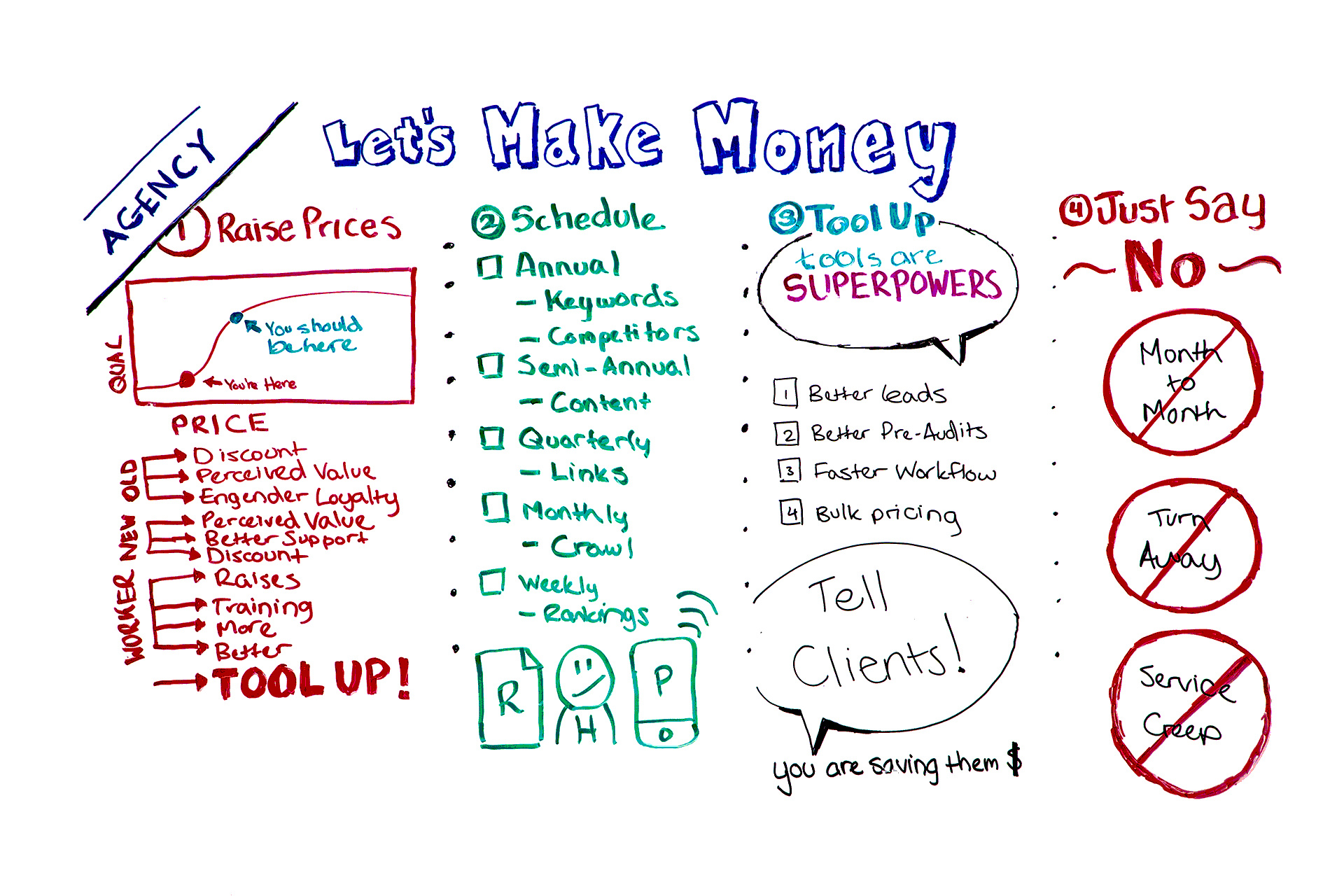
Let’s Make Money: 4 Tactics for Agencies Looking to Succeed – Best of Whiteboard Friday

Posted by rjonesx.

We spend a lot of time discussing SEO tactics, but in a constantly changing industry and especially in times of uncertainty, the strategies agencies should employ in order to see success deserve more attention. In this popular (and still relevant) Whiteboard Friday, Russ Jones discusses four essential success tactics that’ll ultimately increase your bottom line. 

Russ also delved into the topic of profitability in his MozCon Virtual presentation this year. To watch his and our other amazing speaker presentations, you can purchase access to the 2020 video bundle here.  

Agency tactics

Click on the whiteboard image above to open a high-resolution version in a new tab!

Video Transcription

Howdy, Moz fans. I am Russ Jones, and I can’t tell you how excited I am for my first Whiteboard Friday. I am Principal Search Scientist here at Moz. But before coming to Moz, for the 10 years prior to that, I was the Chief Technology Officer of a small SEO agency back in North Carolina. So I have a strong passion for agencies and consultants who are on the ground doing the work, helping websites rank better and helping build businesses.

So what I wanted to do today was spend a little bit of time talking about the lessons that I learned at an agency that admittedly I only learned through trial and error. But before we even go further, I just wanted to thank the folks at Hive Digital who I learned so much from, Jeff and Jake and Malcolm and Ryan, because the team effort over time is what ended up building an agency. Any agency that succeeds knows that that’s part of it. So we’ll start with that thank-you.

But what I really want to get into is that we spend a lot of time talking about SEO tactics, but not really about how to succeed in an industry that changes rapidly, in which there’s almost no certification, and where it can be difficult to explain to customers exactly how they’re going to be successful with what you offer. So what I’m going to do is break down four really important rules that I learned over the course of that 10 years. We’re going to go through each one of them as quickly as possible, but at the same time, hopefully you’ll walk away with some good ideas. Some of these are ones that it might at first feel a little bit awkward, but just follow me.

1. Raise prices

The first rule, number one in Let’s Make Money is raise your prices. Now, I remember quite clearly two years in to my job at Hive Digital — it was called Virante then — and we were talking about raising prices. We were just looking at our customers, saying to ourselves, “There’s no way they can afford it.” But then luckily we had the foresight that there was more to raising prices than just charging your customers more.

How it benefits old customers

The first thing that just hit us automatically was… “Well, with our old customers, we can just discount them. It’s not that bad. We’re in the same place as we always were.” But then it occurred to us, “Wait, wait, wait. If we discount our customers, then we’re actually increasing our perceived value.” Our existing customers now think, “Hey, they’re actually selling something better that’s more expensive, but I’m getting a deal,” and by offering them that deal because of their loyalty, you engender more loyalty. So it can actually be good for old customers.

How it benefits new customers

Now, for new customers, once again, same sort of situation. You’ve increased the perceived value. So your customers who come to you think, “Oh, this company is professional. This company is willing to invest. This company is interested in providing the highest quality of services.” In reality, because you’ve raised prices, you can. You can spend more time and money on each customer and actually do a better job. The third part is, “What’s the worst that could happen?” If they say no, you offer them the discount. You’re back where you started. You’re in the same position that you were before.

How it benefits your workers

Now, here’s where it really matters — your employees, your workers. If you are offering bottom line prices, you can’t offer them raises, you can’t offer them training, you can’t hire them help, or you can’t get better workers. But if you do, if you raise prices, the whole ecosystem that is your agency will do better.

How it improves your resources

Finally, and most importantly, which we’ll talk a little bit more later, is that you can finally tool up. You can get the resources and capital that you need to actually succeed. I drew this kind of out.

If we have a graph of quality of services that you offer and the price that you sell at, most agencies think that they’re offering great quality at a little price, but the reality is you’re probably down here. You’re probably under-selling your services and, because of that, you can’t offer the best that you can.

You should be up here. You should be offering higher quality, your experts who spend time all day studying this, and raising prices allows you to do that.

2. Schedule

Now, raising prices is only part one. The second thing is discipline, and I am really horrible about this. The reality is that I’m the kind of guy who looks for the latest and greatest and just jumps into it, but schedule matters. As hard as it is to admit it, I learned this from the CPC folks because they know that they have to stay on top of it every day of the week.

Well, here’s something that we kind of came up with as I was leaving the company, and that was to set all of our customers as much as possible into a schedule.

  • Annually: we would handle keywords and competitors doing complete analysis.
  • Semi-annually: Twice a year, we would do content analysis. What should you be writing about? What’s changed in your industry? What are different keywords that you might be able to target now given additional resources?
  • Quarterly: You need to be looking at links. It’s just a big enough issue that you’ve got to look at it every couple of months, a complete link analysis.
  • Monthly: You should be looking at your crawls. Moz will do that every week for you, but you should give your customers an idea, over the course of a month, what’s changed.
  • Weekly: You should be doing rankings

But there are three things that, when you do all of these types of analysis, you need to keep in mind. Each one of them is a…

  • Report
  • Hours for consulting
  • Phone call

This might seem like a little bit of overkill. But of course, if one of these comes back and nothing changed, you don’t need to do the phone call, but each one of these represents additional money in your pocket and importantly better service for your customers.

It might seem hard to believe that when you go to a customer and you tell them, “Look, nothing’s changed,” that you’re actually giving them value, but the truth is that if you go to the dentist and he tells you, you don’t have a cavity, that’s good news. You shouldn’t say to yourself at the end of the day, “Why’d I go to the dentist in the first place?” You should say, “I’m so glad I went to the dentist.” By that same positive outlook, you should be selling to your customers over and over and over again, hoping to give them the clarity they need to succeed.

3. Tool up!

So number three, you’re going to see this a lot in my videos because I just love SEO tools, but you’ve got to tool up. Once you’ve raised prices and you’re making more money with your customers, you actually can. Tools are superpowers. Tools allow you to do things that humans just can’t do. Like I can’t figure out the link graph on my own. I need tools to do it. But tools can do so much more than just auditing existing clients. For example, they can give you…

Better leads:

You can use tools to find opportunities.Take for example the tools within Moz and you want to find other car dealerships in the area that are really good and have an opportunity to rank, but aren’t doing as well as they should be in SERPs. You want to do this because you’ve already serviced successfully a different car dealership. Well, tools like Moz can do that. You don’t just have to use Moz to help your clients. You can use them to help yourself.

Better pre-audits:

Nobody walks into a sales call blind. You know who the website is. So you just start with a great pre-audit.

Faster workflows:

Which means you make more money quicker. If you can do your keyword analysis annually in half the time because you have the right tool for it, then you’re going to make far more money and be able to serve more customers.

Bulk pricing:

This one is just mind-blowingly simple. It’s bulk pricing. Every tool out there, the more you buy from them, the lower the price is. I remember at my old company sitting down at one point and recognizing that every customer that came in the door would need to spend about $1,000 on individual accounts to match what they were getting through us by being able to take advantage of the bulk discounts that we were getting as an agency by buying these seats on behalf of all of our customers.

So tell your clients when you’re talking to them on the phone, in the pitch be like, “Look, we use Moz, Majestic, Ahrefs, SEMrush,” list off all of the competitors. “We do Screaming Frog.” Just name them all and say, “If you wanted to go out and just get the data yourself from these tools, it would cost you more than we’re actually charging you.” The tools can sell themselves. You are saving them money.

4. Just say NO

Now, the last section, real quickly, are the things you’ve just got to learn to say no to. One of them has a little nuance to it. There’s going to be some bite back in the comments, I’m pretty sure, but I want to be careful with it.

No month-to-month contracts

The first thing to say no to is month-to-month contracts.

If a customer comes to you and they say, “Look, we want to do SEO, but we want to be able to cancel every 30 days.” the reality is this. They’re not interested in investing in SEO. They’re interested in dabbling in SEO. They’re interested in experimenting with SEO. Well, that’s not going to succeed. It’s only going to take one competitor or two who actually invest in it to beat them out, and when they beat them out, you’re going to look bad and they’re going to cancel their account with you. So sit down with them and explain to them that it is a long-term strategy and it’s just not worth it to your company to bring on customers who aren’t interested in investing in SEO. Say it politely, but just turn it away.

Don’t turn anything away

Now, notice that my next thing is don’t turn anything away. So here’s something careful. Here’s the nuance. It’s really important to learn to fire clients who are bad for your business, where you’re losing money on them or they’re just impolite, but that doesn’t mean you have to turn them away. You just need to turn them in the right direction. That right direction might be tools themselves. You can say, “Look, you don’t really need our consulting hours. You should go use these tools.” Or you can turn them to other fledgling businesses, friends you have in the industry who might be struggling at this time.

I’ll tell you a quick example. We don’t have much time, but many, many years ago, we had a client that came to us. At our old company, we had a couple of rules about who we would work with. We chose not to work in the adult industry. But at the time, I had a friend in the industry. He lived outside of the United States, and he had fallen on hard times. He literally had his business taken away from him via a series of just really unscrupulous events. I picked up the phone and gave him a call. I didn’t turn away the customer. I turned them over to this individual.

That very next year, he had ended up landing a new job at the top of one of the largest gambling organizations in the world. Well, frankly, they weren’t on our list of people we couldn’t work with. We landed the largest contract in the history of our company at that time, and it set our company straight for an entire year. It was just because instead of turning away the client, we turned them to a different direction. So you’ve got to say no to turning away everybody. They are opportunities. They might not be your opportunity, but they’re someone’s.

No service creep

The last one is service creep. Oh, man, this one is hard. A customer comes up to you and they list off three things that you offer that they want, and then they say, “Oh, yeah, we need social media management.” Somebody else comes up to you, three things you want to offer, and they say, “Oh yeah, we need you to write content,” and that’s not something you do. You’ve just got to not do that. You’ve got to learn to shave off services that you can’t offer. Instead, turn them over to people who can do them and do them very well.

What you’re going to end up doing in your conversation, your sales pitch is, “Look, I’m going to be honest with you. We are great at some things, but this isn’t our cup of tea. We know someone who’s really great at it.” That honesty, that candidness is just going to give them such a better relationship with you, and it’s going to build a stronger relationship with those other specialty companies who are going to send business your way. So it’s really important to learn to say no to say no service creep.

Well, anyway, there’s a lot that we went over there. I hope it wasn’t too much too fast, but hopefully we can talk more about it in the comments. I look forward to seeing you there. Thanks.

Video transcription by Speechpad.com


Ready for more?

You’ll uncover even more SEO goodness in the MozCon 2020 video bundle. At this year’s special low price of $129, this is invaluable content you can access again and again throughout the year to inspire and ignite your SEO strategy:

  • 21 full-length videos from some of the brightest minds in digital marketing
  • Instant downloads and streaming to your computer, tablet, or mobile device
  • Downloadable slide decks for presentations

Get my MozCon 2020 video bundle

Sign up for The Moz Top 10, a semimonthly mailer updating you on the top ten hottest pieces of SEO news, tips, and rad links uncovered by the Moz team. Think of it as your exclusive digest of stuff you don’t have time to hunt down but want to read!

Creative Diversification — More Hooks and Less Risk for Link Building

Posted by GeorgeRoot

As digital PRs we can often get stuck with our “campaign goggles” on, especially in the ideation and production stage of a creative campaign.

By this I mean, you have a preconceived idea of where you’d like your campaign to be featured, what kind of headlines you want it to achieve, and how people should read your data and story.

As we all know, we can’t control the outcomes of a campaign, but we can certainly push them in the right direction.

To give your link building campaigns the best chance in the outreach stage, you need to make sure there is enough creative diversification during the production process, especially for data-led pieces and surveys. This opens up your “journalist pool” and gives you a ton more people to outreach to with a potential interest in your piece.

What is creative diversification?

Creative diversification is how you minimize the amount of risk in your link building campaign by ensuring your idea has enough breadth during the production process. It doesn’t matter what format you’re using for each campaign — you always need to confirm it’s diverse enough to stand up in a changing news landscape. You want to develop an idea that can naturally explore multiple angles and sectors in the outreach phase. This flexibility needs to be set up before production, by exploring the potential outcomes and headlines you’re going after before you have them.

Find related topics

In the production stage, we obviously need to focus on our fundamental topic. This is often the domain’s main reason for being. It could be finance, travel, fashion — you get the picture.

Then you want to start branching out and overlaying topics: finance + students, travel + safety, fashion + Elon Musk, and so on. You’re attempting to grab subtopics of interest.

Every link builder will have a different approach to discovering these topics, but the simplest way to get started is to grab a piece of paper and start scribbling ideas by word association. Just write as much as you can and you’ll find there’s lots of closely-related topic areas your content could delve into. (Tools like BuzzSumo would be invaluable here, but if you’re after a free alternative, I have been enjoying playing with AlsoAsked.com lately for related topic inspiration. Nothing is going to beat existing news content, though.)

It’s also crucial to think about topic relevance, because if you question a tenuous link between your domain and topic matter, you can be certain journalists will, too. Link relevance is a whole other conversation to be had, but as long as it aligns with your client’s goals and you’re happy with showing them the link/coverage in full, you can’t go far wrong.

As a team at Root, we scrutinize our data points and approaches a lot in the production phase of each campaign and we find that championing personal expertise and curiosity often leads to some interesting statistics. My own passion for veganism gave us a unique angle which proved fruitful when we went out with a third round of outreach for our recent COVID-19 spending campaign.

Take off your campaign goggles

If the idea for your new campaign was born from your mind, you’re emotionally and personally invested whether you like it or not. You’ll need to put these feelings aside to engage with as many potential angles as possible from the start.

When I say you need to take off your campaign goggles, you need to (preferably with a colleague) tear apart the campaign and think about where you can add further value. It’s best to approach this objectively, so if you can tackle a colleague’s campaign and vice-versa, even better.

Some link builders will look at their angles and opportunities only once the content has been created and consider it an outreach decision. Success is definitely possible this way, but you’re stopping yourself from being as successful as you might have been had you thoroughly drilled into your content before and during the production process.

Highlight the key areas and approaches you’d like to tackle beforehand and you can feed this into your outreach strategy later on.

Make sector-specific data for journalists

When creating media lists and discovering relevant journalists, link builders can often be encouraged to rush through and ignore the content itself. If you know what they’re writing about, both on Twitter and in publications, you can begin to think about what data you could craft specifically for them.

In the campaign I mention in this blog, we focused on side-hustle data related to the fundamental topic of how people are earning their money during the pandemic, which was directly influenced by journalists.

The journalist who covered this specific topic in USA Today fortunately tweeted a lot about the stories he was working on, so it made it incredibly easy for us to tailor some content toward his interest and later offer him the type of unique data he wanted.

Aside from keeping tabs on Twitter, you can also find out what they’re interested in through Google Discover and Reddit to understand what’s being talked about and what is topical.

I know many digital PRs review key publications directly on a regular basis and have big Feedly feeds or watch insight roundups on YouTube instead. Either way, thinking about what a journalist will need in the next few weeks is imperative to early planning and ensuring your campaign is diverse enough from the get-go.

Diversify outreach with hash URLs

Another way you can make certain your content is diversified and prepared for a breadth of outreach is through the use of URL fragments or “hash URLs”. In the case of our coronavirus spending research campaign, we used article hooks on the page to provide anchor links from the table of contents at the top which then allowed us to offer another layer of personalization.

The key findings or headlines section in a table of contents is an essential piece to any long-form data campaign and makes it incredibly easy for journalists and readers to find the most relevant statistics to them in literally seconds.

If you’ve never implemented this yourself, there’s a simpler way than hooks — you just need to know your HTML basics. (Please excuse me if I butcher this description as a non-dev!) Place id=”#subject” within the heading tag, so it would look like: <h2 id=”#subject”>.

In the example below, a BBC journalist used the URL with “#vegetarian” when referencing our statistics about plant-based food usage. This came from the ID tag and meant the journalist could link directly to the bits of research that was relevant to their article.

On top of that, we could send journalists semi-personalized links in our outreach, too. It’s a win-win and is best practice for users and search engine crawlers to navigate your long-form content anyway.

This is a literal manifestation of your creative diversification process early on, as it’s now been produced and each hash URL is an extra asset pointing journalists to the most relevant data for them.

Creative diversification in action

The campaign I’ve mentioned in this piece was a lengthy, yet simple, survey campaign for a fin-tech client asking Americans about their spending habits during the pandemic. We secured a range of coverage, but the three biggest placements we landed (BBC, CNBC, and USA today) all covered different angles and data points from each other, but from this one survey, and that wasn’t an accident.

In the production stage, we knew we needed to focus on the campaign fundamentals: spending during the pandemic. Our related topics led us to grocery store spending and another leap encouraged us to look at food choices (were American’s eating more veg during lockdown? Hmm). These topics were still closely related to our core focus (finances) and therefore useful for our outreach in terms of securing relevant and high quality links.

When it came to the outreach strategy, we prioritized landing placements tied directly to the campaign fundamentals, then the related topics fed into the consecutive rounds which we chose depending on the strength of the data we received from the survey.

If you’re thinking in the production process that there’s too much going on with too many angles, you may have just created multiple mini content campaigns for yourself.

We’ve found time and time again that the simpler stories and slimmer, more targeted outreach emails will land placements way more often than bloated emails trying to offer up far too much content at once.

That’s not to say that you should automatically split up larger pieces of content, but your outreach should be the final step in diversifying your piece. A data analysis research piece that taps into multiple sectors should simply highlight the most relevant information to the journalist in bite-size sections. We gave grocery spend data to retail business journalists, vegan food consumption data to food writers, and side-hustle data to those writing on the latest employment trends.

The next time you’re creating a content campaign, have your team (even if that’s just you) ruthlessly find new sectors, journalists, and angles to target, to ensure your next piece is as diverse as possible. Creative diversification = more hooks and less risk.


To help us serve you better, please consider taking the 2020 Moz Blog Reader Survey, which asks about who you are, what challenges you face, and what you’d like to see more of on the Moz Blog.

Take the Survey

Sign up for The Moz Top 10, a semimonthly mailer updating you on the top ten hottest pieces of SEO news, tips, and rad links uncovered by the Moz team. Think of it as your exclusive digest of stuff you don’t have time to hunt down but want to read!

Fifteen Years Is a Long Time in SEO

Posted by willcritchlow

I’ve been in an introspective mood lately.

Earlier this year (15 years after starting Distilled in 2005), we spun out a new company called SearchPilot to focus on our SEO A/B testing and meta-CMS technology (previously known as Distilled ODN), and merged the consulting and conferences part of the business with Brainlabs.

I’m now CEO of SearchPilot (which is primarily owned by the shareholders of Distilled), and am also SEO Partner at Brainlabs, so… I’m sorry everyone, but I’m very much staying in the SEO industry.

As such, it feels a bit like the end of a chapter for me rather than the end of the book, but it has still had me looking back over what’s changed and what hasn’t over the last 15 years I’ve been in the industry.

I can’t lay claim to being one of the first generation of SEO experts, but having been building websites since around 1996 and having seen the growth of Google from the beginning, I feel like maybe I’m second generation, and maybe I have some interesting stories to share with those who are newer to the game.

I’ve racked my brain to try and remember what felt significant at the time, and also looked back over the big trends through my time in the industry, to put together what I think makes an interesting reading list that most people working on the web today would do well to know about.

The big eras of search

I joked at the beginning of a presentation I gave in 2018 that the big eras of search oscillated between directives from the search engines and search engines rapidly backing away from those directives when they saw what webmasters actually did:

While that slide was a bit tongue-in-cheek, I do think that there’s something to thinking about the eras like:

  1. Build websites: Do you have a website? Would you like a website? It’s hard to believe now, but in the early days of the web, a lot of folks needed to be persuaded to get their business online at all.
  2. Keywords: Basic information retrieval became adversarial information retrieval as webmasters realized that they could game the system with keyword stuffing, hidden text, and more.
  3. Links: As the scale of the web grew beyond user-curated directories, link-based algorithms for search began to dominate.
  4. Not those links: Link-based algorithms began to give way to adversarial link-based algorithms as webmasters swapped, bought, and manipulated links across the web graph.
  5. Content for the long tail: Alongside this era, the length of the long tail began to be better-understood by both webmasters and by Google themselves — and it was in the interest of both parties to create massive amounts of (often obscure) content and get it indexed for when it was needed.
  6. Not that content: Perhaps predictably (see the trend here?), the average quality of content returned in search results dropped dramatically, and so we see the first machine learning ranking factors in the form of attempts to assess “quality” (alongside relevance and website authority).
  7. Machine learning: Arguably everything from that point onwards has been an adventure into machine learning and artificial intelligence, and has also taken place during the careers of most marketers working in SEO today. So, while I love writing about that stuff, I’ll return to it another day.

History of SEO: crucial moments

Although I’m sure that there are interesting stories to be told about the pre-Google era of SEO, I’m not the right person to tell them (if you have a great resource, please do drop it in the comments), so let’s start early in the Google journey:

Google’s foundational technology

Even if you’re coming into SEO in 2020, in a world of machine-learned ranking factors, I’d still recommend going back and reading the surprisingly accessible early academic work:

If you weren’t using the web back then, it’s probably hard to imagine what a step-change improvement Google’s PageRank-based algorithm was over the “state-of-the-art” at the time (and it’s hard to remember, even for those of us that were):

Google’s IPO

In more “things that are hard to remember clearly,” at the time of Google’s IPO in 2004, very few people expected Google to become one of the most profitable companies ever. In the early days, the founders had talked of their disdain for advertising, and had experimented with keyword-based adverts somewhat reluctantly. Because of this attitude, even within the company, most employees didn’t know what a rocket ship they were building.

From this era, I’d recommend reading the founders’ IPO letter (see this great article from Danny Sullivan — who’s ironically now @SearchLiaison at Google):

“Our search results are the best we know how to produce. They are unbiased and objective, and we do not accept payment for them or for inclusion or more frequent updating.”

“Because we do not charge merchants for inclusion in Froogle [now Google shopping], our users can browse product categories or conduct product searches with confidence that the results we provide are relevant and unbiased.” — S1 Filing

In addition, In the Plex is an enjoyable book published in 2011 by Steven Levy. It tells the story of what then-CEO Eric Schmidt called (around the time of the IPO) “the hiding strategy”:

“Those who knew the secret … were instructed quite firmly to keep their mouths shut about it.”

“What Google was hiding was how it had cracked the code to making money on the Internet.”

Luckily for Google, for users, and even for organic search marketers, it turned out that this wasn’t actually incompatible with their pure ideals from the pre-IPO days because, as Levy recounts, “in repeated tests, searchers were happier with pages with ads than those where they were suppressed”. Phew!

Index everything

In April 2003, Google acquired a company called Applied Semantics and set in motion a series of events that I think might be the most underrated part of Google’s history.

Applied Semantics technology was integrated with their own contextual ad technology to form what became AdSense. Although the revenue from AdSense has always been dwarfed by AdWords (now just “Google Ads”), its importance in the history of SEO is hard to understate.

By democratizing the monetization of content on the web and enabling everyone to get paid for producing obscure content, it funded the creation of absurd amounts of that content.

Most of this content would have never been seen if it weren’t for the existence of a search engine that excelled in its ability to deliver great results for long tail searches, even if those searches were incredibly infrequent or had never been seen before.

In this way, Google’s search engine (and search advertising business) formed a powerful flywheel with its AdSense business, enabling the funding of the content creation it needed to differentiate itself with the largest and most complete index of the web.

As with so many chapters in the story, though, it also created a monster in the form of low quality or even auto-generated content that would ultimately lead to PR crises and massive efforts to fix.

If you’re interested in the index everything era, you can read more of my thoughts about it in slide 47+ of From the Horse’s Mouth.

Web spam

The first forms of spam on the internet were various forms of messages, which hit the mainstream as email spam. During the early 2000s, Google started talking about the problem they’d ultimately term “web spam” (the earliest mention I’ve seen of link spam is in an Amit Singhal presentation from 2005 entitled Challenges in running a Commercial Web Search Engine [PDF]).

I suspect that even people who start in SEO today might’ve heard of Matt Cutts — the first head of webspam — as he’s still referenced often despite not having worked at Google since 2014. I enjoyed this 2015 presentation that talks about his career trajectory at Google.

Search quality era

Over time, as a result of the opposing nature of webmasters trying to make money versus Google (and others) trying to make the best search engine they could, pure web spam wasn’t the only quality problem Google was facing. The cat-and-mouse game of spotting manipulation — particularly of on-page content, external links, and anchor text) — would be a defining feature of the next decade-plus of search.

It was after Singhal’s presentation above that Eric Schmidt (then Google’s CEO) said, “Brands are the solution, not the problem… Brands are how you sort out the cesspool”.

Those who are newer to the industry will likely have experienced some Google updates (such as recent “core updates”) first-hand, and have quite likely heard of a few specific older updates. But “Vince”, which came after “Florida” (the first major confirmed Google update), and rolled out shortly after Schmidt’s pronouncements on brand, was a particularly notable one for favoring big brands. If you haven’t followed all the history, you can read up on key past updates here:

A real reputational threat

As I mentioned above in the AdSense section, there were strong incentives for webmasters to create tons of content, thus targeting the blossoming long tail of search. If you had a strong enough domain, Google would crawl and index immense numbers of pages, and for obscure enough queries, any matching content would potentially rank. This triggered the rapid growth of so-called “content farms” that mined keyword data from anywhere they could, and spun out low-quality keyword-matching content. At the same time, websites were succeeding by allowing large databases of content to get indexed even as very thin pages, or by allowing huge numbers of pages of user-generated content to get indexed.

This was a real reputational threat to Google, and broke out of the search and SEO echo chamber. It had become such a bugbear of communities like Hacker News and StackOverflow, that Matt Cutts submitted a personal update to the Hacker News community when Google launched an update targeted at fixing one specific symptom — namely that scraper websites were routinely outranking the original content they were copying.

Shortly afterwards, Google rolled out the update initially named the “farmer update”. After it launched, we learned it had been made possible because of a breakthrough by an engineer called Panda, hence it was called the “big Panda” update internally at Google, and since then the SEO community has mainly called it the Panda update.

Although we speculated that the internal working of the update was one of the first real uses of machine learning in the core of the organic search algorithm at Google, the features it was modelling were more easily understood as human-centric quality factors, and so we began recommending SEO-targeted changes to our clients based on the results of human quality surveys.

Everything goes mobile-first

I gave a presentation at SearchLove London in 2014 where I talked about the unbelievable growth and scale of mobile and about how late we were to realizing quite how seriously Google was taking this. I highlighted the surprise many felt hearing that Google was designing mobile first:

“Towards the end of last year we launched some pretty big design improvements for search on mobile and tablet devices. Today we’ve carried over several of those changes to the desktop experience.” — Jon Wiley (lead engineer for Google Search speaking on Google+, which means there’s nowhere to link to as a perfect reference for the quote but it’s referenced here as well as in my presentation).

This surprise came despite the fact that, by the time I gave this presentation in 2014, we knew that mobile search had begun to cannibalize desktop search (and we’d seen the first drop in desktop search volumes):

And it came even though people were starting to say that the first year of Google making the majority of its revenue on mobile was less than two years away:

Writing this in 2020, it feels as though we have fully internalized how big a deal mobile is, but it’s interesting to remember that it took a while for it to sink in.

Machine learning becomes the norm

Since the Panda update, machine learning was mentioned more and more in the official communications from Google about algorithm updates, and it was implicated in even more. We know that, historically, there had been resistance from some quarters (including from Singhal) towards using machine learning in the core algorithm due to the way it prevented human engineers from explaining the results. In 2015, Sundar Pichai took over as CEO, moved Singhal aside (though this may have been for other reasons), and installed AI / ML fans in key roles.

It goes full-circle

Back before the Florida update (in fact, until Google rolled out an update they called Fritz in the summer of 2003), search results used to shuffle regularly in a process nicknamed the Google Dance:

Most things have been moving more real-time ever since, but recent “Core Updates” appear to have brought back this kind of dynamic where changes happen on Google’s schedule rather than based on the timelines of website changes. I’ve speculated that this is because “core updates” are really Google retraining a massive deep learning model that is very customized to the shape of the web at the time. Whatever the cause, our experience working with a wide range of clients is consistent with the official line from Google that:

Broad core updates tend to happen every few months. Content that was impacted by one might not recover — assuming improvements have been made — until the next broad core update is released.

Tying recent trends and discoveries like this back to ancient history like the Google Dance is just one of the ways in which knowing the history of SEO is “useful”.

If you’re interested in all this

I hope this journey through my memories has been interesting. For those of you who also worked in the industry through these years, what did I miss? What are the really big milestones you remember? Drop them in the comments below or hit me up on Twitter.

If you liked this walk down memory lane, you might also like my presentation From the Horse’s Mouth, where I attempt to use official and unofficial Google statements to unpack what is really going on behind the scenes, and try to give some tips for doing the same yourself:


To help us serve you better, please consider taking the 2020 Moz Blog Reader Survey, which asks about who you are, what challenges you face, and what you’d like to see more of on the Moz Blog.

Take the Survey

Sign up for The Moz Top 10, a semimonthly mailer updating you on the top ten hottest pieces of SEO news, tips, and rad links uncovered by the Moz team. Think of it as your exclusive digest of stuff you don’t have time to hunt down but want to read!

Desktop, Mobile, or Voice? (D) All of the Above — Best of Whiteboard Friday

Posted by Dr-Pete

Needless to say, we’re facing more and more complexity in our everyday work, and the answers to our questions are about as clear as mud. In the wake of the 2018 mobile-first index, and since more searchers are home and not on-the-go, we’re left wondering where to focus our optimization efforts. Is desktop the most important? Is mobile? What about the voice phenomenon that’s now become part of our day-to-day lives?

As with most things, the most important factor is to consider your audience. People aren’t siloed to a single device — your optimization strategy shouldn’t be, either. In this informative Whiteboard Friday, Dr. Pete soothes our fears about a multi-platform world and highlights the necessity of optimizing for a journey rather than a touchpoint.

Desktop, Mobile, or Voice? All of the above.

Click on the whiteboard image above to open a high-resolution version in a new tab!

Video Transcription

Hey, everybody. It’s Dr. Pete here from Moz. I am the Marketing Scientist here, and I flew in from Chicago just for you fine people to talk about something that I think is worrying us a little bit, especially with the rollout of the mobile index recently, and that is the question of: Should we be optimizing for desktop, for mobile, or for voice? I think the answer is (d) All of the above. I know that might sound a little scary, and you’re wondering how you do any of these. So I want to talk to you about some of what’s going on, some of our misconceptions around mobile and voice, and some of the ways that maybe this is a little easier than you think, at least to get started.

The mistakes we make

So, first of all, I think we make a couple of mistakes. When we’re talking about mobile for the last few years, we tend to go in and we look at our analytics and we do this. These are made up. The green numbers are made up or the blue ones. We say, “Okay, about 90% of my traffic is coming from desktop, about 10% is coming from mobile, and nothing is coming from voice. So I’m just going to keep focusing on desktop and not worry about these other two experiences, and I’ll be fine.” There are two problems with this:

Self-fulfilling prophecy

One is that these numbers are kind of a self-fulfilling prophecy. They might not be coming to your mobile site. You might not be getting those mobile visitors because your mobile experience is terrible. People come to it and it’s lousy, and they don’t come back. In the case of voice, we might just not be getting that data yet. We have very little data. So this isn’t telling us anything. All this may be telling us is that we’re doing a really bad job on mobile and people have given up. We’ve seen that with Moz in the past. We didn’t adopt to mobile as fast as maybe we should have. We saw that in the numbers, and we argued about it because we said, “You know what? This doesn’t really tell us what the opportunity is or what our customers or users want. It’s just telling us what we’re doing well or badly right now, and it becomes a self-fulfilling prophecy.”

Audiences

The other mistake I think we make is the idea that these are three separate audiences. There are people who come to our site on desktop, people who come to our site on mobile, people who come to our site on voice, and these are three distinct groups of people. I think that’s incredibly wrong, and that leads to some very bad ideas and some bad tactical decisions and some bad choices.

So I want to share a couple of stats. There was a study Google did called The Multiscreen World, and this was almost six years ago, 2012. They found six years ago that 65% of searchers started a search on their smartphones. Two-thirds of searchers started on smartphones six years ago. Sixty percent of those searches were continued on a desktop or laptop. Again, this has been six years, so we know the adoption rate of mobile has increased. So these are not people who only use desktop or who only use mobile. These are people on a journey of search that move between devices, and I think in the real world it looks more something like this right now.

Another stat from the series was that 88% of people said that they used their smartphone and their TV at the same time. This isn’t shocking to you. You sit in front of the TV with your phone and you sit in front of the TV with your laptop. You might sit in front of the TV with a smartwatch. These devices are being used at the same time, and we’re doing more searches and we’re using more devices. So one of these things isn’t replacing the other.

The cross-device journey

So a journey could look something like this. You’re watching TV. You see an ad and you hear about something. You see a video you like. You go to your phone while you’re watching it, and you do a search on that to get more information. Then later on, you go to your laptop and you do a bit of research, and you want that bigger screen to see what’s going on. Then at the office the next day, you’re like, “Oh, I’ll pull up that bookmark. I wanted to check something on my desktop where I have more bandwidth or something.” You’re like, “Oh, maybe I better not buy that at work. I don’t want to get in trouble. So I’m going to home and go back to my laptop and make that purchase.” So this purchase and this transaction, this is one visitor on this chain, and I think we do this a lot right now, and that’s only going to increase, where we operate between devices and this journey happens across devices.

So the challenge I would make to you is if you’re looking at this and you’re saying, “Only so many percent of our users are on mobile. Our mobile experience doesn’t matter that much. It’s not that important. We can just live with the desktop people. That’s enough. We’ll make enough money.” If they’re really on this journey and they’re not segmented like this, and this chain, you break it, what happens? You lose that person completely, and that was a person who also used desktop. So that person might be someone who you bucketed in your 90%, but they never really got to the device of choice and they never got to the transaction, because by having a lousy mobile experience, you’ve broken the chain. So I want you to be aware of that, that this is the cross-device journey and not these segmented ideas.

Future touchpoints

This is going to get worse. This is going to get scarier for us. So look at the future. We’re going to be sitting in our car and we’re going to be listening — I still listen to CDs in the car, I know it’s kind of sad — but you’re going to be listening to satellite radio or your Wi-Fi or whatever you have coming in, and let’s say you hear a podcast or you hear an author and you go, “Oh, that person sounds interesting. I want to learn more about them.” You tell your smartwatch, “Save this search. Tell me something about this author. Give me their books.” Then you go home and you go on Google Home and you pull up that search, and it says, “Oh, you know what? I’ve got a video. I can’t play that because obviously I’m a voice search device, but I can send that to Chromecast on your TV.” So you send that to your TV, and you watch that. While you’re watching the TV, you’ve got your phone out and you’re saying, “Oh, I’d kind of like to buy that.” You go to Amazon and you make that transaction.

So it took this entire chain of devices. Again now, what about the voice part of this chain? That might not seem important to you right now, but if you break the chain there, this whole transaction is gone. So I think the danger is by neglecting pieces of this and not seeing that this is a journey that happens across devices, we’re potentially putting ourselves at much higher risk than we think.

On the plus side

I also want to look at sort of the positive side of this. All of these devices are touchpoints in the journey, and they give us credibility. We found something interesting at Moz a few years ago, which was that our sale as a SaaS product on average took about three touchpoints. People didn’t just hit the Moz homepage, do a free trial, and then buy it. They might see a Whiteboard Friday. They might read our Beginner’s Guide. They might go to the blog. They might participate in the community. If they hit us with three touchpoints, they were much more likely to convert.

So I think the great thing about this journey is that if you’re on all these touchpoints, even though to you that might seem like one search, it lends you credibility. You were there when they ran the search on that device. You were there when they tried to repeat that search on voice. The information was in that video. You’re there on that mobile search. You’re there on that desktop search. The more times they see you in that chain, the more that you seem like a credible source. So I think this can actually be good for us.

The SEO challenge

So I think the challenge is, “Well, I can’t go out and hire a voice team and a mobile team and do a design for all of these things. I don’t want to build a voice app. I don’t have the budget. I don’t have the buy-in.” That’s fine.
One thing I think is really great right now and that we’re encouraging people to experiment with, we’ve talked a lot about featured snippets. We’ve talked about these answer boxes that give you an organic result. One of the things Google is trying to do with this is they realize that they need to use their same core engine, their same core competency across all devices. So the engine that powers search, they want that to run on a TV. They want that to run on a laptop, on a desktop, on a phone, on a watch, on Goggle Home. They don’t want to write algorithms for all of these things.

So Google thinks of their entire world in terms of cards. You may not see that on desktop, but everything on desktop is a card. This answer box is a card. That’s more obvious. It’s got that outline. Every organic result, every ad, every knowledge panel, every news story is a card. What that allows Google to do, and will allow them to do going forward, is to mix and match and put as many pieces of information as it makes sense for any given device. So for desktop, that might be a whole bunch. For mobile, that’s going to be a vertical column. It might be less. But for a watch or a Google Glass, or whatever comes after that, or voice, you’re probably only going to get one card.

But one great thing right now, from an SEO perspective, is these featured snippets, these questions and answers, they fit on that big screen. We call it result number zero on desktop because you’ve got that box, and you’ve got a bunch of stuff underneath it. But that box is very prominent. On mobile, that same question and answer take up a lot more screen space. So they’re still a SERP, but that’s very dominant, and then there’s some stuff underneath. On voice, that same question and answer pairing is all you get, and we’re seeing that a lot of the answers on voice, unless they’re specialty like recipes or weather or things like that, have this question and answer format, and those are also being driven by featured snippets.

So the good news I think, and will hopefully stay good news going forward, is that because Google wants all these devices to run off that same core engine, the things you do to rank well for desktop and to be useful for desktop users are also going to help you rank on mobile. They’re going to help you rank on voice, and they’re going to help you rank across all these devices. So I want you to be aware of this. I want you to try and not to break that chain. But I think the things we’re already good at will actually help us going forward in the future, and I’d highly encourage you to experiment with featured snippets to see how questions and answers appear on mobile and to see how they appear on Google Home, and to know that there’s going to be an evolution where all of these devices benefit somewhat from the kind of optimization techniques that we’re already good at hopefully.

Encourage the journey chain

So I also want to say that when you optimize for answers, the best answers leave searchers wanting more. So what you want to do is actually encourage this chain, encourage people to do more research, give them rich content, give them the kinds of things that draw them back to your site, that build credibility, because this chain is actually good news for us in a way. This can help us make a purchase. If we’re credible on these devices, if we have a decent mobile experience, if we come up on voice, that’s going to help us really kind of build our brand and be a positive thing for us if we work on it.

So I’d like you to tell me, what are your fears right now? I think we’re a little scared of the mobile index. What are you worried about with voice? What are you worried about with IoT? Are you concerned that we’re going to have to rank on our refrigerators, and what does that mean? So it’s getting into science fiction territory, but I’d love to talk about it more. I will see you in the comment section.

Video transcription by Speechpad.com


To help us serve you better, please consider taking the 2020 Moz Blog Reader Survey, which asks about who you are, what challenges you face, and what you’d like to see more of on the Moz Blog.

Take the Survey

Sign up for The Moz Top 10, a semimonthly mailer updating you on the top ten hottest pieces of SEO news, tips, and rad links uncovered by the Moz team. Think of it as your exclusive digest of stuff you don’t have time to hunt down but want to read!

The MozCon Virtual Video Bundle Is Here (Plus, Our 2019 Videos are FREE!)

Posted by cheryldraper

This year’s MozCon was unlike any other. In the midst of a global pandemic, we pivoted from planning our traditional 1,600-plus in-person shindig to an online conference that ended up bigger and more well-attended than anything we’d done before. MozCon Virtual was a delightful journey into the unknown. Just a few of the practical lessons we learned:

And while it may have felt a little different this year, with 21 industry experts covering topics all the way from easy-to-implement machine learning to effective content promotion to crafting a keyword strategy that accounts for a world in crisis, MozCon Virtual offered up the same caliber of high-quality content as any in-person event we’ve ever thrown.

And we’re happy to share that if you missed the conference live, the MozCon 2020 video bundle is now available for your viewing pleasure!

Start watching now

For $129, you’ll gain access to every presentation and speaker deck to watch as many times as you’d like. Schedule a viewing party with your team and get everyone on board with the best digital marketing advice, data, tools, and resources for the coming year.

If you’d like a taste of what this year’s video bundle’s got cooking, check out Rob Ousbey’s talk from this year’s event:

A Novel Approach to Scraping Websites

Throughout a decade in SEO consulting, Rob needed to extract data from websites on many an occasion. Often this was at scale from sites that didn’t have an API or export feature, or on sites that required some kind of authentication. While this was primarily a way to collect & combine data from different SEO tools, the use-cases were endless.

He found a technique that helped immensely, particularly when traditional tools couldn’t do the job — but hadn’t seen anyone using the same approach. In this very tactical session, Rob will walk through the steps he’s used to extract data from all sorts of sites, from small fry to the giants, and give you the tools and knowledge to do the same.

As a bonus, Rob’s put together a list of handy resources on his website to support you as you pursue your own data collection dreams!


Watch the MozCon 2019 videos for free in our SEO Learning Center!

Now that our MozCon Virtual videos are out in the world, we’ve released all the content from MozCon 2019 for free in our SEO Learning Center. Twenty-six sessions full of actionable insights and digital marketing advice await you — read on to see what goodies you might have missed last year!

Web Search 2019: The Essential Data Marketers Need

Rand Fishkin

It’s been a rough couple years in search. Google’s domination and need for additional growth has turned the search giant into a competitor for more and more publishers, and plateaued the longstanding trend of Google’s growing referral traffic. But in the midst of this turmoil, opportunities have emerged, too. In this presentation, Rand will look not only at how Google (and Amazon, YouTube, Instagram, and others) have leveraged their monopoly power in concerning ways, but also how to find opportunities for traffic, branding, and marketing success.

Human > Machine > Human: Understanding Human-Readable Quality Signals and Their Machine-Readable Equivalents

Ruth Burr Reedy

The push and pull of making decisions for searchers versus search engines is an ever-present SEO conundrum. How do you tackle industry changes through the lens of whether something is good for humans or for machines? Ruth will take us through human-readable quality signals and their machine-readable equivalents and how to make SEO decisions accordingly, as well as how to communicate change to clients and bosses.

Improved Reporting & Analytics Within Google Tools

Dana DiTomaso

Covering the intersections between some of our favorite free tools — Google Data Studio, Google Analytics, and Google Tag Manager — Dana will be deep-diving into how to improve your reporting and analytics, even providing downloadable Data Studio templates along the way.

Local SERP Analytics: The Challenges and Opportunities

Rob Bucci

We all know that SERPs are becoming increasingly local. Google is more and more looking to satisfy local intent queries for searchers. There’s a treasure-trove of data in local SERPs that SEOs can use to outrank their competitors. In this session, Rob will talk about the challenges that come with trying to do SERP analytics at a local level and the opportunities that await those who can overcome those challenges.

Keywords Aren’t Enough: How to Uncover Content Ideas Worth Chasing

Ross Simmonds

Many marketers focus solely on keyword research when crafting their content, but it just isn’t enough if you want to gain a competitive edge. Ross will share a framework for uncovering content ideas leveraged from forums, communities, niche sites, good old-fashioned SERP analysis, tools and techniques to help along the way, and exclusive research surrounding the data that backs this up.

How to Supercharge Link Building with a Digital PR Newsroom

Shannon McGuirk

Everyone who’s ever tried their hand at link building knows how much effort it demands. If only there was a way to keep a steady stream of quality links coming in the door for clients, right? In this talk, Shannon will share how to set up a “digital PR newsroom” in-house or agency-side that supports and grows your link building efforts. Get your note-taking hand ready, because she’s going to outline her process and provide a replicable tutorial for how to make it happen.

From Zero to Local Ranking Hero

Darren Shaw

From zero web presence to ranking hyper-locally, Darren will take us along on the 8-month-long journey of a business growing its digital footprint and analyzing what worked (and didn’t) along the way. How well will they rank from a GMB listing alone? What about when citations were added, and later indexed? Did having a keyword in the business name help or harm, and what changes when they earn a few good links? Buckle up for this wild ride as we discover exactly what impact different strategies have on local rankings.

Esse Quam Videri: When Faking It Is Harder than Making It

Russ Jones

Covering a breadth of SEO topics, Russ will show us how the correct use of available tools makes it easier to actually be the best in your market rather than try to cut corners and fake it. If you’re a fan of hacks and shortcuts, come prepared to have your mind changed.

Building a Discoverability Powerhouse: Lessons from Merging an Organic, Paid, & Content Practice

Heather Physioc

Search is a channel that can’t live in a silo. In order to be its most effective, search teams have to collaborate successfully across paid, organic, content and more. Get tips for integrating and collaborating from the hard knocks and learnings of merging an organic, paid and performance content team into one Discoverability group. Find out how we went from three teams of individual experts to one integrated Discoverability powerhouse, and learn from our mistakes and wins as you apply the principles in your own company.

Brand Is King: How to Rule in the New Era of Local Search

Mary Bowling

Get ready for a healthy dose of all things local with this talk! Mary will deep-dive into how the Google Local algorithm has matured in 2019 and how marketers need to mature with it; how the major elements of the algo (relevance, prominence, and proximity) influence local rankings and how they affect each other; how local results are query-dependent; how to feed business info into the Knowledge Graph; and how brand is now “king” in local search.

Making Memories: Creating Content People Remember

Casie Gillette

We know that only 20% of people remember what they read, but 80% remember what they saw. How do you create something people actually remember? You have to think beyond words and consider factors like images, colors, movement, location, and more. In this talk, Casie will dissect what brands are currently doing to capture attention and how everyone, regardless of budget or resources, can create the kind of content their audience will actually remember.

20 Years in Search & I Don’t Trust My Gut or Google

Wil Reynolds

What would your reaction be if you were told that one of Wil’s clients got more conversions from zero-volume search terms than search terms with 1000+ searches per month? It’s true. Wil found this out in seconds, leading him to really look at his whole client strategy through a new lens. It also made him question company-wide strategies. How prevalent is this across all clients? Don’t they all deserve to get these insights? It required him to dig into the long tail, deep. To use big data and see PPC data as insights, not just marketing.

What would your reaction be if you were told that Google’s “bad click” business could be generating as much annually as Starbucks or McDonalds?

Wil will be making the case for big data, agencies, and why building systems that looking at every single search term you get matched to is the future of search marketing.

Super-Practical Tips for Improving Your Site’s E-A-T

Marie Haynes

Google has admitted that they measure the concept of “Expertise, Authoritativeness, and Trustworthiness” in their algorithms. If your site is categorized under YMYL (Your Money or Your Life), you absolutely must have good E-A-T in order to rank well. In this talk, you’ll learn how Google measures E-A-T and what changes you can make both on site and off in order to outrank your competitors. Using real-life examples, Marie will answer what E-A-T is and how Google measures it, what changes you can make on your site to improve how E-A-T is displayed, and what you can do off-site to improve E-A-T.

Fixing the Indexability Challenge: A Data-Based Framework

Areej AbuAli

How do you turn an unwieldy 2.5 million-URL website into a manageable and indexable site of just 20,000 pages? Areej will share the methodology and takeaways used to restructure a job aggregator site which, like many large websites, had huge problems with indexability and the rules used to direct robot crawl. This talk will tackle tough crawling and indexing issues, diving into the case study with flow charts to explain the full approach and how to implement it.

What Voice Means for Search Marketers: Top Findings from the 2019 Report

Christi Olson

How can search marketers take advantage of the strengths and weaknesses of today’s voice assistants? Diving into three scenarios for informational, navigational, and transactional queries, Christi will share how to use language semantics for better content creation and paid targeting, how to optimize existing content to be voice-friendly (including the new voice schema markup!), and what to expect from future algorithm updates as they adapt to assistants that read responses aloud, no screen required. Highlighting takeaways around voice commerce from the report, this talk will ultimately provide a breakdown on how search marketers can begin to adapt their shopping experience for v-commerce.

Redefining Technical SEO

Paul Shapiro

It’s time to throw the traditional definition of technical SEO out the window. Why? Because technical SEO is much, much bigger than just crawling, indexing, and rendering. Technical SEO is applicable to all areas of SEO, including content development and other creative functions. In this session, you’ll learn how to integrate technical SEO into all aspects of your SEO program.

How Many Words Is a Question Worth?

Dr. Peter J. Meyers

Traditional keyword research is poorly suited to Google’s quest for answers. One question might represent thousands of keyword variants, so how do we find the best questions, craft content around them, and evaluate success? Dr. Pete dives into three case studies to answer these questions.

Fraggles, Mobile-First Indexing, & the SERP of the Future

Cindy Krum

Before you ask: no, this isn’t Fraggle Rock, MozCon edition! Cindy will cover the myriad ways mobile-first indexing is changing the SERPs, including progressive web apps, entity-first indexing, and how “fraggles” are indexed in the Knowledge Graph and what it all means for the future of mobile SERPs.

Killer CRO and UX Wins Using an SEO Crawler

Luke Carthy

CRO, UX, and an SEO crawler? You read that right! Luke will share actionable tips on how to identify revenue wins and impactful low-hanging fruit to increase conversions and improve UX with the help of a site crawler typically used for SEO, as well as a generous helping of data points from case studies and real-world examples.

Content, Rankings, and Lead Generation: A Breakdown of the 1% Content Strategy

Andy Crestodina

How can you use data to find and update content for higher rankings and more traffic? Andy will take us through a four-point presentation that pulls together the most effective tactics around content into a single high-powered content strategy with even better results.

Running Your Own SEO Tests: Why It Matters & How to Do It Right

Rob Ousbey

Google’s algorithms have undergone significant changes in recent years. Traditional ranking signals don’t hold the same sway they used to, and they’re being usurped by factors like UX and brand that are becoming more important than ever before. What’s an SEO to do?

The answer lies in testing.

Sharing original data and results from clients, Rob will highlight the necessity of testing, learning, and iterating your work, from traditional UX testing to weighing the impact of technical SEO changes, tweaking on-page elements, and changing up content on key pages. Actionable processes and real-world results abound in this thoughtful presentation on why you should be testing SEO changes, how and where to run them, and what kinds of tests you ought to consider for your circumstances.

Dark Helmet’s Guide to Local Domination with Google Posts and Q&A

Greg Gifford

Google Posts and Questions & Answers are two incredibly powerful features of Google My Business, yet most people don’t even know they exist. Greg will walk through Google Posts in detail, sharing how they work, how to use them, and tips for optimization based on testing with hundreds of clients. He’ll also cover the Q&A section of GMB (a feature that lets anyone in the community speak for your business), share the results of a research project covering hundreds of clients, share some hilarious examples of Q&A run wild, and explain exactly how to use Q&A the right way to win more local business.

How to Audit for Inclusive Content

Emily Triplett Lentz

Digital marketers have a responsibility to learn to spot the biases that frequently find their way into online copy, replacing them with alternatives that lead to stronger, clearer messaging and that cultivate wider, more loyal and enthusiastic audiences. Last year, Help Scout audited several years of content for unintentionally exclusionary language that associated physical disabilities or mental illness with negative-sounding terms, resulting in improved writing clarity and a stronger brand. You’ll learn what inclusive content is, how it helps to engage a larger and more loyal audience, how to conduct an audit of potentially problematic language on a site, and how to optimize for inclusive, welcoming language.

Get the Look: Improve the Shopper Experience with Image and Visual Search Optimization

Joelle Irvine

With voice, local, and rich results only rising in importance, how do image and visual search fit into the online shopping ecosystem? Using examples from Google Images, Google Lens, and Pinterest Lens, Joelle will show how image optimization can improve the overall customer experience and play a key role in discoverability, product evaluation, and purchase decisions for online shoppers. At the same time, accepting that image recognition technology is not yet perfect, she will also share actionable tactics to better optimize for visual search to help those shoppers find that perfect style they just can’t put into words.

Factors that Affect the Local Algorithm that Don’t Impact Organic

Joy Hawkins

Google’s local algorithm is a horse of a different color when compared with the organic algo most SEOs are familiar with. Joy will share results from a SterlingSky study on how proximity varies greatly when comparing local and organic results, how reviews impact ranking (complete with data points from testing), how spam is running wild (and how it negatively impacts real businesses), and more.

Featured Snippets: Essentials to Know & How to Target

Britney Muller

By now, most SEOs are comfortable with the idea of featured snippets, but actually understanding and capturing them in the changing search landscape remains elusive. Britney will share some eye-opening data about the SERPs you know and love while equipping you with a bevy of new tricks for winning featured snippets into your toolbox.


Ready for more?

You’ll uncover even more SEO goodness in the MozCon 2020 video bundle. At this year’s special low price of $129, this is invaluable content you can access again and again throughout the year to inspire and ignite your SEO strategy:

  • 21 full-length videos from some of the brightest minds in digital marketing
  • Instant downloads and streaming to your computer, tablet, or mobile device
  • Downloadable slide decks for presentations

Get my MozCon 2020 video bundle

Sign up for The Moz Top 10, a semimonthly mailer updating you on the top ten hottest pieces of SEO news, tips, and rad links uncovered by the Moz team. Think of it as your exclusive digest of stuff you don’t have time to hunt down but want to read!

Adjusting Paid Campaigns During a Recession

Posted by ryanmoothart

Our world changed dramatically in March of 2020 as a new viral threat to our livelihoods took hold in the United States and around the world. Here in the US (at the time of writing this post), COVID-19 has not relented

Some industries have been more heavily affected than others. For example, travel and tourism businesses have been hurting far more than many other industries due to social distancing guidelines and stay-at-home orders.

However, all businesses should re-evaluate their planned budgets for paid search and other paid digital campaigns for the next 12 to 24 months. Hopefully, this pandemic cedes faster than that and the economy comes out of our pending depression more rapidly at some point next year. But since nobody can know for sure when that will happen, it’s better to be safe and plan accordingly. Ask yourself the following questions:

  • What assumptions did you make about your priorities heading into 2020?
  • How has the global pandemic and economic recession affected those priorities thus far?
  • How have your trends changed and what shift(s) have you already had to make?

You’ll be on your way to creating a more stable plan for your paid digital advertising campaigns once you’re able to answer those questions.

Now comes the most difficult part: how do you take these changes into account and plan ahead for the next year, or even two years?

To do this effectively, you need to make a choice about which overarching business goal is more important to you:

1. Drive sufficient sales volume even at the expense of profitability.

    OR

    2. Maintain a profitability margin even if it means losing out on sales volume.

      Don’t pick both. Obviously, you want to drive more sales and maintain or increase profitability — everyone wants to do that. But if your business has struggled since the breakout of this recession, you don’t have the luxury right now of picking both. If you pursue both goals, you’re more likely to implement competing tactics in your campaigns that may result in hitting neither. So, pick one. If you can hit it consistently going forward in this new environment, then you can start striving to hit the other in addition.

      Focusing on sales volume

      If your primary goal is sales volume, reference the year-over-year trends you’ve witnessed since the COVID-19 outbreak and the onset of the recession. Pay close attention to the last month or two since things have started returning to a “more normal” outlook with regards to businesses reopening (albeit with strong rules around social distancing). For instance:

      • Have you seen website traffic bounce back a bit since May, but not sales or conversions?
      • Have these things increased in certain channels but not in others?
      • How has your ad spend volume correlated with these shifts in conversions?
      • Have you seen increases in cost per conversion levels that look more stable now?
      • How do all of these things compare year over year?

      Whatever you’re witnessing after answering these questions, plan on those year-over-year trends continuing for the foreseeable future. Take into account seasonality and plan out how many conversions, sales, and/or how much revenue you want to acquire each month or each week going forward. Once you have those hard numbers planned out, do some quick math by accounting for your cost per conversion and return on ad spend (ROAS) levels, and correlate how much money you’re going to need to spend to meet those sales targets.


      Do these new budgets and targets allow you to meet your overall sales goals? You may find you’re able to hit targets for a certain channel directly (paid search, for example), but will still be behind overall. If that’s the case, reference your impression share or share of voice metrics, competitive insights, and tools like Moz or Google Trends to see if it’s realistic to push for even more sales volume if your existing forecasts don’t meet your goals.

      If these things indicate little room for potential growth, revise your sales volume targets and expectations down to account for this new post-COVID normal. In this instance, your opportunity for potential growth will lie in high-funnel channels (e.g. programmatic advertising, digital video ads, traditional media buying) to reach more potential new customers. Just be sure to account for how many conversions or sales these high-funnel channels actually assist with to make sure you’re putting your advertising budgets to good use.

      Focusing on profitability

      If your primary goal is profitability, reference the same trends and answer the same set of questions as above. Again, pay close attention to the last month or two as the economic recession has begun settling itself in for the long haul. Whatever you’re witnessing, plan on those year-over-year trends continuing. Then, taking into account seasonality, forecast what your campaign budgets should be by month or by week given your desired ROAS or ROI levels.

      Instead of having to adjust your budgets up in order to hit a desired sales volume threshold, you may find that your forecasted budget is lower than you originally anticipated coming into 2020. You’re likely going to have to cut budgets down or pause certain campaigns entirely that just aren’t profitable right now as changes in conversion costs and/or demand have negatively impacted your trends. If this is happening to you, plan on taking that budget you’re now cutting out of your certain paid campaigns and reinvest any potential remaining funds into other channels or savings (assuming such funds aren’t wiped out by lower sales volume).

      This opportunity to maintain a certain profit margin will likely result in less overall revenue and return for your business as a whole. The goal here is to stay profitable enough where you don’t have to make significant cuts to your overall business. Sacrifice what you need to in paid digital advertising to stay afloat and maintain viability throughout the duration of this economic recession.

      One more thing to keep in mind

      As we’re still in the early stages of vast uncertainty, be nimble and reactive as economic circumstances change. You may find yourself doing a lot more re-forecasting on a consistent basis this year and next year due to fluctuation in economic climate and outlook. Just remember everyone else is in the same boat as you — nobody knows what’s coming in the next year or two, let alone the next few months.


      To help us serve you better, please consider taking the 2020 Moz Blog Reader Survey, which asks about who you are, what challenges you face, and what you’d like to see more of on the Moz Blog.

      Take the Survey

      Sign up for The Moz Top 10, a semimonthly mailer updating you on the top ten hottest pieces of SEO news, tips, and rad links uncovered by the Moz team. Think of it as your exclusive digest of stuff you don’t have time to hunt down but want to read!

      Using the Flowchart Method for Diagnosing Ranking Drops — Best of Whiteboard Friday

      Posted by KameronJenkins

      Being able to pinpoint the reason for a ranking drop is one of our most perennial and potentially frustrating tasks as SEOs, especially in 2020. There are an unknowable number of factors that go into ranking these days, but luckily the methodology for diagnosing those fluctuations is readily at hand. In this popular Whiteboard Friday, the wonderful Kameron Jenkins shows us a structured way to diagnose ranking drops using a flowchart method and critical thinking.

      Flowchart method for diagnosing ranking drops

      Click on the whiteboard image above to open a high-resolution version in a new tab!

      Video Transcription

      Hey, everyone. Welcome to this week’s edition of Whiteboard Friday. My name is Kameron Jenkins. I am the new SEO Wordsmith here at Moz, and I’m so excited to be here. Before this, I worked at an agency for about six and a half years. I worked in the SEO department, and really a common thing we encountered was a client’s rankings dropped. What do we do?

      This flowchart was kind of built out of that mentality of we need a logical workflow to be able to diagnose exactly what happened so we can make really pointed recommendations for how to fix it, how to get our client’s rankings back. So let’s dive right in. It’s going to be a flowchart, so it’s a little nonlinear, but hopefully this makes sense and helps you work smarter rather than harder.

      Was it a major ranking drop?: No

      The first question I’d want to ask is: Was their rankings drop major? By major, I would say that’s something like page 1 to page 5 overnight. Minor would be something like it just fell a couple positions, like position 3 to position 5.

      We’re going to take this path first. It was minor.

      Has there been a pattern of decline lasting about a month or greater?

      That’s not a magic number. A month is something that you can use as a benchmark. But if there’s been a steady decline and it’s been one week it’s position 3 and then it’s position 5 and then position 7, and it just keeps dropping over time, I would consider that a pattern of decline.

      So if no, I would actually say wait.

      • Volatility is normal, especially if you’re at the bottom of page 1, maybe page 2 plus. There’s going to be a lot more shifting of the search results in those positions. So volatility is normal.
      • Keep your eyes on it, though. It’s really good to just take note of it like, “Hey, we dropped. Okay, I’m going to check that again next week and see if it continues to drop, then maybe we’ll take action.”
      • Wait it out. At this point, I would just caution against making big website updates if it hasn’t really been warranted yet. So volatility is normal. Expect that. Keep your finger on the pulse, but just wait it out at this point.

      If there has been a pattern of decline though, I’m going to have you jump to the algorithm update section. We’re going to get there in a second. But for now, we’re going to go take the major rankings drop path.

      Was it a major ranking drop?: Yes

      The first question on this path that I’d want to ask is:

      Was there a rank tracking issue?

      Now, some of these are going seem pretty basic, like how would that ever happen, but believe me it happens every once in a while. So just before we make major updates to the website, I’d want to check the rank tracking.

      I. The wrong domain or URL.

      That can be something that happens a lot. A site maybe you change domains or maybe you move a page and that old page of that old domain is still listed in your ranking tracker. If that’s the case, then the rank tracking tool doesn’t know which URL to judge the rankings off of. So it’s going to look like maybe you dropped to position 10 overnight from position 1, and that’s like, whoa, that’s a huge update. But it’s actually just that you have the wrong URL in there. So just check that. If there’s been a page update, a domain update, check to make sure that you’ve updated your rank tracker.

      II. Glitches.

      So it’s software, it can break. There are things that could cause it to be off for whatever reason. I don’t know how common that is. It probably is totally dependent on which kind of software you use. But glitches do happen, so I would manually check your rankings.

      III. Manually check rankings.

      One way I would do that is…

      • Go to incognito in Google and make sure you’re logged out so it’s not personalized. I would search the term that you’re wanting to rank for and see where you’re actually ranking.
      • Google’s Ad Preview tool. That one is really good too if you want to search where you’re ranking locally so you can set your geolocation. You could do mobile versus desktop rankings. So it could be really good for things like that.
      • Crosscheck with another tool, like Moz’s tool for rank tracking. You can pop in your URLs, see where you’re ranking, and cross-check that with your own tool.

      So back to this. Rank tracking issues. Yes, you found your problem. If it was just a rank tracking tool issue, that’s actually great, because it means you don’t have to make a lot of changes. Your rankings actually haven’t dropped. But if that’s not the issue, if there is no rank tracking issue that you can pinpoint, then I would move on to Google Search Console.

      Problems in Google Search Console?

      So Google Search Console is really helpful for checking site health matters. One of the main things I would want to check in there, if you experience a major drop especially, is…

      I. Manual actions.

      If you navigate to Manual Actions, you could see notes in there like unnatural links pointing to your site. Or maybe you have thin or low-quality content on your site. If those things are present in your Manual Actions, then you have a reference point. You have something to go off of. There’s a lot of work involved in lifting a manual penalty that we can’t get into here unfortunately. Some things that you can do to focus on manual penalty lifting…

      • Moz’s Link Explorer. You can check your inbound links and see their spam score. You could look at things like anchor text to see if maybe the links pointing to your site are keyword stuffed. So you can use tools like that.
      • There are a lot of good articles too, in the industry, just on getting penalties lifted. Marie Haynes especially has some really good ones. So I would check that out.

      But you have found your problem if there’s a manual action in there. So focus on getting that penalty lifted.

      II. Indexation issues.

      Before you move out of Search Console, though, I would check indexation issues as well. Maybe you don’t have a manual penalty. But go to your index coverage report and you can see if anything you submitted in your sitemap is maybe experiencing issues. Maybe it’s blocked by robots.txt, or maybe you accidentally no indexed it. You could probably see that in the index coverage report. Search Console, okay. So yes, you found your problem. No, you’re going to move on to algorithm updates.

      Algorithm updates

      Algorithm updates happen all the time. Google says that maybe one to two happen per day. Not all of those are going to be major. The major ones, though, are listed. They’re documented in multiple different places. Moz has a really good list of algorithm updates over time. You can for sure reference that. There are going to be a lot of good ones. You can navigate to the exact year and month that your site experienced a rankings drop and see if it maybe correlates with any algorithm update.

      For example, say your site lost rankings in about January 2017. That’s about the time that Google released its Intrusive Interstitials Update, and so I would look on my site, if that was the issue, and say, “Do I have intrusive interstitials? Is this something that’s affecting my website?”

      If you can match up an algorithm update with the time that your rankings started to drop, you have direction. You found an issue. If you can’t match it up to any algorithm updates, it’s finally time to move on to site updates.

      Site updates

      What changes happened to your website recently? There are a lot of different things that could have happened to your website. Just keep in mind too that maybe you’re not the only one who has access to your website. You’re the SEO, but maybe tech support has access. Maybe even your paid ad manager has access. There are a lot of different people who could be making changes to the website. So just keep that in mind when you’re looking into it. It’s not just the changes that you made, but changes that anyone made could affect the website’s ranking. Just look into all possible factors.

      Other factors that can impact rankings

      A lot of different things, like I said, can influence your site’s rankings. A lot of things can inadvertently happen that you can pinpoint and say, “Oh, that’s definitely the cause.”

      Some examples of things that I’ve personally experienced on my clients’ websites…

      I. Renaming pages and letting them 404 without updating with a 301 redirect.

      There was one situation where a client had a blog. They had hundreds of really good blog posts. They were all ranking for nice, long tail terms. A client emailed into tech support to change the name of the blog. Unfortunately, all of the posts lived under the blog, and when he did that, he didn’t update it with a 301 redirect, so all of those pages, that were ranking really nicely, they started to fall out of the index. The rankings went with it. There’s your problem. It was unfortunate, but at least we were able to diagnose what happened.

      II. Content cutting.

      Maybe you’re working with a UX team, a design team, someone who is looking at the website from a visual, a user experience perspective. A lot of times in these situations they might take a page that’s full of really good, valuable content and they might say, “Oh, this is too clunky. It’s too bulky. It has too many words. So we’re going to replace it with an image, or we’re going to take some of the content out.”

      When this happens, if the content was the thing that was making your page rank and you cut that, that’s probably something that’s going to affect your rankings negatively. By the way, if that’s happening to you, Rand has a really good Whiteboard Friday on kind of how to marry user experience and SEO. You should definitely check that out if that’s an issue for you.

      III. Valuable backlinks lost.

      Another situation I was diagnosing a client and one of their backlinks dropped. It just so happened to be like the only thing that changed over this course of time. It was a really valuable backlink, and we found out that they just dropped it for whatever reason, and the client’s rankings started to decline after that time. Things like Moz’s tools, Link Explorer, you can go in there and see gained and lost backlinks over time. So I would check that out if maybe that might be an issue for you.

      IV. Accidental no index.

      Depending on what type of CMS you work with, it might be really, really easy to accidentally check No Index on this page. If you no index a really important page, Google takes it out of its index. That could happen. Your rankings could drop.So those are just some examples of things that can happen. Like I said, hundreds and hundreds of things could have been changed on your site, but it’s just really important to try to pinpoint exactly what those changes were and if they coincided with when your rankings started to drop.

      SERP landscape

      So we got all the way to the bottom. If you’re at the point where you’ve looked at all of the site updates and you still haven’t found anything that would have caused a rankings drop, I would say finally look at the SERP landscape.

      What I mean by that is just Google your keyword that you want to rank for or your group of keywords that you want to rank for and see which websites are ranking on page 1. I would get a lay of the land and just see:

      • What are these pages doing?
      • How many backlinks do they have?
      • How much content do they have?
      • Do they load fast?
      • What’s the experience?

      Then make content better than that. To rank, so many people just think avoid being spammy and avoid having things broken on your site. But that’s not SEO. That’s really just helping you be able to compete. You have to have content that’s the best answer to searchers’ questions, and that’s going to get you ranking.

      I hope that was helpful. This is a really good way to just kind of work through a ranking drop diagnosis. If you have methods, by the way, that work for you, I’d love to hear from you and see what worked for you in the past. Let me know, drop it in the comments below.

      Thanks, everyone. Come back next week for another edition of Whiteboard Friday.

      Video transcription by Speechpad.com

      Sign up for The Moz Top 10, a semimonthly mailer updating you on the top ten hottest pieces of SEO news, tips, and rad links uncovered by the Moz team. Think of it as your exclusive digest of stuff you don’t have time to hunt down but want to read!

      Daily SEO Fix: Investigate Changes in Your Rankings with Moz Pro

      Posted by Ola.King

      As members of the Moz onboarding team — which gives one-on-one walkthroughs of Moz products to over 500 customers a month — we have our finger on the pulse of what people are asking for when it comes to SEO. We’re here to help you uncover the relevant Moz Pro features for your business.

      We know that somewhere along the journey of improving your website and drumming up more traffic (and hopefully conversions), you’ll want to track rankings for your target keywords. Perhaps you started by noticing a traffic drop on your website. Or maybe you’re actively adapting your business in response to new challenges as a result of the COVID-19 pandemic. You’ll ultimately want to know how your page rankings were affected, and start to explore what you can do next.

      In this series of Daily SEO Fix videos, the Moz onboarding team takes you through workflows using the Moz Pro tools. We help you coast through your rankings analysis to gain some actionable insights, from tracking your performance against your competitors to making impactful improvements to your pages.

      Don’t have a community account or free trial yet? Sign up first, then book your walkthrough to chat with our onboarding team.

      Start your free trial


      Segment and sort keyword rankings

      One constant in SEO is that ranking positions are always changing. Some keywords tend to move around more than others, and they can be tricky to spot. Luckily, Moz Pro has a simple way to focus on these keywords.

      In this Daily Fix, Maddie shows you how you can sort out your keywords by ranking gains and losses, so that you can glean some insight into how to make the relevant improvements.


      View rankings over time and vs. competitors

      They say you can’t manage what you don’t measure. This is also true for SEO.

      By tracking your keywords, you can measure the impact of your SEO efforts and identify strengths, weaknesses, and opportunities to optimize your SEO.

      Moz Pro allows you to track your ranking performance over time. You can quickly see exactly what page on your site is ranking in the highest position for a particular keyword, as well as other pages that may be ranking for the same keyword. This helps you easily flag potential keyword cannibalization on your site.

      In this Daily Fix, Jo on the learning team will shows you exactly how this works.


      On-page optimization

      There aren’t many things more confusing than seeing pages rank for keywords that have absolutely nothing to do with your business. You’re always signalling something to the search engines — whether you intend to or not. Optimizing your on-page SEO ensures you control that signal.

      On-page SEO is the practice of optimizing individual web pages for specific keyword(s) in order to rank higher and earn more relevant traffic in search engines.

      In this Daily Fix, I show you how to use the page optimization tool to improve your on-page SEO.

      Be sure to check out our post on on-page ranking factors if you want more tips.


      Compare link profiles

      Link building is one of the aspects of SEO that can’t be done in isolation. In order to know how much effort you should dedicate to link building, you first need to look at your competitive landscape.

      Moz Pro’s link explorer allows you to compare the link profile of up to five websites. In a snapshot, you get insight into many important metrics like domain authority, spam score, external and follow links, etc. You can easily use the graphs to spot trends in the type of links your competitors are getting, and even click through to see the individual links. In this video, Alicia shows you how.

      For more tips on building links, check our beginner’s guide to link building.


      All crawled pages

      Technical SEO is table stakes, and arguably the most important aspect of your SEO work.

      Even if you use the right keywords, create the most optimized pages, and have every authoritative site in the world linking to you, if the crawlers are’t able to index your pages correctly or you’re not following best technical SEO practices, your pages won’t rank as well as they deserve. Moz Pro’s Site Crawl tool helps you ensure that your technical SEO is on point.

      In this Daily Fix, Emilie shows you some tips you can use to improve your rankings with Site Crawl.

      Sign up for The Moz Top 10, a semimonthly mailer updating you on the top ten hottest pieces of SEO news, tips, and rad links uncovered by the Moz team. Think of it as your exclusive digest of stuff you don’t have time to hunt down but want to read!

      What Do Dolphins Eat? Lessons from How Kids Search — Best of Whiteboard Friday

      Posted by willcritchlow

      We’re bringing back this slightly different-from-the-norm Whiteboard Friday, in which the fantastic Will Critchlow shares lessons from how kids search. Kids may search differently than adults, but there are some interesting insights from how they use Google that can help deepen our understanding of searchers in general. Comfort levels with particular search strategies, reading only the bold words, taking search suggestions and related searches as answers — there’s a lot to dig into. 

      Click on the whiteboard image above to open a high-resolution version in a new tab!

      Video Transcription

      Hi, everyone. I’m Will Critchlow, founder and CEO of Distilled, and this week’s Whiteboard Friday is a little bit different. I want to talk about some surprising and interesting and a few funny facts that I learnt when I was reading some research that Google did about how kids search for information. So this isn’t super actionable. This is not about tactics of improving your website particularly. But I think we get some insights — they were studying kids aged 7 to 11 — by looking at how kids interact. We can see some reflections or some ideas about how there might be some misconceptions out there about how adults search as well. So let’s dive into it.

      What do dolphins eat?

      I’ve got this “What do dolphins eat?” because this was the first question that the researchers gave to the kids to say sit down in front of a search box, go. They tell this little anecdote, a little bit kind of soul-destroying, of this I think it was a seven-year-old child who starts typing dolphin, D-O-L-F, and then presses Enter, and it was like sadly there’s no dolphins, which hopefully they found him some dolphins. But a lot of the kids succeeded at this task.

      Different kinds of searchers

      The researchers divided the ways that the kids approached it up into a bunch of different categories. They found that some kids were power searchers. Some are what they called “developing.” They classified some as “distracted.” But one that I found fascinating was what they called visual searchers. I think they found this more commonly among the younger kids who were perhaps a little bit less confident reading and writing. It turns out that, for almost any question you asked them, these kids would turn first to image search.

      So for this particular question, they would go to image search, typically just type “dolphin” and then scroll and go looking for pictures of a dolphin eating something. Then they’d find a dolphin eating a fish, and they’d turn to the researcher and say “Look, dolphins eat fish.” Which, when you think about it, I quite like in an era of fake news. This is the kids doing primary research. They’re going direct to the primary source. But it’s not something that I would have ever really considered, and I don’t know if you would. But hopefully this kind of sparks some thought and some insights and discussions at your end. They found that there were some kids who pretty much always, no matter what you asked them, would always go and look for pictures.

      Kids who were a bit more developed, a bit more confident in their reading and writing would often fall into one of these camps where they were hopefully focusing on the attention. They found a lot of kids were obviously distracted, and I think as adults this is something that we can relate to. Many of the kids were not really very interested in the task at hand. But this kind of path from distracted to developing to power searcher is an interesting journey that I think totally applies to grown-ups as well.

      In practice: [wat do dolfin eat]

      So I actually, after I read this paper, went and did some research on my kids. So my kids were in roughly this age range. When I was doing it, my daughter was eight and my son was five and a half. Both of them interestingly typed “wat do dolfin eat” pretty much like this. They both misspelled “what,” and they both misspelled “dolphin.” Google was fine with that. Obviously, these days this is plenty close enough to get the result you wanted. Both of them successfully answered the question pretty much, but both of them went straight to the OneBox. This is, again, probably unsurprising. You can guess this is probably how most people search.

      “Oh, what’s a cephalopod?” The path from distracted to developing

      So there’s a OneBox that comes up, and it’s got a picture of a dolphin. So my daughter, a very confident reader, she loves reading, “wat do dolfin eat,” she sat and she read the OneBox, and then she turned to me and she said, “It says they eat fish and herring. Oh, what’s a cephalopod?” I think this was her going from distracted into developing probably. To start off with, she was just answering this question because I had asked her to. But then she saw a word that she didn’t know, and suddenly she was curious. She had to kind of carefully type it because it’s a slightly tricky word to spell. But she was off looking up what is a cephalopod, and you could see the engagement shift from “I’m typing this because Dad has asked me to and it’s a bit interesting I guess” to “huh, I don’t know what a cephalopod is, and now I’m doing my own research for my own reasons.” So that was interesting.

      “Dolphins eat fish, herring, killer whales”: Reading the bold words

      My son, as I said, typed something pretty similar, and he, at the point when he was doing this, was at the stage of certainly capable of reading, but generally would read out loud and a little bit halting. What was fascinating on this was he only read the bold words. He read it out loud, and he didn’t read the OneBox. He just read the bold words. So he said to me, “Dolphins eat fish, herring, killer whales,” because killer whales, for some reason, was bolded. I guess it was pivoting from talking about what dolphins eat to what killer whales eat, and he didn’t read the context. This cracked him up. So he thought that was ridiculous, and isn’t it funny that Google thinks that dolphins eat killer whales.

      That is similar to some stuff that was in the original research, where there were a bunch of common misconceptions it turns out that kids have and I bet a bunch of adults have. Most adults probably don’t think that the bold words in the OneBox are the list of the answer, but it does point to the problems with factual-based, truthy type queries where Google is being asked to be the arbiter of truth on some of this stuff. We won’t get too deep into that.

      Common misconceptions for kids when searching

      1. Search suggestions are answers

      But some common misconceptions they found some kids thought that the search suggestions, so the drop-down as you start typing, were the answers, which is bit problematic. I mean we’ve all seen kind of racist or hateful drop-downs in those search queries. But in this particular case, it was mainly just funny. It would end up with things like you start asking “what do dolphins eat,” and it would be like “Do dolphins eat cats” was one of the search suggestions.

      2. Related searches are answers

      Similar with related searches, which, as we know, are not answers to the question. These are other questions. But kids in particular — I mean, I think this is true of all users — didn’t necessarily read the directions on the page, didn’t read that they were related searches, just saw these things that said “dolphin” a lot and started reading out those. So that was interesting.

      How kids search complicated questions

      The next bit of the research was much more complex. So they started with these easy questions, and they got into much harder kind of questions. One of them that they asked was this one, which is really quite hard. So the question was, “Can you find what day of the week the vice president’s birthday will fall on next year?” This is a multifaceted, multipart question.

      How do they handle complex, multi-step queries?

      Most of the younger kids were pretty stumped on this question. Some did manage it. I think a lot of adults would fail at this. So if you just turn to Google, if you just typed this in or do a voice search, this is the kind of thing that Google is almost on the verge of being able to do. If you said something like, “When is the vice president’s birthday,” that’s a question that Google might just be able to answer. But this kind of three-layered thing, what day of the week and next year, make this actually a very hard query. So the kids had to first figure out that, to answer this, this wasn’t a single query. They had to do multiple stages of research. When is the vice president’s birthday? What day of the week is that date next year? Work through it like that.

      I found with my kids, my eight-year-old daughter got stuck halfway through. She kind of realized that she wasn’t going to get there in one step, but also couldn’t quite structure the multi-levels needed to get to, but also started getting a bit distracted again. It was no longer about cephalopods, so she wasn’t quite as interested.

      Search volume will grow in new areas as Google’s capabilities develop

      This I think is a whole area that, as Google’s capabilities develop to answer more complex queries and as we start to trust and learn that those kind of queries can be answered, what we see is that there is going to be increasing, growing search volume in new areas. So I’m going to link to a post I wrote about a presentation I gave about the next trillion searches. This is my hypothesis that essentially, very broad brush strokes, there are a trillion desktop searches a year. There are a trillion mobile searches a year. There’s another trillion out there in searches that we don’t do yet because they can’t be answered well. I’ve got some data to back that up and some arguments why I think it’s about that size. But I think this is kind of closely related to this kind of thing, where you see kids get stuck on these kind of queries.

      Incidentally, I’d encourage you to go and try this. It’s quite interesting, because as you work through trying to get the answer, you’ll find search results that appear to give the answer. So, for example, I think there was an About.com page that actually purported to give the answer. It said, “What day of the week is the vice president’s birthday on?” But it had been written a year before, and there was no date on the page. So actually it was wrong. It said Thursday. That was the answer in 2016 or 2017. So that just, again, points to the difference between primary research, the difference between answering a question and truth. I think there’s a lot of kind of philosophical questions baked away in there.

      Kids get comfortable with how they search – even if it’s wrong

      So we’re going to wrap up with possibly my favorite anecdote of the user research that these guys did, which was that they said some of these kids, somewhere in this developing stage, get very attached to searching in one particular way. I guess this is kind of related to the visual search thing. They find something that works for them. It works once. They get comfortable with it, they’re familiar with it, and they just do that for everything, whether it’s appropriate or not. My favorite example was this one child who apparently looked for information about both dolphins and the vice president of the United States on the SpongeBob SquarePants website, which I mean maybe it works for dolphins, but I’m guessing there isn’t an awful lot of VP information.

      So anyway, I hope you’ve enjoyed this little adventure into how kids search and maybe some things that we can learn from it. Drop some anecdotes of your own in the comments. I’d love to hear your experiences and some of the funny things that you’ve learnt along the way. Take care.

      Video transcription by Speechpad.com


      To help us serve you better, please consider taking the 2020 Moz Blog Reader Survey, which asks about who you are, what challenges you face, and what you’d like to see more of on the Moz Blog.

      Take the Survey

      Sign up for The Moz Top 10, a semimonthly mailer updating you on the top ten hottest pieces of SEO news, tips, and rad links uncovered by the Moz team. Think of it as your exclusive digest of stuff you don’t have time to hunt down but want to read!

      Crie um site como este com o WordPress.com
      Comece agora